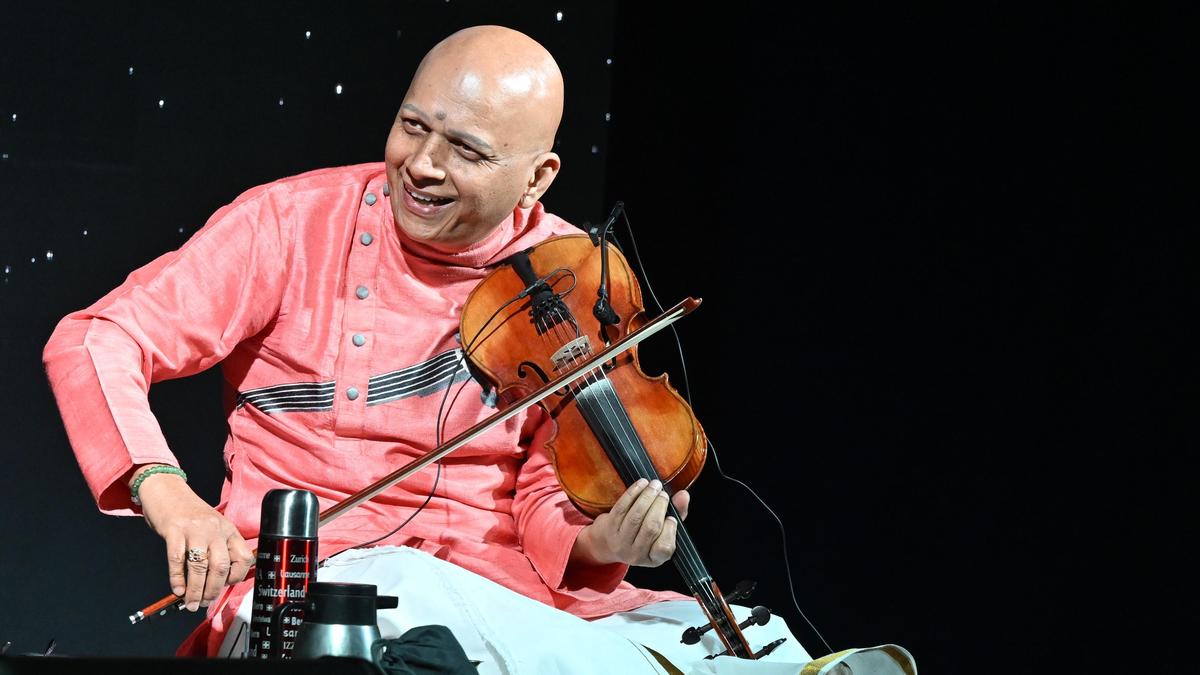
In the Carnatic world, where the voice often dominates, it is heartening to see instruments becoming the talking point. This was the case at Kumaresh Rajagopalan’s Talapravaham, a production that once again brought to the fore the immense possibilities of rhythm — demonstrating how an entire concert can be conceived around it.
Held recently at Vani Mahal, Kumaresh and his ensemble presented seven compositions in seven different talas. The performance was not merely an exploration of tala; it also highlighted its intrinsic bond with melody. And Kumaresh’s inimitable way with the strings of his violin celebrated this connection.
Introducing the concept, Kumaresh reflected on his 55-year musical journey with his brother, Ganesh, and their shared curiosity about music. He spoke of how their questions led them beyond mere inquiry and into the pursuit of answers. “When we find answers, it becomes less of a statement and more of a path,” he observed.
One such question was about the absence of specially composed pieces or the violin. The answer was Ragapravaham, a collection of compositions for melodic instruments created by Ganesh and Kumaresh, founded on the idea that music transcends lyrics.

Kumaresh with ‘ghatam’ Karthick, mridangist Anantha R. Krishnan
| Photo Credit:
R. Ravindran
Kumaresh also touched upon the relative freedom of artistic expression in Indian classical music, particularly the scope for improvisation, in contrast to the more closely prescribed performance of Western classical compositions. This freedom led to another question: why should the 35 talas of Carnatic music not have compositions of their own? Kumaresh responded by composing tunes for each tala, allowing rhythm to become melody.
The 35-tala system is built on the seven fundamental rhythmic frameworks known as the Suladi Sapta Talas — Dhruva, Matya, Rupaka, Jhampa, Triputa, Ata and Eka. Each tala is shaped by a distinct combination of rhythmic units, or angas — laghu, dhrutam and anudhrutam. The five jatis, determined by the number of counts in the laghu, produce five variations of each tala, resulting in 35 talas. Together, they offer a vast rhythmic canvas for composers and performers.
For the evening’s concert, Kumaresh selected seven talas and set each composition in a different raga. The opening piece, in Nattai, was set to Tisra-jati Dhruva tala. This was followed by a composition in the relatively uncommon raga Malavi, set to Misra-jati Ata tala. Its rapid-fire phrases were handled with agility, with Karthik Akshay Ganesh providing able support.
A pleasing Hamsanadam followed, set to Chatusra-jati Triputa tala. The piece concluded with a brief ghatam solo in tisra gati. During Akshay’s solo, Kumaresh interspersed phrases from the mandra sthayi, creating a deep, warm and resonant tonal texture.
The next composition, in Kannada raga and Chatusra-jati Triputa tala, was marked by a pleasing melodic flow. The inclusion of Janya Abhishek came as a pleasant surprise in the subsequent piece, set in Shanmukhapriya and Khanda-jati Ata tala. Kumaresh’s embellishments brought out the raga’s emotive dimensions, complemented by Janya’s sensitive playing.
Ganesh spoke of the need for music to be entertaining, educative and capable of providing an elevating experience at the same time. His next composition, in Ahiri and Sankeerna-jati Jhampa tala, was especially melodious, revealing the expressive potential of a tala that is less frequently encountered in mainstream concert repertoire.
The concluding piece, in Sindhu Bhairavi and Sankeerna-jati Eka tala, brought the three artistes together in a seamless musical dialogue. The neraval, set in sankeerna nadai, offered a further exploration of rhythmic interplay.
Kumaresh brought the concert to a thoughtful close by observing that musical traditions continually rediscover themselves over time, even as their core values remain unchanged. His emphasis on sangeetha jnanamu — musical knowledge — rather than merely sahitya jnanamu, or knowledge of lyrics, captured the central idea of the evening: the primacy of music itself.
Anantha R. Krishnan on the mridangam and S. Karthik on the ghatam provided assured and responsive support, drawing on their considerable experience to complement the proceedings.
Through Talapravaham, Kumaresh demonstrated how curiosity can become a creative force, transforming the grammar of tala into a vehicle for melodic expression.
Published – September 21, 2026 04:07 pm IST
#Talapravaham #Kumaresh #crafts #violin #concert #led #rhythm
