Protocols of Living, the ongoing exhibition at Dhi Contemporary gallery in Madhapur, Hyderabad, showcases artworks of some of India’s emerging contemporary creative voices. On view till August 3, the show highlights the visions of four artists working across diverse mediums. The works explore themes of history, collective memory shaped by crises and personal experiences, identity, infrastructure, social behaviour, institutions and governance.
The artworks reflect the systems, structures and habits that influence contemporary existence. Rather than directly depicting these systems, they focus on the visible and invisible frameworks such as spaces marked by absence, fragmented forms of communication, traces of displacement and landscapes transformed by human intervention.
Art docent Shreya Subrahmanyam says the exhibition seeks to draw attention to structures that often go unnoticed and yet govern daily life.

Here are a few exhibits that stand out:
Against the Invisible
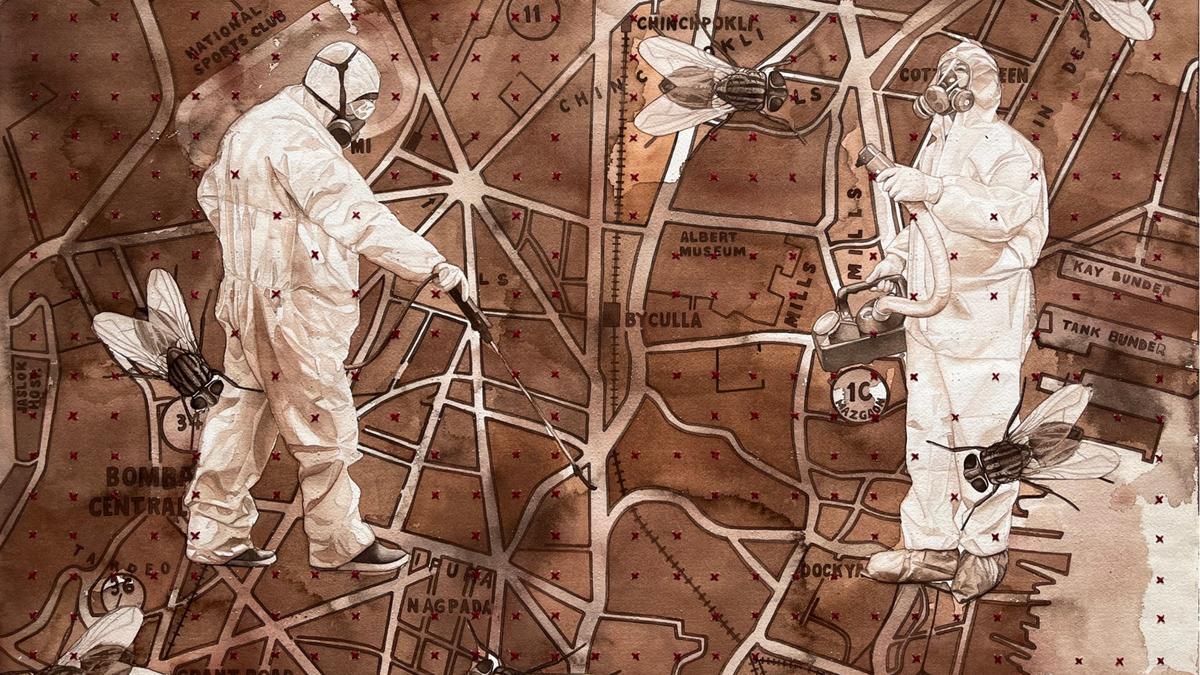
Gayathri T Santhosh’s Against the Invisible is an immersive mixed-media installation created with watercolour and hand stitching on paper and archival materials such as maps and photographs. Her artwork explores how collective memory is shaped by global catastrophe and uncertainty as well as the recurring structures through which societies respond to moments of upheaval, thereby examining the histories of diseases, their carriers, displacement and mortality.
Drawing inspiration from her research of the Bombay Plague of 1896, the Calcutta Plague of 1898 and the COVID-19 pandemic, the artist reflects on collective trauma and how societies understand loss, resilience and continuity across time. The artist uses cross-embroidery to represent lives lost and the grief that follows.

Another artwork by Gayathri, titled Route Map of an Invisible Enemy, uses the azo-dye technique and stitching as metaphorical acts of marking, mending and remembrance. The cyclical act of stitching reflects the trial-and-error pursuit of survival in times of crises. Her artwork also symbolises flies as bearers of collective tragedy.
Ritual by Prajwal Naitam

One of Prajwal Naitam’s artworks
| Photo Credit:
Special Arrangement
Prajwal Naitam explores themes centred on relationships between the people and the land, community, ancestral memory and indigenous understandings of kinship and interdependence. Working with a mixed-media installation that incorporates soil and acrylic on paper, the artist explores cultural knowledge that challenges dominant systems of society that shape development, identity and cultural continuity. Hailing from the Gond tribal community, the artist draws inspiration from oral traditions and ritual practices, particularly the Bada Dev Gango Pooja that involves the worship of the Mahua tree.
Pay & Use Toilet by Subhendu Karmakar

An artwork by Subhendu Karmakar
| Photo Credit:
Special Arrangement
Themes centred on lived experiences, heterotopias, public infrastructure, material decay and the passage of time take centre stage in Subhendu’s artwork. The Bengal-based artist works primarily with iron sheets, acrylic paint, dust and paper to reveal the intersection of care, neglect, maintenance and the collective relationship with shared spaces.

“My work is rooted in observing public spaces and the ways they slowly accumulate dust, rust and stains over time. I see in them a parallel to the gradual shifts that shape communities”, he says.
Soumen Ray’s The Event and Absent
Soumen Ray’s The Event and Absent express contrasting themes, each positioned in dialogue with the other. The Event draws inspiration from everyday life, memory and social realities. It features a large group of dogs gathered in a rural setting, mirroring the collective gathering of people living in rural areas.

Soumen Ray’s artwork titled Absent
| Photo Credit:
Special Arrangement
Absent explores the conflict between progress and the past. It portrays a deserted playground space that symbolises the decline of community activities brought about by rapid development. The artist uses muted-grey colour palette for most of his paintings to depict pollution and environmental change. One can also witness cultural and historical elements of West Bengal in his artworks such as Kolkata’s iconic yellow taxis, the Goddesses Kali and Durga, the region’s street art and the majestic Bengal tiger.
(The writer is an intern)
Published – July 29, 2026 03:03 pm IST
#art #exhibition #Hyderabad #unpacks #systems #shape #everyday #life
