Deep in the Kew Gardens archive some years ago, Henry Noltie found a drawing that had been cut in half. It was a large watercolour of a salak palm (Salacca zalacca). He didn’t think he’d ever find the other half, but months later, it turned up mounted on a herbarium sheet in a specimen cupboard, where it lay unidentified. More indifference than inefficiency — for what could be the value of anonymous “company-style” paintings of plants from the Indian subcontinent from 200 years ago?
A lot for someone like Noltie, who is pleased that some “wonderful paper conservators have been able to rejoin Humpty Dumpty”, as he refers to the two halves. Days before the launch of his book Flora Indica: Recovering Lost Stories from Kew’s Indian Drawings (Roli Books, ₹2,495) in Delhi, he remembers the last few years that he has (in the words of William Dalrymple, who has written the foreword) “spent sleuthing in the dusty, dark cupboards” of the Royal Botanic Gardens at Kew.

Scottish botanist and taxonomist Henry Noltie

Flora Indica: Recovering Lost Stories
Finding and restoring that drawing — and hundreds, if not thousands, like it — has consumed the renowned Scottish botanist and taxonomist in his later career. Now a research associate at the Royal Botanic Garden Edinburgh, Noltie’s detective work began in the early 2010s, when he became aware of and sorted through a vast collection of Indian drawings there: about a quarter of a million of them.
That led him to a similar project at Kew. Sifting through 7,500 drawings brought him and his co-curator, Hyderabad-based researcher Sita Reddy, to about 50 that were showcased as part of the exhibition Flora Indica, at Kew’s Shirley Sherwood Gallery until April before coming to India (later this year). Although that is not nearly enough, if you ask him.

Livistona chinensis (Chinese fan palm); attributed to Vishnuprasad, c. 1825
“One of [the purposes of this book was to raise] appreciation of the skill of the artists,” says Noltie over a Zoom call, adding that they were able to include 100 illustrations in the book. “Botanical illustration in India did go into a decline over the last 100 years, but in the last 20 years, there has been a huge resurgence of interest.” He’s heard of the newly formed Indian Botanical Art Society, and of the courses in Udaipur and elsewhere. “So, this book could serve as a source of inspiration for contemporary artists,” he adds.
Botanical and taxonomical work is going on all the time, he adds. “New species of plants continue to be discovered in India [one of the world’s 17 megadiverse countries] because a lot of the work in the early days was done by British botanists who were here on a short-term basis, without the resources or time to explore the more distant places, like Arunachal Pradesh, which is a hot spot. Even the Western Ghats; there are constantly new species in certain groups, like impatiens and begonia.”

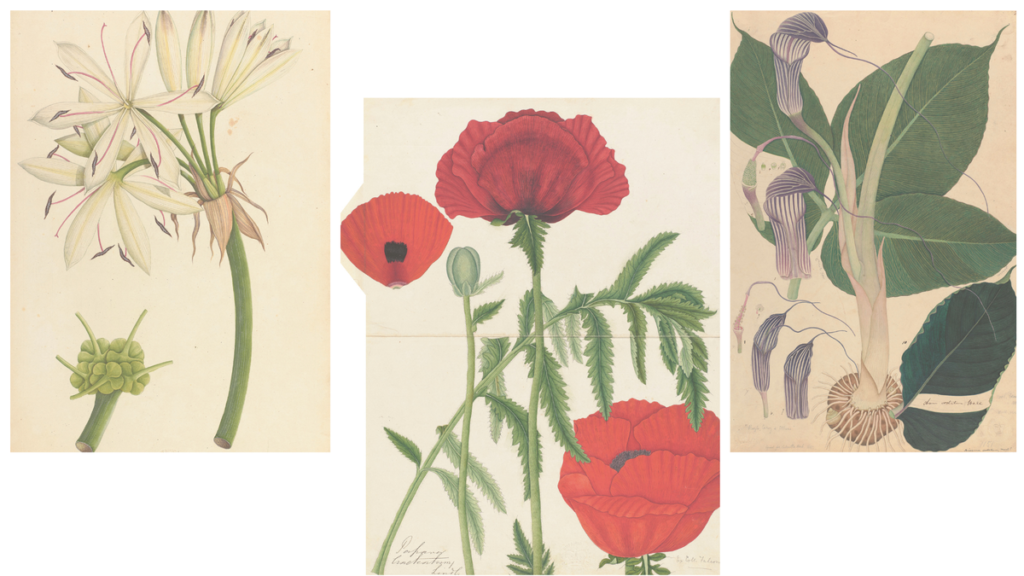
Arisaema costatum (Himalayan cobra lily); artist: Vishnuprasad, c. 1821
Foot soldiers of Indian flora
Noltie has just returned to Delhi via Shillong, where he walked through what remains of the Khasi Hills forests — fragmented now, the sacred groves among the few intact pockets — and found, in one forested patch, a tree fern still tall enough (about 4 ft.) to suggest the canopy it once lived beneath. The same species appears in drawings from two centuries ago at its full, magnificent height of over seven feet.
It’s the sort of stories and connections that Flora Indica is full of: less a coffee table book, more a result of patient historical excavation. Noltie’s research explores the work of 20 Indian artists in the service of the East India Company between 1790 and 1850, from 11 of the Kew’s collections.

Papaver bracteatum (Persian poppy); Later Saharanpur artist, 1838–42
Three stories run in parallel through its pages. There is the institutional history: the Company botanists, the Scottish surgeons, the garden superintendents who commissioned the works. There is the botanical record itself: extraordinary plant life being studied, named and documented for the first time. And then there is the most elusive thread: the artists. Men such as Vishnuprasad, whose single surviving letter — a charming note welcoming Wallich back to Calcutta after a four-year absence — is one of the only personal documents any of these painters left behind.
Noltie has argued that this school of painting should not be named for its East India Company sponsor but for the Indian artists themselves, the real foot soldiers of the genre. All of this buoyed by illustrations in a mash of styles: Mughal miniature meets Marwar School meets Neoclassicism. Turns out, there is a silver lining to these drawings languishing in dark corners of rooms: the stunning watercolour has stayed naturally preserved.

Cucumis sativus var sikkimensis (Sikkim cucumber); Lutchman Singh or Ramanath Banerjee, c. 1850
A life with plants
The instinct to credit the overlooked runs through everything Noltie does. He grew up in Yorkshire and then Dundee, in a family where botany was ambient — his mother, grandmother and great-aunts were all enthusiasts — while empirical study, by way of his scientist father, was a way of life. At Oxford, he wavered briefly between botany and zoology, until a mentor heard of his indecision and looked at him with such undisguised horror that he reconsidered on the spot. “I thought, I can’t upset her like that,” he says with a little smile.
Noltie then joined the Royal Botanic Garden Edinburgh, where he spent 30 years — beginning in exhibitions, then pivoting to taxonomy, spending 12 years on the flora of Bhutan before turning, after 1999, to the historical and artistic side of RBGE’s Indian collections. He retired in 2017, but has barely stopped working since.

Trapa natans var. bispinosa (water chestnut)
Importance of taxonomy
Of course, his primary zone of investigation, the terrain of India, is not like what it was 30 years ago, let alone 200 years ago. On the highway out from Shillong, he remembers with disdain the hillsides being blasted to dust for construction. “I’ve never seen anything like it,” he says quietly. “Very, very upsetting.”
But not all is lost. He remembers visiting the Rani Baug garden (Jijamata Udyaan) in Mumbai recently and feeling thrilled by the transformation (his last visit was in 2000). In Kolkata, the Botanic Garden has been similarly revived. “These green lungs are unbelievably important — as a source of solace, inspiration, oxygen, education,” he says.

Pinus roxburghii (longleaf Indian pine); unknown artist, 1826–32

Crinum cf. lorifolium (amaryllidaceae); unknown artist, c. 1795
The Flora Indica book, Noltie hopes, will inspire more Indian botanists and artists to engage with the wonders growing in their own backyard. The exhibition, meanwhile, will follow its book to India in facsimile form — to Hyderabad, Mumbai, Kolkata, Bangalore — the drawings printed at high resolution and framed locally. The art would come home, in its way.
I ask, finally, about the purpose of taxonomy in the 21st century, with its collapsing forests and accelerating extinctions. “Plants are the basis of all biodiversity,” he says. “Having accurate names for plants is fundamental to any conservation or climate change monitoring work.” The number of students choosing to study taxonomy is not what it might be, he adds, but that inexplicable rise in interest in botanical drawing and art is heartening, because the knowledge risks dying with the people who hold it. “It’s vitally important that this work continues,” he concludes.
The Mumbai-based independent journalist writes on culture, lifestyle and technology.
#Henry #Nolties #Flora #Indica #Recovering #Lost #Stories #Kews #Indian #Drawings #flowers #backstory