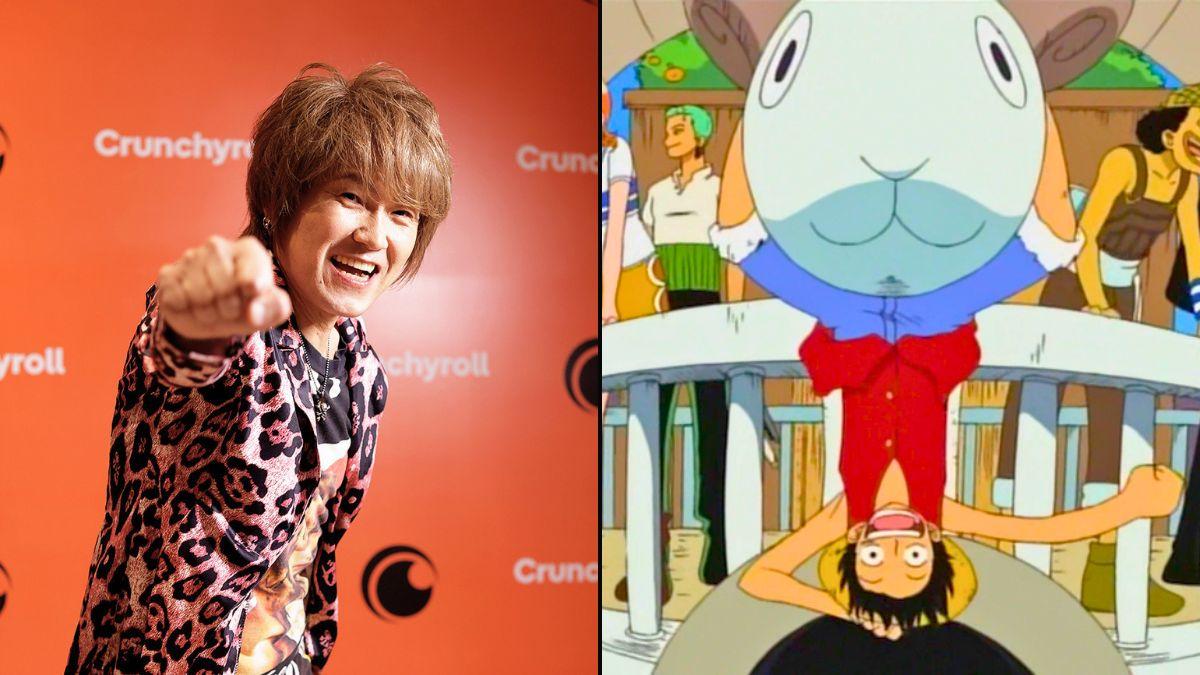
In 1999, a new television anime adaptation of ONE PIECE began airing on Japanese broadcaster Fuji TV, bringing Eiichiro Oda’s bestselling pirate manga to the screen through animation produced by Toei Animation. The series would go on to become one of the longest-running and most internationally successful anime franchises ever made, yet Hiroshi Kitadani, the singer chosen to perform its first opening theme, had little reason to expect that the assignment would define the next quarter-century of his career.

Looking back on “We Are!”, the song released in October 1999 as the anime’s first iconic opening theme, Kitadani still speaks about it with the enthusiasm of someone encountering it for the first time all over again. “We Are! is a song that changed my life,” he tells The Hindu. “It is still a precious treasure. I’ve sung it tens of thousands of times, but it’s still a great song.”

Hiroshi Kitadani performs live at the Mumbai Comic Con 2026
| Photo Credit:
Crunchyroll, TOEI
The timing of that recording proved significant for both artist and franchise. Kitadani debuted as a professional musician during the 1990s and was still relatively early in his solo career when he was approached to sing “We Are!”, a composition by veteran anime composer Kohei Tanaka with lyrics by Shoko Fujibayashi. The song accompanied the anime’s earliest episodes and became inseparable from the series’ introduction to television audiences.
Even so, Kitadani entered the project with limited familiarity with Oda’s story. “It was the first time I sang an anime song,” he recalls. “To be honest, I hadn’t read ONE PIECE before.” At the time, he knew the manga was already popular in Japan, which made the release exciting, yet the scale of what followed remained unimaginable. “I never thought it would be loved by so many people around the world.”

That global reach eventually transformed Kitadani from a singer associated with a successful television theme into one of the most recognisable voices in anime music. Twenty-five years after its debut, “We Are!” remains central to official anniversary celebrations and milestone broadcasts, including the anime’s 1,000th-episode commemorative opening sequence. The song continues to attract millions of listeners through official releases and performances, giving it unusual longevity even within a medium known for memorable theme songs.
One reason the relationship endured is that Kitadani never became frozen in a single era of the franchise. After “We Are!” came “We Go!” in 2011, followed by “Over the Top” in 2019 and “Uuuuus!” in 2024, allowing him to return repeatedly as the anime entered new stages of its story. He describes those later songs as fundamentally different creative experiences because the production team now wrote with his voice and performance style in mind. “We Are! was the only song that wasn’t written for me,” he explains through a translator. “We Go!, Over the Top, and Uuuuus! are the songs that focused on me specifically to perform and write the song.”
That continuity created challenges. By the time ONE PIECE entered its second decade on television, audience expectations had become part of the process. “During the We Go! Time period, I had a lot of pressure,” he says. “I was really worried if We Go!, as the second follow-up song to We Are! would make ONE PIECE fans just as happy.”

The pressure emerged because the franchise itself had grown far beyond Japan. Kitadani vividly remembers discovering that expansion first-hand during an appearance in São Paulo, Brazil. Internet fandom was still developing at the time, which made the reception harder to anticipate. “I wondered if anyone from even the farthest part of Japan knew the song,” he says humbly. But when the opening notes began, he found himself facing a crowd of roughly 10,000 people who already knew every word. “When I saw the scene unfold, I was so elated that I was moved to tears.”
That international response continues to fascinate him because much of the audience sings in a language they do not speak fluently. Kitadani believes the process resembles how Japanese listeners embraced Western rock music decades earlier. “When we like rock music, we don’t know English, but we remember foreign artists’ songs in English,” he says. “I think it’s because they have an interest or affection for Japanese music.” Fans learn choruses through repetition, creating moments during overseas concerts where thousands of voices join together in Japanese. “It’s touching that everyone sings in Japanese,” he says.

Hiroshi Kitadani performs live at the Mumbai Comic Con 2026
| Photo Credit:
Crunchyroll, TOEI
But even after decades of performing the song, Kitadani places “We Are!” among a small group of anime themes that have retained a cultural presence far beyond their original broadcasts. Asked which openings from that era he still admires, he points to “CHA-LA HEAD-CHA-LA,” the theme from Dragon Ball Z performed by Hironobu Kageyama, Yoko Takahashi’s “A Cruel Angel’s Thesis” from Neon Genesis Evangelion, and Koji Wada’s “Butter-Fly” from Digimon Adventure.
Throughout those years, Kitadani maintained a connection with Oda himself, whose manga has sold hundreds of millions of copies worldwide. Although he says the creator never offered direct artistic instructions, their meetings left an impression. “When I first met him, he was really young,” Kitadani remembers. Seeing someone of that age responsible for such an expansive world filled him with admiration. “Such a young person was writing this. [It was] such an inspiration.”

Asked which member of the Straw Hat crew resonates with him most after Luffy, Kitadani points to Brook, saying he enjoys imagining the skeletal musician shifting between the violin-playing member of the Straw Hat crew and the flamboyant stage presence of his alter ego, Soul King, performing rock music inspired by bands such as Queen.
And when asked what lesson he carries from ONE PIECE after more than two decades attached to the franchise, Kitadani answers with a phrase familiar to the longtime fans: “Nakama wa daiji na koto desu” — “friends are important”.
ONE PIECE is currently streaming on Crunchyroll, with the anime having recently moved from the Egghead storyline into the ongoing Elbaph Arc, the latest chapter in Eiichiro Oda’s long-running pirate saga
Published – June 03, 2026 02:26 pm IST
#voice #PIECE #Hiroshi #Kitadani #changed #life
