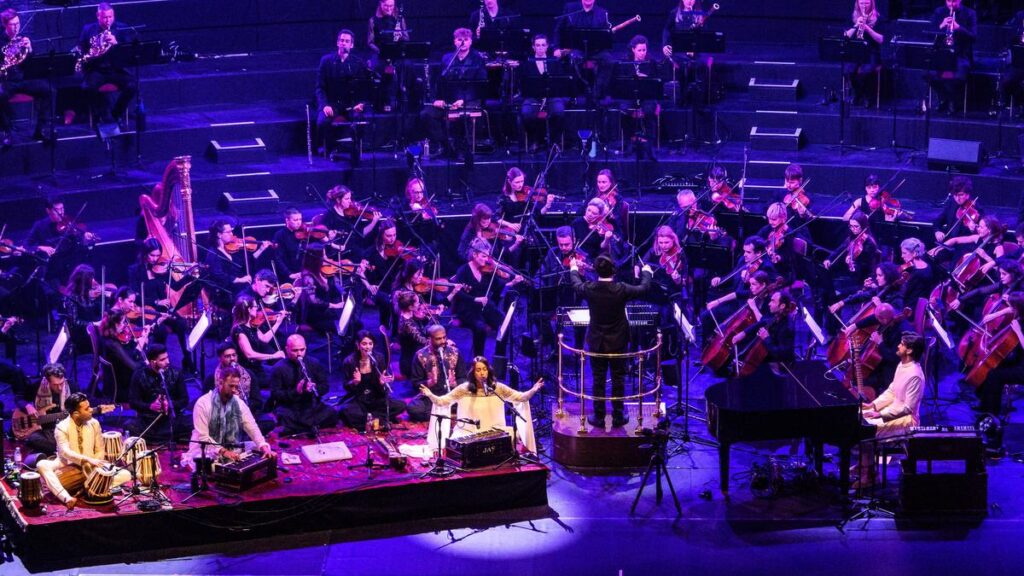
The curtain rises on two distinct worlds. A small, intimate circle of qawwals amid the large spread of a Western orchestra. Harmoniums exhale and sarangis yearn on one side, as violins unfurl and cellos linger on the other. An incandescent voice soars with Sufi verses that have resonated in shrines and courts across the Indian subcontinent for over seven centuries, straddling devotional invocation, longing and surrender.
Soon, taalis and pizzicato, sargams and cadenzas, taranas and tremolos become one. Like a tide gathering force, a sonic interplay of diverse instruments — and players — surges with a choir and collective chants. Sounds from unrelated traditions discover a shared breath, defying the parochial labels thrust upon them — of birth, identity, ownership and authority — and liberating audiences from those very shackles. Regardless of whether the listeners grasp the poetry, the raga or Sufi mysticism, they leave with a sense that finding oneself is about losing oneself.
This is the Orchestral Qawwali Project (OQP), which draws on Western classical, South Asian and Indian classical traditions to reframe qawwali through orchestral scores. And it is coming to India for the first time this December on a four-city tour as the inaugural offering of a new cultural platform Ruhbaru.

The project brings together Qawwali, Western classical, South Asian and Indian classical traditions.
| Photo Credit:
Special Arrangement
The two traditions make unlikely foils. Qawwali is about obeying the moment through improvisation, repetition and live interaction, while an orchestra is about obeying the score through a structure finalised before the first rehearsal and followed to the last note. But for composer Rushil Ranjan and vocalist, veena player and multi-instrumentalist Abi Sampa — OQP founders and partners in life as well as music — both forms speak to the same quest for transcendence.
Despite her roots in Sri Lanka and upbringing in the UK, Sampa grew up steeped in Indian classical music. Her parents, having fled the war, exposed her to Carnatic music. She went on to learn Western classical piano, saxophone, Saraswati veena and Bharatanatyam. Besides, she sang in different languages and forms, including bhajans at satsangs and, by 16, qawwalis too. “From a young age, I liked to merge worlds,” says Sampa, a practising dentist. “At my Carnatic arangetram, I wanted to sing a ghazal. My guru was cross with me,” she laughs.

Rushil Ranjan and Abi Sampa.
| Photo Credit:
Special Arrangement
Cyprus-bred Ranjan, on the other hand, neither grew up with Indian music nor received any formal training in it; instead, he taught himself the saxophone, piano and guitar, picturing a future in pop. He hadn’t even heard of qawwali until he went to Oxford at 20 to study law. But when he did, he was blown away by its “operatic gravitas”. “It instinctively felt like cinematic, grand orchestral scores were the right place for qawwali. They complemented each other so well,” he says, adding he had to make “every day a school day” for the last six years to make up for the late start. “Both qawwali and Western orchestral music are sacred traditions that share a connection to spirituality, a numinous quality, and the aspiration to elicit that feeling from the listener.”
The couple recorded their first qawwalis in 2019. Ranjan tiptoed through a shoestring budget by layering strings upon strings and building an entire orchestral track using only a handful of players they could afford. They released Man kunto maula on YouTube the following year and, buoyed by its viral success, launched OQP during the COVID-19 lockdown.
Their first live performance in 2021 with a qawwali troupe and a quartet piqued the interest of the Scottish Chamber Orchestra. With just three months to turn his experiments into a real orchestral score, Ranjan quickly taught himself how to write one. He also learnt studio production, orchestral arranging and composition.. That concert, a chamber-sized affair, arrived the very next year to a rapturous reception.

Abi Sampa performing Rushil Ranjan’s symphonic interpretation of Allama Muhammad Iqbal’s poem for the Manchester Camerata.
| Photo Credit:
Special Arrangement
Ranjan’s watershed moment came in 2023 when he wrote Shikwa — a symphonic interpretation of Allama Muhammad Iqbal’s poem — for the Manchester Camerata. Listening to Sampa rehearse the complex score with the full orchestra convinced Ranjan that “the two forms existed in equal conversation” with each other. The collaboration marked their transition from recorded tracks and smaller set-ups to symphony orchestras, 50-piece choirs and original, large-scale commissions.

The Orchestral Qawwali Project also features Sufi whirling dervish-inspired choreography.
| Photo Credit:
Special Arrangement
The measure of how well the fusion works is, as their kora player and singer Sona Jobarteh put it, in making sure the glue holding the two forms together is not seen. “Our music is not intended to supplant either form,” says Ranjan, adding “It is a lot more than the sum of its parts.”
Winning over the purists, in both camps, hasn’t been easy. “Interestingly, people who are the best at what they do tend to not be too conservative about it,” he says. “At that stage, they are just looking for the music to be good.”
No one knows this better than ace composer A.R. Rahman, who is often at the receiving end of barbs from gatekeepers. Rahman’s endorsement came by way of an invitation for OQP to perform with his Firdaus Orchestra in Dubai in 2022. He and Ranjan later co-composed Rangreza, a Sufi fusion performance by Sampa, the Royal Philharmonic Orchestra, London Voices and the Sunshine Orchestra, which premiered earlier this year at Royal Albert Hall. “He is the biggest inspiration because of how connected he is to the spirituality within music,” says Ranjan.

The Qawwali Project unites centuries-old Sufi poetry and soulful vocals with the grandeur of a Western classical orchestra.
| Photo Credit:
Special Arrangement
Although the long qawwali pieces are condensed into 10-15 minutes, they are still long enough for Sampa to say everything she needs to. The tempo, never fixed, follows the day’s mood. To keep it as free as possible, Ranjan, Sampa and conductor Melvin Tay sketch melodic or lyrical points where they “meet each other”.
“It’s important to respect the foundations,” says Sampa, “but it’s also important for us to keep pushing boundaries, find new ways to express ourselves, make traditions relevant and give the next generation an access point to go deeper and appreciate them.”
The four concerts will be held on December 5, Yashobhoomi, New Delhi, December 6, Terraform Arena, Bengaluru, December 12, Ramoji Film City, Hyderabad and December 13, JW Marriot, Sahar, Mumbai.
#Orchestral #Qawwali #Project #India #time #December