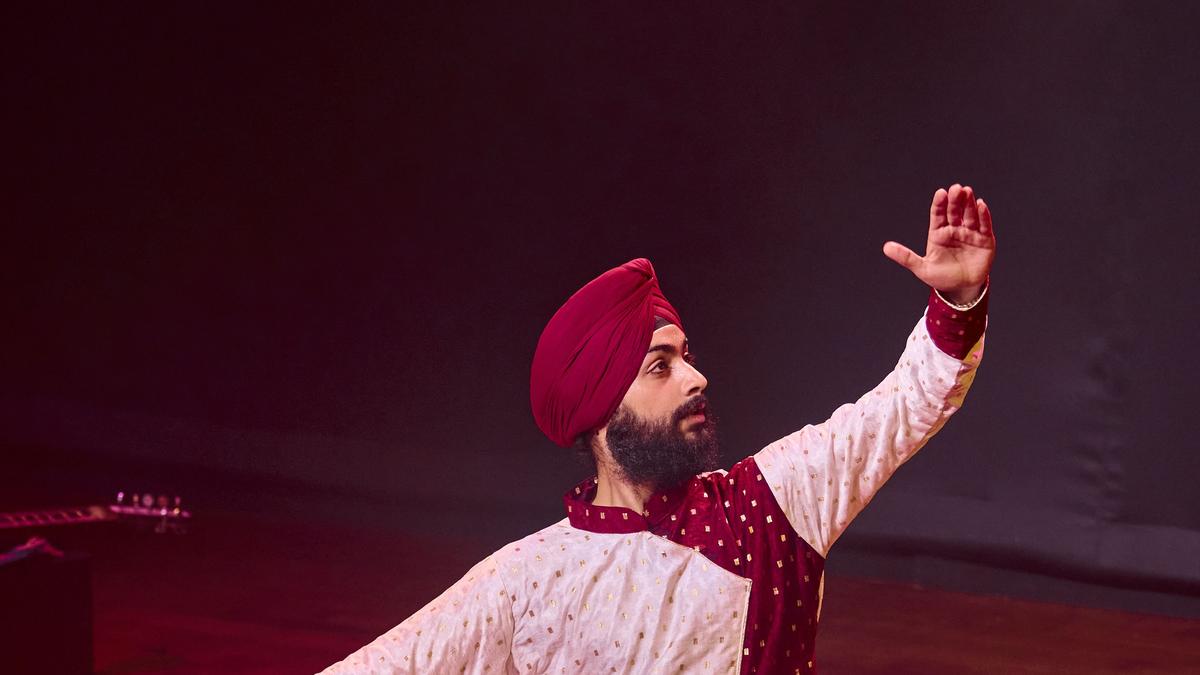

Taranjot Singh.
| Photo Credit: Special arrangement
The first thing that strikes you is the jingles from Taranjot Singh’s ghungroos. And then you meet a young sikh man in a turban, moving through the intricate tatkar, chakars and tukras of Kathak with the intensity of someone who has found a language of his own. For a 21-year-old dancer from Ludhiana, this journey carries a significance that goes beyond dance. Not because men are unfamiliar in Indian classical dance — traditions have been shaped by legends such as Pt. Birju Maharaj, Guru Kelucharan Mohapatra and Kalamandalam Gopi, among others — but because Taranjot grew up in a world where he was expected to find his expression in forms such as Bhangra.
But then credit goes to the one woman who stood by his side — his mother. A trained classical singer, she wanted to have a daughter who would learn Kathak. Instead, she had two sons — and years later, one of them chose to fulfil her dream.

Taranjot underwent training under Pulkit Jain, a disciple of Jaipur Gharana exponent Pt. Rajendra Gangani.
| Photo Credit:
Special Arrangement
Taranjot underwent training under Pulkit Jain, a disciple of Jaipur Gharana exponent Pt. Rajendra Gangani. And his journey was not devoid of questions from neighbours or snide comments on social media. He also faced rejections at dance competitions. The pandemic then brought his early performance opportunities to a halt till Dance Deewane Season 4 happened in 2024. The national platform changed the conversation around him, but not why he dances. Today, Taranjot continues to perform in his turban. At its heart, his story is about a son carrying his mother’s dream — and a young dancer discovering that he does not have to choose between who he is and the art he loves.
His journey recently brought him to Mumbai’s Nita Mukesh Ambani Cultural Centre, where he performed Nrityam by Taranjot Singh & Ensemble, bringing the vigorous rhythms, intricate footwork and expressive grace of the Jaipur gharana to the stage.
“I started with hip-hop, Bhangra, contemporary and then moved to Kathak. But the first challenge was to convince my father. Coming from a Sikh family and a society that is still quite patriarchal, the idea of a son dancing in ghungroo was a huge taboo — and perhaps it still is,” says Taranjot, adding, “My mother, however, was always supportive. My father respected her encouragement, but his only condition was, ‘Do whatever you want, but your education must not suffer’. I was 13 when I began learning Kathak.”

Taranjot Singh brought Kathak’s intricate footwork and grace to the stage at his NMACC performance.
| Photo Credit:
Special Arrangement
Speaking about how the training was both physically and emotionally demanding, Taranjot says he used to practice six to eight hours a day. “At one point, it reached the 10-hour mark. Those long hours were physically daunting, especially in the beginning, but they were worth it.”
Reflecting on how people reacted to the life choice he made, Taranjot recalls that many began commenting on how effeminate he looked. “It was not easy dealing with it. Even on social media, when I posted something, people, instead of encouraging me, would ask why I had chosen to become a Kathak dancer. These stereotypes are created by society, and people keep reinforcing them.”
Though he was introduced on reality shows as India’s first Sikh Kathak artiste, Taranjot says there may have been other male Kathak dancers from the Sikh community before him. Apart from his classical training, he credits reality television with teaching him that nothing matters more than hard work. Taranjot recalls watching actor and dancer Madhuri Dixit, a judge on the show, rehearse tirelessly. “No matter what level you reach, there is always room to become better.”
Quite like his mother, who dreamt of seeing him become a Kathak dancer, Taranjot wishes to take his art to international stages. In doing so, he hopes to show how art transcends gender and religious barriers.
Published – September 29, 2026 04:44 pm IST
#young #Sikh #artistes #Kathak #journey
