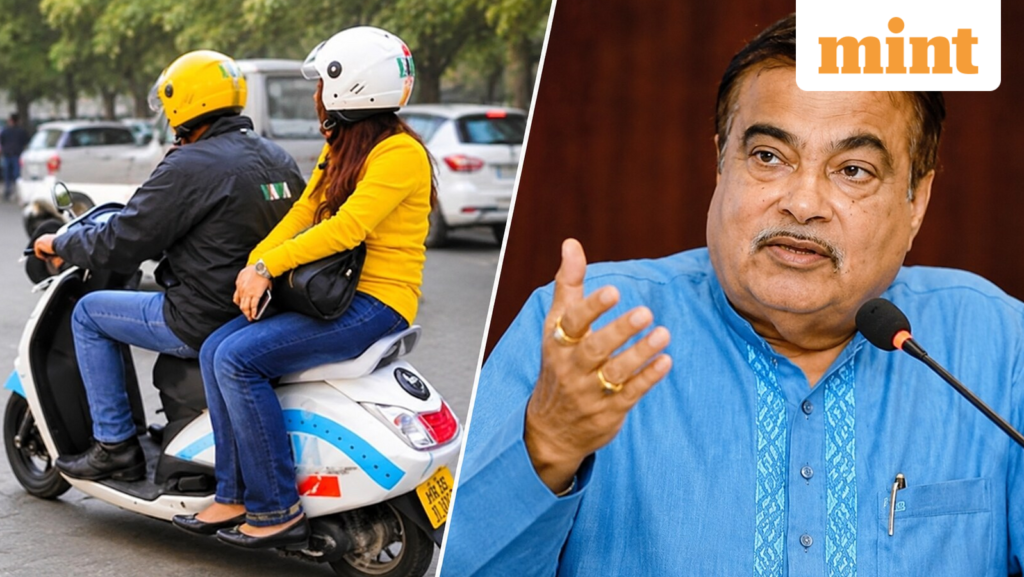
Union Road Transport and Highways Minister Nitin Gadkari on Thursday, November 19, urged all states to permit privately owned motorcycles and scooters to be used for passenger rides through app-based aggregator platforms such as Rapido, Uber and Ola, saying the move could open up employment opportunities for millions of people.
Addressing the ‘RIDE: A Showcase of Aggregator and Delivery Services’ programme, Gadkari asked state transport commissioners to implement the Centre’s Motor Vehicle Aggregator Guidelines (MVAG) 2025, which provide for the aggregation of non-transport motorcycles for passenger journeys.
According to a PTI report, Gadkari said only Rajasthan had fully implemented the guidelines, while Haryana and Uttar Pradesh had adopted them partially.
“I called all state Transport Commissioners and requested them to take the initiative (allowing all non-transport or private motorcycles for passenger rides through aggregator platforms) in their respective states as well,” he said.
The minister also said he had written to state governments, urging them to allow private two-wheelers to be registered with aggregator platforms for commercial passenger services.
Gadkari says 15-20 crore people could benefit
Making a case for expanding bike-taxi services, Gadkari said the move could create substantial livelihood opportunities, particularly for people facing poverty, unemployment and socio-economic disadvantages.
“Poverty, hunger, unemployment, and socio-economic and educational backwardness exist everywhere. Why should not we provide people with employment opportunities so that they can live with dignity and self-respect?” he said.
The minister said that allowing private motorcycles to operate as bike taxis across states could generate employment opportunities for 15-20 crore people.
He also highlighted the wider social and economic impact of such opportunities, including the potential to help families improve their living standards, educate their children and afford homes.
“How much poverty would be eradicated? How many people would be able to live with dignity? How many children would get the opportunity to go to school? How many people would be able to own a home? That is what truly matters,” Gadkari said.
What do the Motor Vehicle Aggregator Guidelines 2025 say?
The Ministry of Road Transport and Highways issued the revised Motor Vehicle Aggregator Guidelines in July 2025, providing a regulatory framework for app-based mobility services.
The guidelines allow state governments to permit the aggregation of non-transport motorcycles for passenger journeys through authorised platforms. This means privately registered two-wheelers can potentially be used for bike-taxi services, subject to approval and applicable state regulations.
The Centre’s framework seeks to balance the expansion of shared mobility with passenger safety, security and driver welfare.
Under the guidelines, states can exercise their powers under Section 67(3) of the Motor Vehicles Act, 1988, to permit aggregators to use non-transport motorcycles for passenger journeys.
The framework also identifies potential benefits beyond passenger transport, including affordable mobility, reduced traffic congestion, lower vehicular pollution and hyperlocal delivery services.
Why is the move significant for Rapido, Uber and Ola?
The revised guidelines provide regulatory clarity to India’s bike-taxi industry, where the use of privately registered two-wheelers for commercial passenger rides has faced legal and regulatory challenges in several states.
Platforms such as Rapido, Uber and Ola have been expanding their two-wheeler mobility services, positioning bike taxis as a relatively affordable and convenient option for short-distance urban travel.
However, regulatory uncertainty and state-level restrictions have affected operations in some markets. Karnataka, in particular, witnessed disputes over the legality of bike-taxi services, with restrictions triggering protests and tensions involving operators and riders.
The 2025 guidelines give states a framework to permit these services, although implementation remains dependent on individual state governments.
How have the aggregator guidelines evolved?
The Centre first issued the Motor Vehicle Aggregator Guidelines in 2020 under Section 93 of the Motor Vehicles Act, 1988.
Since then, India’s shared mobility sector has expanded significantly, with growing demand for flexible transport options, including bike taxis, auto-rickshaw rides, shared mobility services and electric vehicles.
The 2025 revision seeks to update the regulatory framework to reflect these changes while giving state governments greater flexibility in regulating aggregator operations.
Gadkari’s latest appeal to state transport commissioners is aimed at accelerating the adoption of the revised framework nationwide, potentially opening up another source of income for private two-wheeler owners.
#Nitin #Gadkari #bats #allowing #private #twowheelers #Rapido #Ola #bike #taxis #move #crore #people