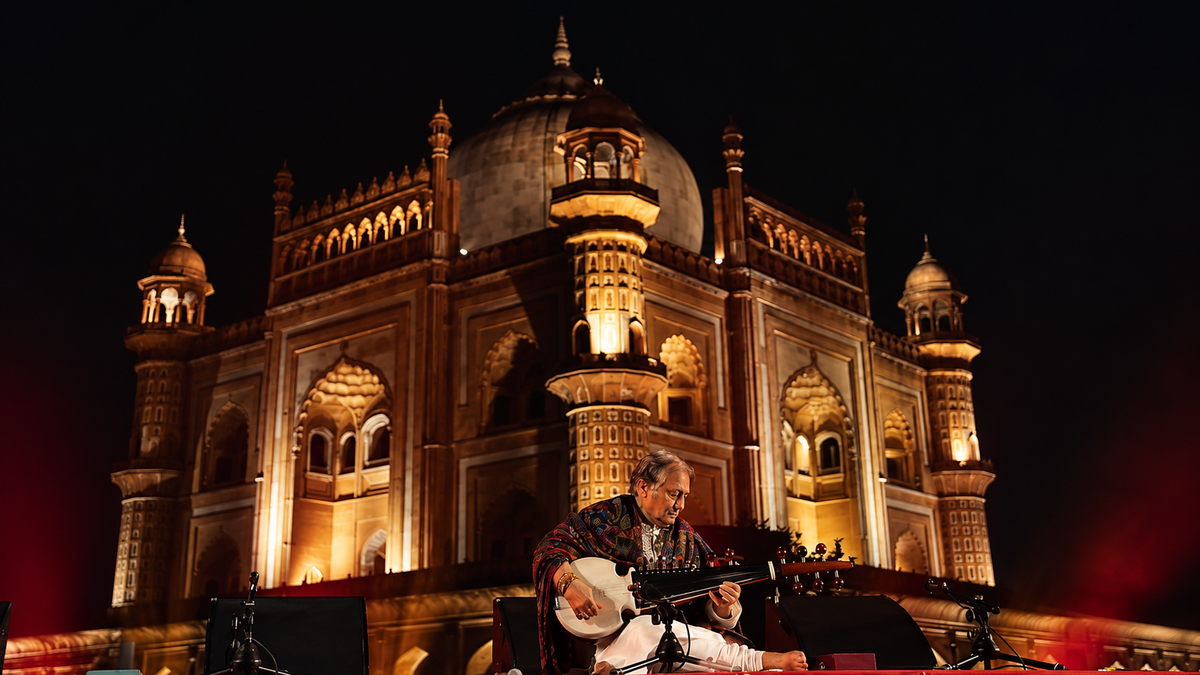
On October 11, about 500 people are expected to gather at Safdarjung Tomb to listen to Vishal Bhardwaj sing ghazals and talk about the stories behind them. The evening, organised by IBTIDA – Ek Mehfil, is called Ghazal Aur Baatein. There will be music and poetry, but there will also be Safdarjung itself: the sandstone and marble mausoleum rising behind the gathering, its garden and fading Mughal grandeur doing some of the work that a concert hall normally leaves to lighting designers.

Purana Qila
| Photo Credit:
Special arrangement
Around the same weekend, Purana Qila will host a different musical experiment. Inkpot India is bringing Amrita Kaur to the fort for Dusk to Dawn, the third chapter of its Songs of the Stone series. One performance takes place as evening falls on October 10; the second begins the following morning. Music is only part of the programme. There is storytelling, food, craft, textiles and the opportunity to experience the fort as daylight disappears and then returns.
This is becoming a familiar way to spend an evening in Delhi. The city has no shortage of auditoriums, clubs and hotel ballrooms, but increasingly the address on the ticket matters almost as much as the performer.
“When it’s a regular concert, the artiste is the hero,” says Simar Malhotra, founder, Inkpot India. “Over here, your hero is not just the music or the artiste. The monument is as much a hero.”
Simar founded Inkpot in 2019 and began Songs of the Stone last year. Its first chapter brought sitarist Mehtab Ali Niazi to the Qutub Minar; the second featured the flautist, Rakesh Chaurasia. According to the organisers, the two editions together drew more than 850 people.
At these performances, Simar says, she deliberately does not try to compete with the surroundings. “The monument does become a stage. There is no stage backdrop.”

Amrita Kaur
| Photo Credit:
Special arrangement
There is something almost self-evident about the appeal. Hearing a raga while looking up at a monument built centuries before the invention of the microphone is difficult to reproduce inside an auditorium. But behind Delhi’s rather elegant new appetite for music among old stones lies a more prosaic question involving Government guidelines, permissions, conservation and commerce.
Because the Archaeological Survey of India (ASI) once had a clear answer to the question of what could happen inside a protected monument.
In 2005, the ASI laid down guidelines governing cultural events at centrally protected sites. Monuments and their grounds were, as a matter of course, not to be used for functions. Exceptions could be made for designated sites where officials were satisfied that the event would cause no damage.
The preferred programmes were classical music, dance and drama. Organisers had to follow restrictions on lighting, sound, crowds, parking and temporary structures, and events generally had to end by 10pm.
Also, admission could not be regulated through the sale of tickets or admission charges.

Vishal Bhardwaj performs at an Ibtida mehfil
| Photo Credit:
Special arrangement
The list of places where cultural programmes could nevertheless be considered included the open area around Qutub Minar and the lawns and outer open areas of Purana Qila.
By 2009, the ASI was considering regular evening music and dance performances at 10 Delhi monuments, including Purana Qila, Safdarjung Tomb, Qutub Minar and Tughlaqabad Fort. Officials spoke of matching performances to places — qawwali at Safdarjung, for instance — and of bringing more cultural activity into monuments. Revenue was part of the conversation too.
In 2023, when the Government was asked in Parliament about cultural events at protected monuments, its answer repeated several of the old restrictions, including the bar on ticketed admission and commercial activity under the stated framework.
At roughly the same time, however, the Government was building a much broader role for outside partners at heritage sites.

Ustad Amjad Ali Khan Saheb performs
| Photo Credit:
Special arrangement
Adopt a Heritage 2.0, launched in 2023, invited public and private entities to participate in improving amenities and visitor experiences at centrally protected monuments. By the following year, Sabhyata Foundation had been designated a Smarak Sarthi for Purana Qila, Safdarjung Tomb, Humayun’s Tomb and Mehrauli Archaeological Park.
Sabhyata, a Section 8 company established in 2018, is a heritage partner. But the vocabulary around monuments has unmistakably expanded. Its offerings now include curated experiences and event spaces at some of Delhi’s best-known historic sites.
The new guard
Anubhav Jain, co-founder of IBTIDA – Ek Mehfil, does not think bigger is necessarily better.
IBTIDA began in 2019, building intimate programmes around music, poetry and conversation. Last November, its Live the Legacy programme at Safdarjung brought together Ustad Amjad Ali Khan, his sons Amaan and Ayaan Ali Bangash and grandsons Zohaan and Abeer Ali Bangash. This October, it returns with Bhardwaj, with tickets at ₹11,210 onwards.
“We’re not here to have this massive scale of 2,000 or 3,000 people,” Anubhav says. With a few hundred listeners, he argues, the evening retains the quality of a gathering rather than becoming another large concert.
He is equally wary of making a night at a monument feel like an educational excursion.
“Nobody is here to learn history,” he says. “History is very much about your point of view and my point of view. We’re not here to preach. We’re just here to say, ‘Hey, we’ve got those three hours. Come, enjoy, relax.’”
Anubhav describes considerable logistical negotiation behind that apparent ease: where audiences can sit, how they move through the site and what precautions need to be taken. Simar similarly says her programmes work within ASI requirements governing matters such as sound and capacity. The sound level must not exceed 10 dB(A), meaning A-weighted decibels, above the ambient noise standard for that area, or 75 dB(A), whichever is lower.
For conservationists, those details are not administrative footnotes.
“The monument comes first,” says Malini Thadani, executive director of the World Monuments Fund India Association. “Every event organised in a historic heritage site must begin with an understanding of the site’s architectural, historical and cultural significance.”
There is no single formula, she says, because monuments are not interchangeable.

Performance-ready
| Photo Credit:
Special arrangement
“The nature and scale of an event should be appropriate to the character, condition and capacity of the site,” Malini says. “Not every monument can accommodate every kind of event. Sometimes the right approach is a smaller event, or no event at all.”
India has been experimenting with this balance for years. Malini recalls music festivals at Banganga in Mumbai and the Ellora Caves where visitor management, sound control and post-event clean-up were important to ensuring that neither the historic site nor the surrounding community was unduly disturbed.
Sound-and-light shows, meanwhile, have become “ubiquitous in so many sites across our country,” she says.
What has changed in Delhi is not the discovery that old buildings make wonderful settings for music but the sophistication with which the setting itself is now packaged.

Inside Kathika Cultural Centre
| Photo Credit:
Special arrangement
“Listening to Amrita in an auditorium versus listening to her when she’s in the Purana Qila — it’s a huge, huge difference,” Simar says, adding, “you’re not just coming for a concert but for a little bit of historic storytelling and craft.”
Earlier this year, however, Purana Qila also demonstrated how quickly the edges of this new model can become messy.
In March, the fort hosted Jahan-e-Khusrau, the long-running Sufi music festival. Tickets reportedly ranged from ₹2,500 to ₹10,000. During the festival, the ASI complained to Delhi Police about commercial activity inside the complex, including stalls and kiosks that it said had not been authorised. ASI officials sought their removal.
At Sunder Nursery, a restored heritage park in Nizamuddin containing important Mughal-era monuments, hiring space is part of the operation. Its amphitheatre and lawns can be booked for cultural and educational programmes. The Garden Amphitheatre is listed from ₹65,000 a day, while larger spaces run into several lakhs. Ticketed programmes require the relevant permissions, and conditions cover matters including sound, security and clean-up.
Preservation
At Kathika Cultural Centre and Museum in Old Delhi, Atul Khanna has approached the question from almost the opposite direction.

Inside Kathika Cultural Centre
| Photo Credit:
Special arrangement
Atul spent more than eight years restoring two 19th-Century havelis in Sita Ram Bazaar. Restoration began in 2015; Kathika opened in 2023. It is not an ASI monument but a privately restored heritage property, and that difference is important. He hosts a daily cultural programme at Kathika, beginning around 11.30am, with performances that can include a dance recital and poetry session, turning the restored haveli into a functioning cultural space rather than a building people simply come to look at.
“My purpose with Kathika is to find a contemporary life for buildings that might otherwise have continued deteriorating,” he says. Today, visitors come for a cultural experience that combines the havelis themselves with music, Kathak, storytelling and the food and texture of Old Delhi. The experience is currently priced at around ₹1,500.

A recital at Kathika Cultural Centre
| Photo Credit:
Special arrangement
“There is also an economic reality behind that romance. Restoring a haveli is expensive, and so is maintaing one. Cultural programming gives the building both an audience and a source of income,” says Atul. A Delhi Government planning document has consequently cited Kathika as a case study in “Heritage Tourism and Cultural Entrepreneurship.”
The appeal of these evenings, however, rests on something fragile. Which means the most valuable thing the organisers have to sell is also the one thing they cannot make more of.
#Delhis #monuments #cultural #venues #revenue #generators
