While growing up in Coimbatore, womanhood often felt like a set of carefully drawn borders. My college taught about gender, work and the economy, but the subtler lessons were about containment: don’t draw attention, don’t step out, and don’t take up public space.
It is a tension many women in South India carry. As Bengaluru-based sex and trauma therapist Neha Bhat puts it, “It’s the same cognitive dissonance: you asked me to put myself first, but are you supporting me systemically to do that?” She adds, “There is always a kind of dissonance in the body when that happens.”
Within this landscape, kink is emerging as a revelation.

“Especially for women, shadow experiences are part of desire,” says Neha, referring to fantasies, curiosities or parts of oneself that may be suppressed or deemed socially unacceptable. “Women are leading the conversation right now. Power has shifted from a male-driven narrative to a femme-driven one.” What appears taboo, she suggests, often signals a move away from performance towards agency.

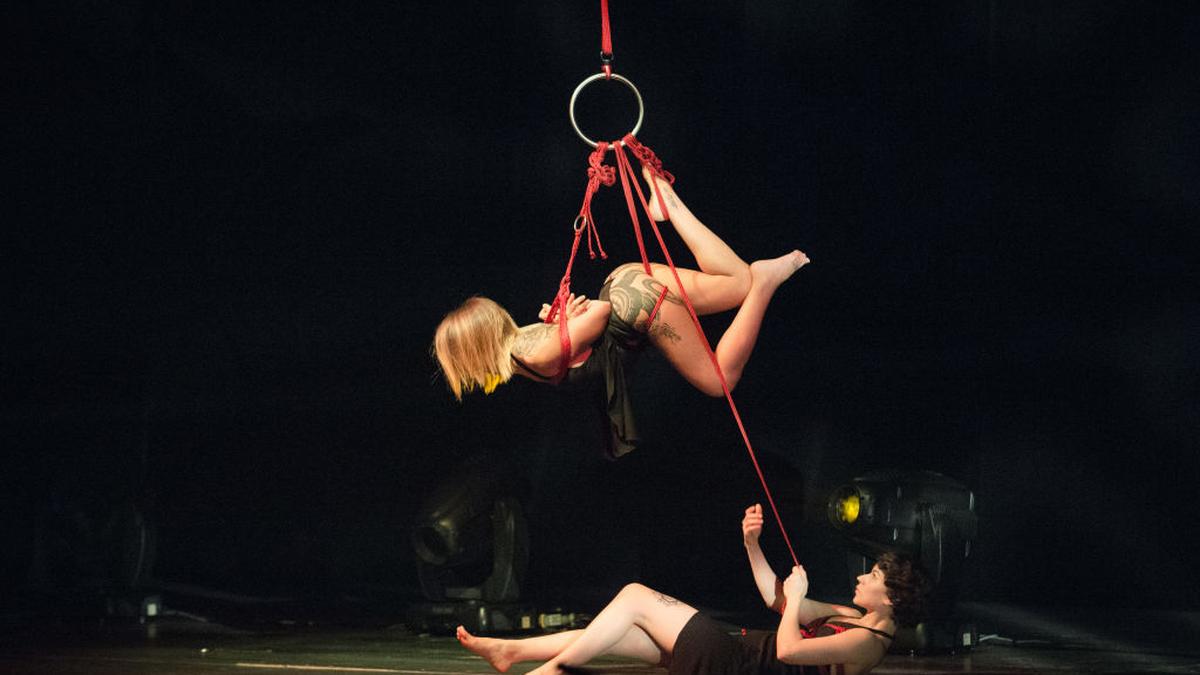
A shibari session
| Photo Credit:
DigiPub
Shimmer’s entry into kink was not born from transgression but with a sensation she could not name during a rope session, often known as Japanese shibari or kinbaku — a practice that uses rope to create patterns of restraint and sensation, with an emphasis on trust and communication between partners.
“The memories of handcuffs and a blindfold came flooding in from decades ago,” says the Chennai native, who is in her mid-40s and self-employed.
For her, shibari became a way for the body to speak before the mind explained itself. “I realised I may want to explore with women,” she says. Not as identity upheaval, but as curiosity.
Chennai-based Bee, who’s in her mid-30s and an artist-designer, first encountered shibari in Puducherry last year at a residential retreat led by Bengaluru-based practitioner Amiya Bhanushali, who hosts intimate, multi-day kink and rope retreats once or twice a year across different locations under her studio, Silly Hands Shibari, touted as India’s only rope-dedicated studio.
Among them was a recent femme-only retreat in Rishikesh called The Great Baddie Pilgrimage, held in November last year.
The Rishikesh retreat was designed exclusively for women and FLINTA (female, lesbian, intersex, non-binary, trans and agender) individuals. With much of her social media audience being men, Amiya wanted to create a space where bodies and curiosity did not have to negotiate the male gaze.
Bee had also been particular about learning from a woman, especially in a rope culture that often leans male. “I was tired of the male dom/fem sub aesthetic,” she says. For her, a woman-led space allowed her to explore sensuality without expectation.
Amiya describes her work as “container-building”.
“Only when you trust the space and facilitators are you open to vulnerability,” she says. “At the workshop, we began with trust falls — a simple exercise where one person leans back and relies on another to catch them.”

In practice, rope work begins with participants being taught basic knots and ways of handling rope safely, before moving into patterns that wrap around the body — sometimes creating sleeves or harnesses that hold the arms or torso in place. As trust builds, the exercises may involve light restraint that limits movement. More advanced techniques, such as partial or full suspension, are typically demonstrated by the facilitators rather than practised by beginners.
What stayed with Bee after the workshop was not just the technique, but the atmosphere. “I became comfortable tying others and being tied, simply as a sensual, playful practice.”
The number of participants varies depending on the retreat. The Rishikesh retreat I attended was limited to 12 spots and cost approximately ₹26,000 on the early-bird rate. The fee included accommodation for three nights and four days, along with a welcome kit containing items such as a flogger and handcuffs, as well as activities like massage sessions, sound healing and a pottery workshop.
Typically, the organisers cap attendance at around 10 participants. In addition to the residential retreats, Amiya’s Silly Hands Shibari regularly conducts non-residential, single-day rope workshops priced between ₹1,000 and ₹2,000 per person at the studio in Bengaluru, in Mumbai, Puducherry and other cities. They also offer private rope-tying sessions in clients’ homes, which cost approximately ₹4,000 to ₹5,000 per session.
They have been hosting roughly one retreat annually for the past few years.
Come undone
For many women, kink is not about breaking rules but about finally hearing themselves. Simran Sanganeria, a sexuality educator who attended the Rishikesh retreat, describes it as a return to the body.
Many at the retreat describe unlearning familiar scripts, where men are expected to make the first move and women to receive, or where intimacy is narrowly defined by traditional gender roles. Participants explore other ways of connecting, where power can be exchanged, paused or shared, rather than assumed.
This unfolding exists within a larger contradiction. While South Indian states rank as relatively safe for women, lived experience still teaches vigilance. Within that tension, kink offers a space where boundaries are spoken, power is negotiated and the body is handled with care.

At the Rishikesh workshop
| Photo Credit:
Special arrangement
For Shimmer, those shifts did not remain inside the retreat. They followed her home.
“If I have specific wants, I now voice it more clearly,” she says. “If I don’t want to receive more, I will say it.”
She describes approaching intimacy with more intention. Whether imagining a threesome or navigating a one-on-one encounter, she says she now thinks through “the entire flow” — what each person is comfortable with, how the experience unfolds and what care looks like afterwards.
For others, the translation is more subtle. Bee, who has not actively sought out a kink community since, describes carrying the experience more as a memory than a routine.
Chennai, as Bee notes, does not yet have a visible and safe kink community. So what these spaces offer is not just experimentation, but a place to practise communication, consent and curiosity.


#South #Indias #womenled #kink #spaces #conversations #desire #consent
