Quiet, rustic, far from the madding crowd. We couldn’t have asked for a better milieu as we reached Kalamachal, a sleepy village, some 30 kilometres from Thiruvananthapuram city. Our destination lay close by — the weaving units of Kalamachal Handloom Weavers’ Cooperative Society.
If Balaramapuram handloom is the first name that comes to mind when one talks about the handloom cluster in the capital city, Kalamachal too has an equally prominent legacy, thanks to the Cooperative Society.
“The Society was formed in 1956. The hearsay is that a few residents of the village who had learnt weaving at Balaramapuram started weaving at their homes and used to do door-to-door sale. Subsequently, a few notable people in the area came together and decided to form a society. Eventually, every household in the village had a loom. The Society would give them wages and the yarn. Later, it was decided to construct a common space for them to work and that’s how the weaving units were set up,” says G Madhu, president of the Society, which has seven members in the director board.

Yarns being dried at the weaving unit
| Photo Credit:
SREEJITH R KUMAR
Right now, four such sheds stand on 1.6 acre and the compound also houses the office of the Society built in 2025.
Madhu admits that the going has been tough for the weaving community as the number of weavers has come down from 2000 to 96. “Among them are those who continue to work on the looms at their homes. In addition to these weavers, there are 25 other labourers who carry out pre-weaving work such as dyeing the yarn and winding them onto bobbins,” he says, adding that women form the major workforce.
Kalamachal handloom has had its own fanbase, sans any publicity. The products include mundu/dhothi (double and single), school uniform fabric, saris, towels, bed sheets, lungis, shirt pieces, floor mats, etc.
The sale is mostly done through the shop located close to the weaving units and an outlet at Nedumangad. They also put up stalls at exhibitions. “The units work throughout the year. Some weavers come on Sundays as well. Their argument is that there are 52 Sundays in a year and so they have no work for almost two months, which they cannot afford,” Madhu says.
The labourers are paid as per the weight of the product(s) they weave. “Besides the wages, we also give them yarn of equivalent weight. From the wages, 10% is deposited in their account with the Society and we disperse that during Onam. In addition they get 31% bonus during Onam. Some of the weavers are enterprising; one of them received ₹50,000 as bonus this Onam. The weavers know that they can earn enough if they work hard and that’s why many of them continue to do it in spite of their age,” says Madhu, adding that this Onam they sold products worth ₹36 lakhs.

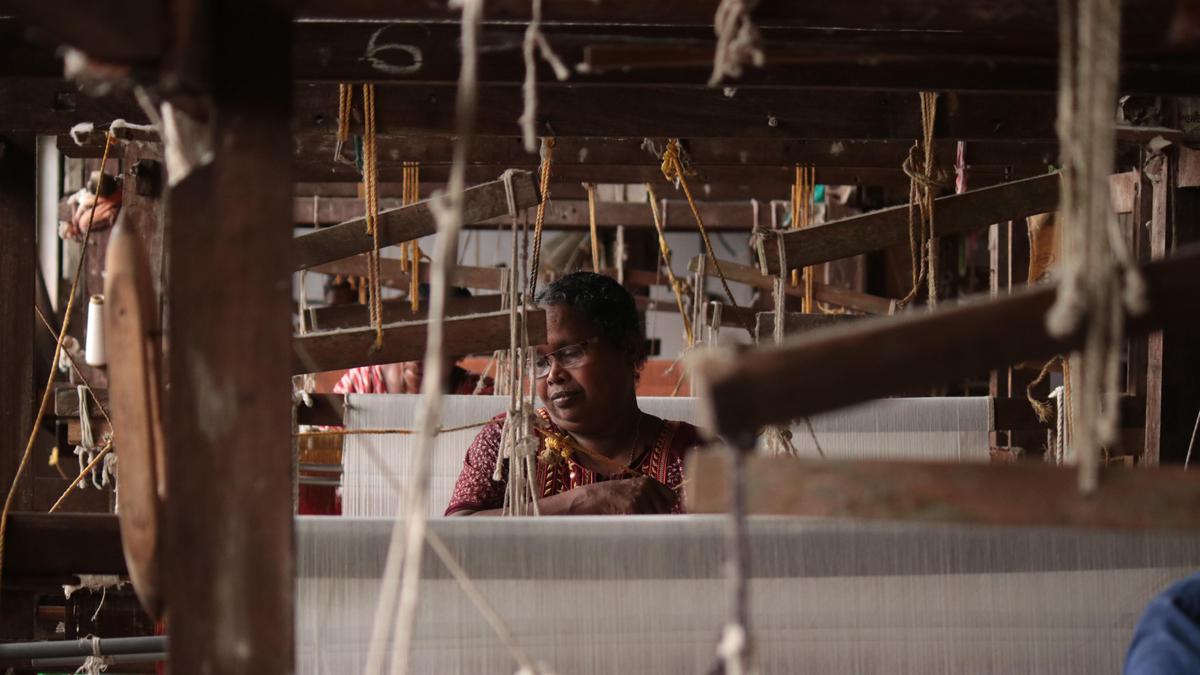
A weaver at work at the weaving unit of Kalamachal Handloom Weavers’ Cooperative Society in Thiruvananthapuram
| Photo Credit:
SREEJITH R KUMAR
Since most of the labourers are in the 60-plus age category the Society is taking all steps to bring in freshers. “Recently we brought in an expert to give three-month training to 20 new weavers. The Government provided us ₹5 lakh for this. We spent another ₹3 lakh to give them further training and now they are proficient weavers,” Madhu adds.
Among the new joinees is Rajani Vijayan. “I felt that it is better to learn a trade. Now I have an income and that makes me happy,” she says.
Meanwhile veterans such as B Chandrika, 62, and K Syamala, 76, are content with their jobs. Chandrika, who commutes around 30 kilometres in total to come to work, says, “I learnt weaving at a young age and used to do door-to-door delivery before I joined the Society. I am happy to keep myself engaged at this age and earn for myself.” Syamala adds, “I couldn’t continue studies after class four. I started out with thaaru chuttal (transferring yarn onto a pirn, which is placed inside a shuttle for weaving) before I picked up weaving.”

A weaver at work at the unit of Kalamachal Handloom Weavers’ Cooperative Society in Thiruvananthapuram
| Photo Credit:
SREEJITH R KUMAR
For people like N Renuka, the job is like a lifeline. A chronic rheumatic patient, she has a metal rod inserted in her right hand, yet she continues to weave. “The hand is swollen and I am in severe pain. But this has been my job for the last 33 years and I cannot stop working.”
Among the few male weavers here is 79-year-old K Sathyasheelan, a weaver for over 60 years now. He was felicitated by the State Government at National Handloom Day last month.

Designs being made on a sari on the electronic jacquard loom
| Photo Credit:
SREEJITH R KUMAR
Besides the 60-plus traditional looms spread across the four sheds, the Society has also installed two electronic jacquard looms, one to weave bedsheet and the other for saris. “We bought this six months back. Designs are loaded into the loom via a pendrive. Individual warp threads are digitally controlled,” says Ajith Salim, secretary of the Society.

A weaver at work at the unit of Kalamachal Handloom Weavers’ Cooperative Society in Thiruvananthapuram
| Photo Credit:
SREEJITH R KUMAR
Faculty from Weavers’ Service Centre at Kannur had come down to give training. Manju RS, one such weaver says, “I had one-week training on the jacquard loom. It takes time to get used to it, especially if we use thin yarn.”
Meanwhile, the units shifted to solar power a few years ago to save on electricity charges.

Kamalakshy, a weaver, is doing ‘thaaru chuttal’, the process of transferring yarn onto a pirn, which is placed inside a shuttle for weaving
| Photo Credit:
SREEJITH R KUMAR
The compound also houses a building where the yarn is dyed.
Madhu mentions that around 30 looms are set up at different houses in and around Kalamachal for those weaves who work from home. “People come from across the district seeking our products and we are trying our best to stay afloat.”
Contact: 9447085008, 8281955148
Published – September 30, 2026 11:29 am IST
#weaving #community #Kalamachal #Thiruvananthapuram #surviving #odds
