Standing on a humid spring evening at the entrance of the Jamshed Bhabha Theatre at the National Centre for the Performing Arts (NCPA), you watch the sun go down over the Arabian Sea, its orange rays shimmering on the water. Perched at the edge of Mumbai’s iconic Marine Drive, the NCPA came up almost 60 years ago on land reclaimed from the sea. As a steady stream of visitors walks in, chatter and laughter fill the spacious foyer, whose neoclassical staircases and tiered crystal chandeliers are reflective of its European-inspired architecture.
When the clock strikes six, the doors to the 1,109-seat proscenium-arch auditorium open for the premiere of Aditi Mangaldas’ ‘The Absence of PRESENCE’. In a first, a contemporary Kathak production unfolds with a live symphony orchestra. The stage is set for a historic collaboration. The 45-member Symphony Orchestra of India (SOI), whose musicians have performed under renowned conductors, including Zubin Mehta, Carlo Rizzi and Sir Mark Elder, is accompanying a dance production for the first time. Led by Melvin Tay, the orchestra occupies the sunken pit by the proscenium, the men in dapper black suits and the women in elegant black gowns. Composer Rushil Ranjan’s score is seamlessly woven into the choreography, creating a rich dialogue between movement and music.

The 45-member Symphony Orchestra of India performing live for ‘The Absence of PRESENCE’.
| Photo Credit:
Adarsh Prathap
Sitting in the centre of the theatre, NCPA chairman and co-founder of SOI, Kushroo N. Suntook, explains before the curtains go up, why the institution commissioned this work. “It reflects on the lives of children distressed and displaced by conflicts across the globe and celebrates the resilience of the human spirit.” His remarks underscore how art can confront uncomfortable realities while giving voice to stories that might otherwise go unheard.
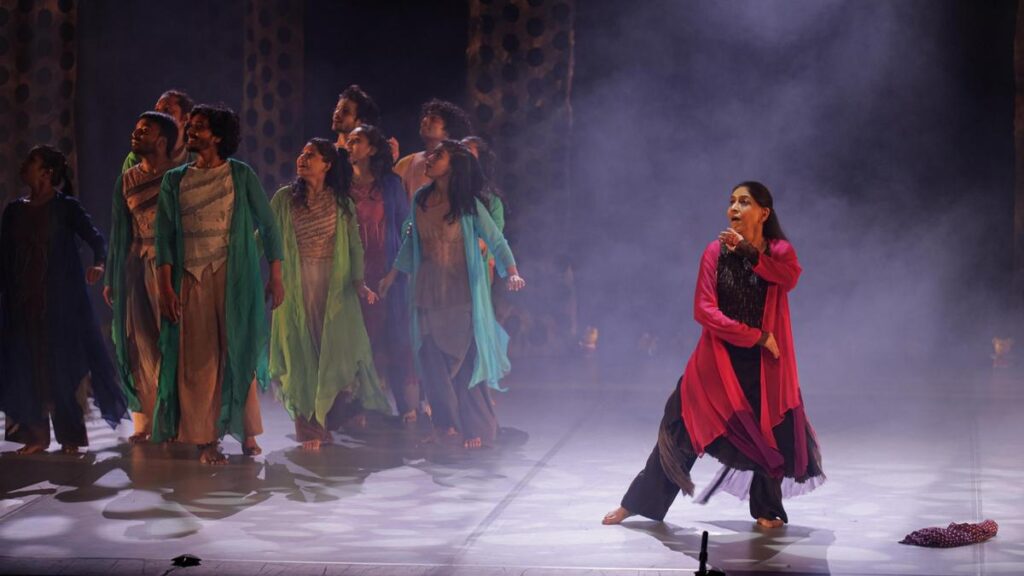
The opening scene of ‘The Absence of PRESENCE’ is stark: children’s clothes dry on a line stretched across the stage, which is soon filled with colourful kites and cute little wind-up toys that whirr. Dancers leap, jump and swirl, portraying children at play amid wreckage and rubble. The scene brings to mind a widely shared video of Ahmed Muin Abu Amsha, a Gaza-based music teacher, sitting in a makeshift tent with a guitar in hand, encouraging children traumatised by the constant hum of drones to sing.

The opening scene that transports the audience into a conflict zone
| Photo Credit:
Adarsh Prathap
Though the parallel with Palestine is apparent, Aditi, who choreographed the production, emphasises that the work is not confined to a particular region or conflict.
“This production is the result of Mr. Suntook’s vision to bring Indian dance and SOI together. We had been looking for a narrative that would facilitate this unusual collaboration. He felt it should be something that resonates universally. With grim images of conflicts world over and the heart-wrenching suffering they inflict on people, especially children, we wanted to create a production that spoke of compassion in a fractured world,” says Aditi.
‘The Absence of PRESENCE’ took shape, somewhat unintentionally, when Aditi created ‘Weeping RED’ as part of the Indian Dancers for Gaza initiative in 2024. “I had to put it together in just three days, but it left a lasting impact on me. I realised that national, cultural and religious identities hold little meaning in such situations,” shares the Kathak exponent.
The experience reaffirmed her belief in art as a means of engaging with larger issues. “It shapes my perspective, and this often finds its way into my choreography. I decided to expand ‘Weeping RED’ into a full-fledged production on genocide across the globe.”

The production was an interplay of sound and stillness
| Photo Credit:
Adarsh Prathap
During research, among the many disturbing stories that left Aditi numb was one about a father in Gaza who returned home with the birth certificates of his newborn twins, only to find his third-floor apartment bombed and his wife and babies dead. “I can only express that pain through my dance, which is why such traumatic imagery makes up most of this production. It might seem morbid when viewed on stage, but I wanted as many episodes as possible to leave an impact on audiences and make them confront these tragedies. So, there are dancers lying under shrouds, others portraying hysterical mothers screaming in desperation, and, in one segment, I keep pulling clothes from a piece of fabric tied around my stomach to suggest an emptied womb,” shares Aditi.
Aditi’s raw and humanistic approach to choreography is evident once again in this work. Her distinct vocabulary dissolves the binaries of dance and drama, as she draws on her Kathak roots to explore the interplay of sound and stillness, dialogue and silence. Her expressionist movements in this work have an almost unrehearsed quality, making the body central to the narrative.

Rushil Ranjan, the composer.
| Photo Credit:
Special Arrangement
Aditi explains, “It is only through minimalist staging that art can remain grounded and become a hard-hitting medium for storytelling. The turning point in my creative journey came when I began to have my own conversation with Kathak and make it relevant to my life, and to the lives of others. That is when I did away with some of its traditional theatricality, replacing it with everyday gestures and emotional honesty.”
Over the past two decades, Aditi has created several productions that embody the kind of cultural intersection that resonates on global platforms, and ‘The absence of presence’ is no exception. The production also serves as a reminder of her engagement with international performance practices, especially through her collaborations with U.K.-based dancer-choreographer Aakash Odedra.
Aditi’s guru Kumudini Lakhia broke new ground with her progressive approach to the dance form and taught Aditi to question and rethink every aspect of Kathak. This is evident in her latest work too, where the aesthetically designed lighting (Ryan Stafford), set design (Manish Kansara) and costumes (Urvashi Kaur), alongside movement and music, allow the dancers to move seamlessly between realism and surrealism. In this journey, the audience ironically encounters a presence of the present, with all its anxieties and hopes.
Published – November 18, 2026 03:10 pm IST
#Kathak #exponent #Aditi #Mangaldas #Symphony #Orchestra #India #create #history #firstofitskind #collaboration