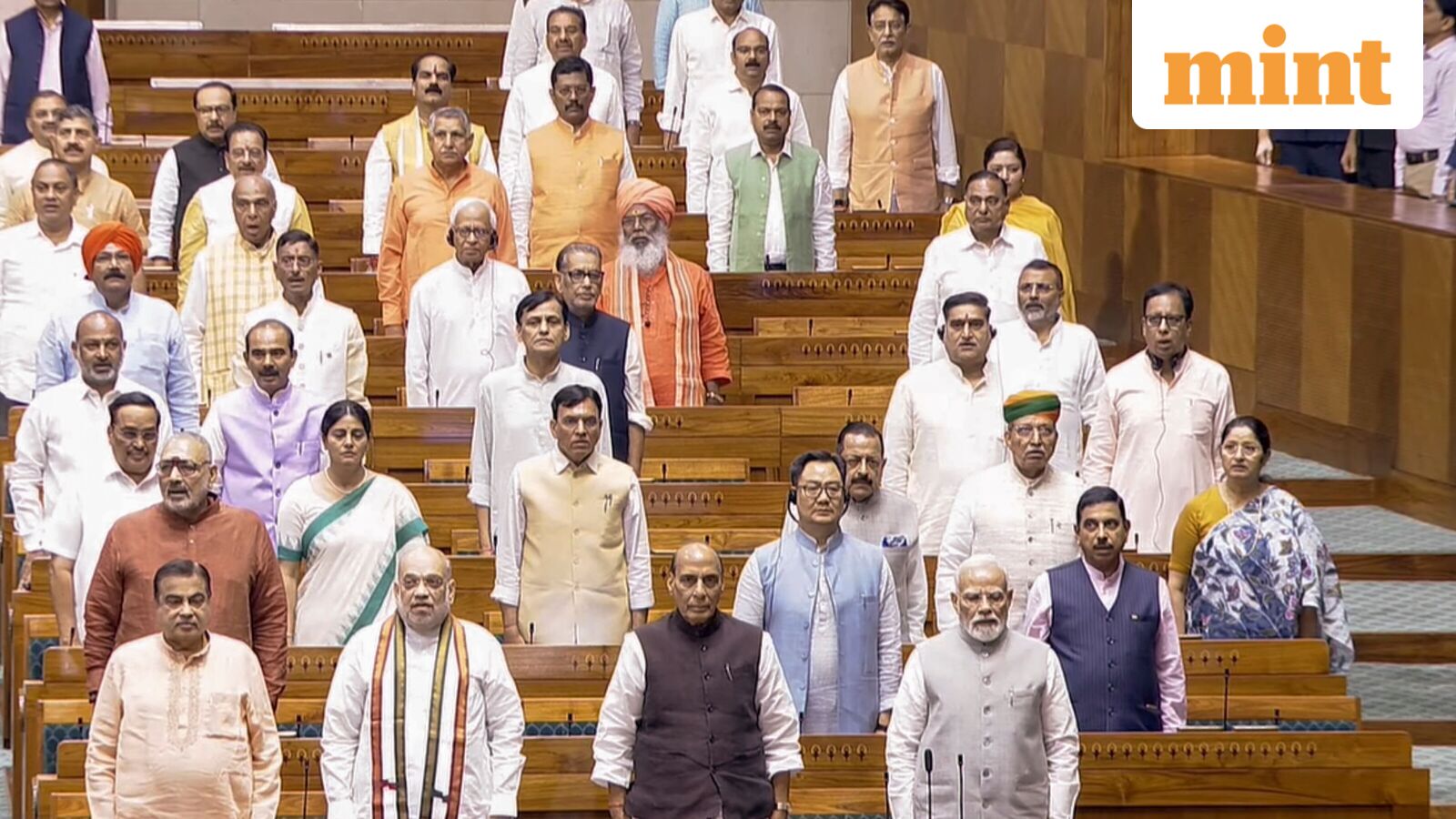
Both Lok Sabha and Rajya Sabha were adjourned sine die on Wednesday, 13 August, bringing the Monsoon Session to an end amid persistent Opposition protests and disruptions.
Union Minister for Parliamentary Affairs Kiren Rijiju said Parliament passed 12 Bills during the Monsoon Session, but the government was not satisfied with the quality of discussions. Eleven of these bills were passed without discussion, Rijiju said, blaming the Opposition for avoiding debates in the House.
“A total of 12 bills were passed, but we are not satisfied with the quality of discussion because the opposition did not allow proper debate to take place, especially in the Lok Sabha,” Rijiju told reporters.
1 – Monsoon Session 2026: 19% in Lok Sabha
Productivity in the Lok Sabha was 19% and in the Rajya Sabha 39%, Rijiju said on Thursday, blaming the Congress for disrupting proceedings during the Monsoon Session and expressing disappointment at the low level of debate.
The productivity of Lok Sabha was 15%, and that of Rajya Sabha was 33%, according to analysis by PRS Legislative Research.
“In the Lok Sabha, 11 bills were passed without discussion, while one underwent discussion… In the Rajya Sabha, the bill was fully discussed. Only the main opposition, the Congress Party, and some others walked out, while other opposition parties participated,” Rijiju said.
The Monsoon Session of Parliament, which began on 21 July, was marked by repeated disruptions, with Opposition protests initially centred on the NEET paper leak and alleged embezzlement of donations at the Ram temple in Ayodhya.
The Opposition later sought a discussion on police action against students protesting over the NEET issue and demanded statements from Prime Minister Narendra Modi and Home Minister Amit Shah.
In a bid to end the deadlock, the government on Monday offered a debate on the NEET issue, followed by a reply from Shah. The Congress rejected the proposal.
Leader of Opposition in Lok Sabha Rahul Gandhi said the Opposition wanted answers on the police action against protesting students and was not interested in listening to Shah’s “imagination and lecture”.
Parliament’s productivity in this session may be low. But it was certainly not the worst. Here are some of the earlier, worst productive sessions of Parliament:
2 – Winter Session 2010: Just 5 % in Lok Sabha
In the 2010 Winter Session of Parliament, the Congress-led UPA was in power for its second term. The BJP was in the Opposition. The session was almost a complete washout and is widely recorded as India’s worst-performing and most disrupted parliamentary session.
The Lok Sabha functioned for only 5 per cent of its scheduled time in the session, and the Rajya Sabha just 2 per cent, according to data compiled by PRS Legislative Research.
This primarily due to intense political standoffs over corruption allegations. The Opposition BJP demanded a probe by a Joint Parliamentary Committee (JPC) over 2G spectrum allocation. The Congress government under Manmohan Singh, as Prime Minister, suggested that the Public Accounts Committee could investigate the matter.
3 – Winter Session 2013: 15 % productivity
This session was held just before the 2014 general elections, when the BJP, with Narendra Modi as its Prime Ministerial candidate, cornered the UPA government over the draft JPC findings on telecom licence allocations.
The lower house, in the Winter Session of 2013, recorded only 15 per cent productivity, while the monsoon session recorded 58 per cent and the budget session recorded 49 per cent, according to data compiled by PRS Legislative Research.
In 2013, Parliament met for 63 days and was productive for 44% of the scheduled time throughout the year. The Monsoon Session of Parliament was extended for a week, something that has not happened in the last four years. 2013 also saw the shortest Winter Session of 10 days.
Both Houses were disrupted over issues such as coal block allocations, the JPC’s draft report on 2G, Telangana, border security with Pakistan and China, and the country’s economic situation. Budget and Winter Sessions were curtailed as Parliament adjourned two days ahead of the planned schedule.
The BJP government came to power under Prime Minister Narendra Modi in 2014.
4-Winter Session 2016: 17% productivity
The 2016 Winter Session of the Parliament ran from November 16 to December 16, 2016. It became one of the least productive sessions in 15 years due to continuous disruptions and intense political protests over the government’s demonetisation announcement.
During the Session, 10 Bills (all in the Lok Sabha ) were introduced. Lok Sabha passed 4 Bills and the Rajya Sabha passed 1 Bill during the session
During the Session, productivity in the Lok Sabha has been 17.39 per cent, and in the Rajya Sabha, 20.61 per cent, according to government data.
5-Monsoon Session 2021: 21% productivity
The productivity of Parliament in this session may be low, but it was certainly not the worst.
The Monsoon Session of Parliament in 2021 was held between 19 July 2021 and 13 August 2021.
The Monsoon Session of the Parliament in 2021 was severely impacted by protests and disruptions. The Lok Sabha productivity dropped to 21 per cent, and the Rajya Sabha to 29 per cent, following an uproar over the farm laws and the Pegasus spyware controversy during the Monsoon Session of Parliament in 2021, according to PRS Legislative Research.
‘Parliamentary obstruction is not undemocratic.’
Opposition disruption of Parliament is not new in India. In 2011, senior BJP leader Rajya Sabha, Arun Jaitley, famously said that “Parliamentary obstruction is not undemocratic.”
Next year, Sushma Swaraj, then the BJP’s leader in the Lok Sabha, said, “Not allowing Parliament to function is also a form of democracy, like any other form.”
Jaitley later went on to become Union Finance Minister and Swaraj became External Affairs Minister.
#productive #Parliament #sessions #years #Monsoon #Session #compare
