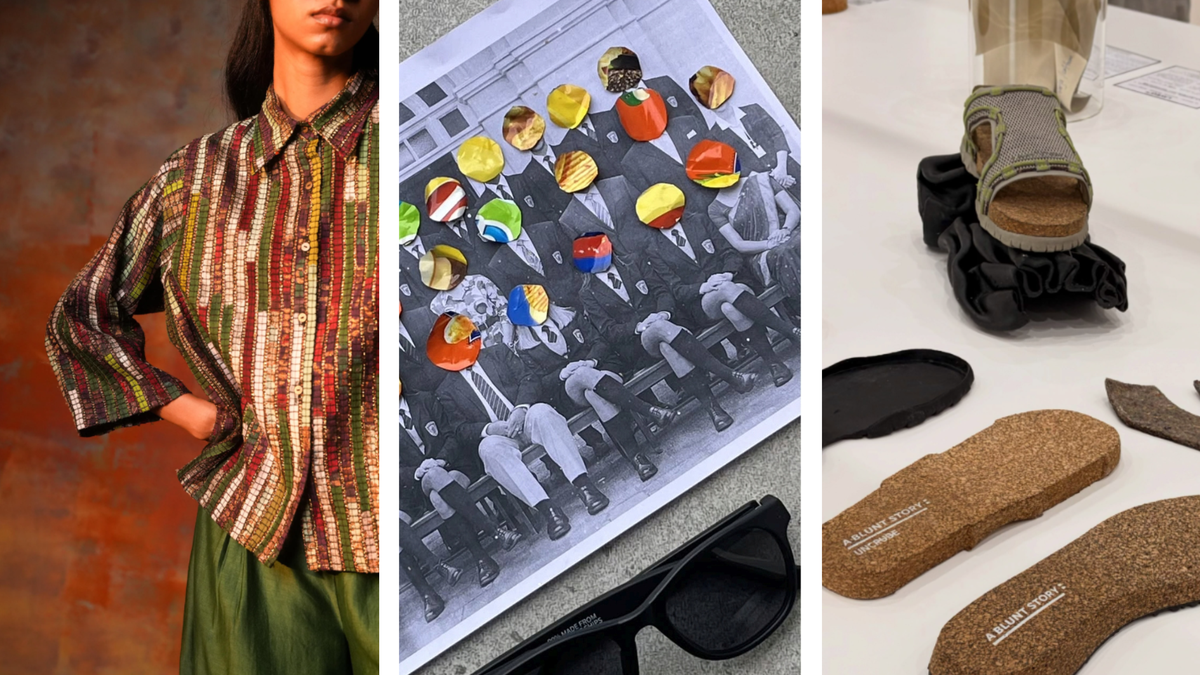
“I grew up in Delhi, and one of my earliest memories is driving past the Ghazipur landfill with my father,” says Ashita Singhal, founder of Paiwand Studio, an upcycling studio that converts fashion waste into textiles and lifestyle products. “I asked him what that enormous hill was, and he replied, ‘It’s our mountain.’” Singhal has since made peace with the quip and turned it around. “I often joke that Ghazipur is my mountain of opportunities.”
On October 13, that joke earned her €50,000 at the French Embassy in New Delhi. Marking the start of the latest edition of Lakmē Fashion Week, Singhal’s Noida-based studio took home the Kering Generation Award, just ahead of Anish Malpani’s Without, an enterprise that recycles the ‘unrecyclable’, and Chandni Batra’s A Blunt Story, a circular footwear brand. All three startups will soon travel through Europe to meet French luxury brand Kering’s designers, suppliers, and competitors, including fast-fashion giant Inditex, where they will exchange ideas on finance, communication, and sustainable growth, culminating in an invitation to the ChangeNOW summit in Paris in 2027.

Ashita Singhal of Paiwand Studio
Global appetite for luxury products has been slowing. Gucci, for example, which accounted for about 51% of Kering’s revenue in 2022, saw sales fall from €10.5 billion in 2022 to €6.0 billion in 2025. This April, Kering presented its turnaround plan, which included a “six-pack” of high-potential regions spanning India, the Middle East, Southeast Asia, Mexico, Brazil and Africa. Kering also announced it would bring its Generation Award to India for the first time.
‘For a world without waste’
Singhal’s winning pitch was that most recycling destroys what it hopes to preserve. Paiwand does the opposite. “Instead of breaking it [waste] down to fibres and making recycled yarn out of it, we preserve the existing material and reweave it into a new circular material,” she explains. The raw material is pre-consumer offcuts that pile up at garment manufacturers, export houses, and design studios. Paiwand processes that into continuous strands [yarn-like strips] that go onto traditional handlooms as weft or through needles for embroidery.
She calls it “craft intelligence — the ability to use traditional craft knowledge to solve the biggest issues of modern times, climate change”. Her own reference point was Panipat’s rag rugs. She adds that the prize money will help build “a distributed circular textile network that connects textile waste generators, local artisan clusters and designers”.
Malpani’s startup, Without, “is short for a world without waste and poverty, where people can live without worry”, he says. Malpani sees his initiative as more of a materials company than a fashion one. “For fashion to be truly sustainable, the change has to happen in the material itself, at the molecular level, and that takes deep science and years of patience.” His proprietary product VerdiFLX is an eyewear-grade compound made largely from post-consumer packaging, “the chip-packet kind of plastic”. He says it matches TR90, the nylon most premium frames use, in weight and stiffness.

Anish Malpani of Without
Meanwhile, the third startup on the list, A Blunt Story, began with a blind spot. “When we think about plastic pollution, we tend to focus on packaging and textiles,” says founder Batra. “But plastics are built into the footwear we wear, too.” Her answer is UNCRUDE, a plant-based sole made mostly from agricultural residue that farmers would otherwise burn. “We want to demonstrate that bio-based materials can be viable alternatives to conventional crude-oil-derived materials.”

Chandni Batra of A Blunt Story
Finding the right opportunity
That a group best known for prominent fashion houses such as Saint Laurent and McQueen is championing such studios says much about Kering’s evolving conscience as it does about growing demand for ecological responsibility from consumers and critics. Global appetite for luxury products has been slowing; Gucci, for example, which accounted for about 51% of Kering’s revenue in 2022, saw sales fall from €10.5 billion in 2022 to €6.0 billion in 2025. At its Capital Markets Day (where it presented its long-term strategy and financial targets to investors and equity analysts) in Florence in April, the group, now led by former Renault chief Luca de Meo, unveiled a turnaround plan. The solution included a “six-pack” of high-potential regions spanning India, the Middle East, Southeast Asia, Mexico, Brazil and Africa. Soon after, Kering announced it would bring its Generation Award to India for the first time.

“Humanity cannot exist without nature. We need to protect nature for those very selfish reasons, because the link between us and what is happening on the planet is inescapable.”Marie-Claire DaveuKering’s Chief Sustainability and Institutional Affairs Officer

Marie-Claire Daveu with Jaspreet Chandok
The award itself began in China in 2018 as a hunt for startups with an environmental upside, and has since travelled to Japan and Saudi Arabia, the latter then expanding to the wider MENA (Middle East and North Africa) region. Marie-Claire Daveu, Kering’s Chief Sustainability and Institutional Affairs Officer, gives a pragmatic answer for why the company is betting on Indian entrepreneurs to introduce exceptional innovations for a sustainable future. “We had been thinking about [bringing the awards to] India for many years, but it was also a question of the right opportunity,” she says. With neither Daveu nor her team based in the country, Kering needed a partner on the ground. Reliance Brands, which already retails Kering’s Bottega Veneta alongside more than 85 international brands (across luxury, bridge-to-luxury, high-premium, and high-street lifestyle) to Indian consumers and knows most segments of the Indian market because of its range of businesses — from telecom to high jewellery — fit the bill. The longlist of startups was nominated through Reliance’s R|Elan Circular Design Challenge, run with the United Nations in India, earlier this year.
A formidable jury, including Daveu, Indian couturiers Rahul Mishra and Manish Malhotra, Sumeet Yadav, head of Reliance Brands, journalist and author Sujata Assomull, Stefan Priesner, the UN Resident Coordinator in India, and Pascal Morand of the Fédération de la Haute Couture et de la Mode, delivered the verdict after much deliberation.
Clothing isn’t inherently sustainable
“If I’m honest, [India] moves faster than [France] does,” Daveu states without hesitation. “You all are more agile, and we are very jealous of that.” She also has a theory for why apparel needs the Generation Award more than most. Jewellery, she points out, is sustainable by design. “You don’t buy a gold ring and then later say, now it’s waste.” Clothing has no such luck, and its raw materials are already pushing back. For example, Cashmere goats are producing less and lower-quality fibre as the climate warms. “Sustainability isn’t separate from our business,” she says. “It is vital to it.”
For the award’s next India editions, Daveu sees Kering tapping into multiple segments and cities. “I won’t say it will be easy, but it will be easier,” she says. Meanwhile, endeavours built from mountains of opportunities in Tier 3 towns are preparing to walk shoulder to shoulder with the Gucci gang.
“In luxury, a good story isn’t enough anymore,” argues Without’s Malpani. “The material has to be as good as, or better than, the story.” But for a conglomerate such as Kering, bringing a new material into its supply chain can take close to a decade. These Indian innovators are eager to get that clock ticking right away.
Whether any of these inventions reach a McQueen or Balenciaga runway is up to Kering’s larger team. They will mentor the winners first, Daveu says, “and then the brands will decide how to work with them”.
The Mumbai-based writer, artist and editor reports on fashion and culture.
#Kering #betting #waste #India
