The entrance to artist Thota Tharrani’s studio in Thiruvanmiyur is layered with paintings, the work of decades leaning into one another. The air carries the scent of paint and incense. We take off our shoes, entering what feels less like a studio than a temple of art.
Inside, the years seem to have accumulated on the walls, on the canvases, in the stacks of drawings that bear witness to a life spent looking and making. There is no single Thota Tharrani to encounter here. There are several: the young student experimenting with watercolours in the late 1960s, the artist drawn to the restless movement of roosters, the painter who turned to abstraction…
“In our country, I don’t think we need to hunt for subjects. Whatever you see might interest you. That is how I started, and I have continued in that way. Anything can become a subject. It depends on how you look at it,” says Tharrani. (The artist, long known as Thota Tharani, now spells his name Tharrani.)

Force, Acrylic on Canvas
| Photo Credit:
Thota Tharrani
On October 24, at Lalit Kala Akademi in Chennai, Artworld – Sarala’s Art International will bring together this expansive body of work in Thota Tharrani – A Retrospective: 1969–Present. Curated by art historian , and critic Ashrafi S Bhagat and second-generation owner of Sarala’s Art Centre, Sarala Banerjee, the exhibition will feature around 280 paintings and drawings, offering visitors an opportunity to trace the many directions his practice has taken.
Ashrafi, who has been writing about Thota Tharrani’s work for years, sees his ability to move between different forms as one of the defining qualities of his practice. “When he showed me the works, I selected those which I feel have a good visual and aesthetic appeal. It comes down to how he has structured his composition, and how he has used vibrant colours, line, colour, space and light. These are the four important elements in Tharrani’s works,” she says.
“He is both a figurative as well as an abstract artist. That is the greatest aspect of his artistic career, that he could switch so easily from one to the other. Otherwise, it is always a process of reaching abstraction. But for him, all of this comes very easily.” she adds.
For Tharrani, the idea of a retrospective is not necessarily about tracing a straight line of artistic evolution. He has never been one to stay with a single subject for too long. “I start something, leave it for a while so that I can do something else, and then return to it. When I work on a set of paintings, I might do 40 or 50 works. But each set will have one specific subject. I don’t mix subjects. I feel that every exhibition should look different. It is like eating the same menu every day. It is better to change the menu,” he says laughing.

Force, Watercolour
| Photo Credit:
Thota Tharrani
The retrospective, which took a year to put together, offers an opportunity to revisit a body of work and a range of mediums, from watercolours and oils to acrylics, pastels and collage. Some of the earliest date to 1967-68, when he was still a student. “In 1967, I did a watercolour, somewhat in my father’s technique. It was closer to the Bengal School of painting. I had to wash the painting about seven times to get the colour I wanted,” he says adding that he remembers making a waterscape influenced by Japanese techniques though he did not have much exposure to that school of art.
Innate exploration
Despite his experiments with different mediums over the decades, drawing remains central to his practice. “My basic love has always been pencil drawing. Once you have that foundation, everything becomes clear. You can decide whether you want to work in watercolour or do a sketch outdoors.”

Rajasthan, Acrylic on Canvas
| Photo Credit:
Thota Tharrani
On his travels, he has taken the opportunity to make quick sketches of whatever catches his eye. He has sketches created in Bengaluru, Kolkata and Delhi, among other places, though not all of them have found their way into exhibitions.
“I would particularly like people to see my earliest works, because I have lost a lot of paintings over the years. We lived in a thatched cottage where rainwater would drip in from different places,” he says, adding “The works I made when I was about 16 are particularly important. I joined college at that age, and I experimented with different techniques. Some of those techniques may be difficult for people to understand today.”

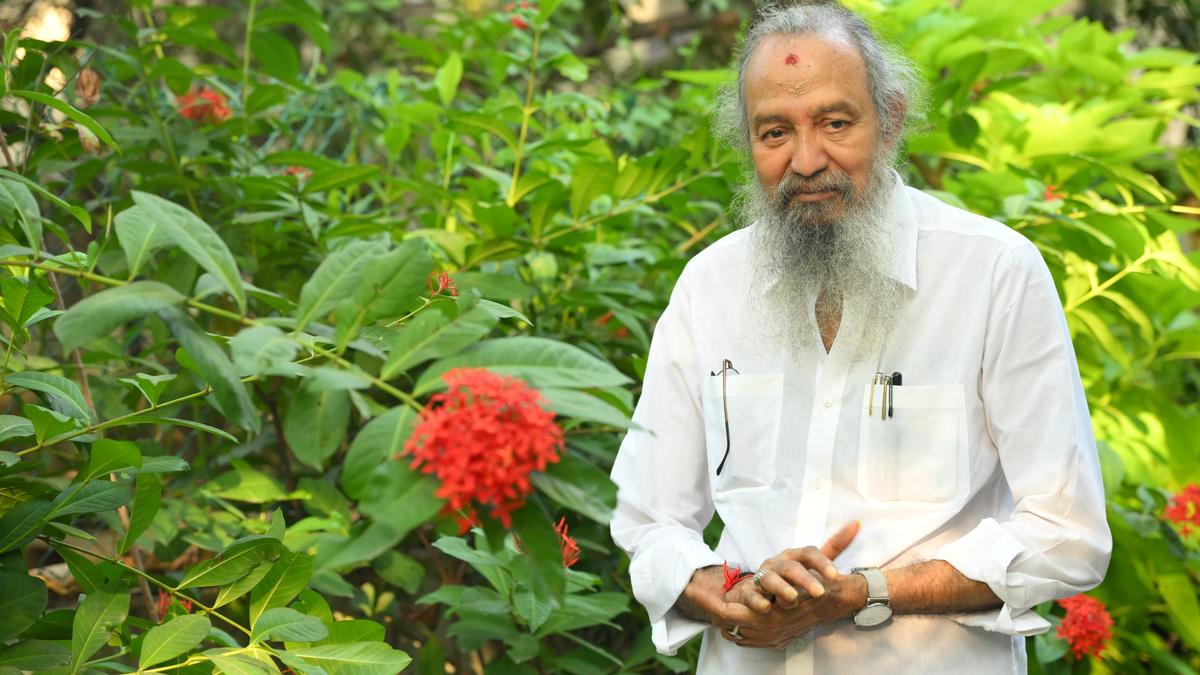
The Hindu in conversation with Thota Tharrani
| Photo Credit:
Thamodharan B
So what is it like to see his life’s work in one room? “Sometimes, when there is nobody around, I sit down and really enjoy the paintings,” he says. “I notice a lot of things. You are the best person to criticise your own work.”
As for what visitors should take away from the retrospective, he leaves that entirely up to them. “Different people will take away different things. I don’t wish to tell what they should,” he says. He has just one request: “Enjoy the paintings, see them, but do not take photographs.”
Thota Tharrani – A Retrospective: 1969–Present will be on display at the Lalit Kala Akademi from October 24 to 30 between 11am to 7pm. Entry is free.
Published – October 21, 2026 04:41 pm IST
#Thota #Tharrani #retrospective #Chennai #brings #decades #art
