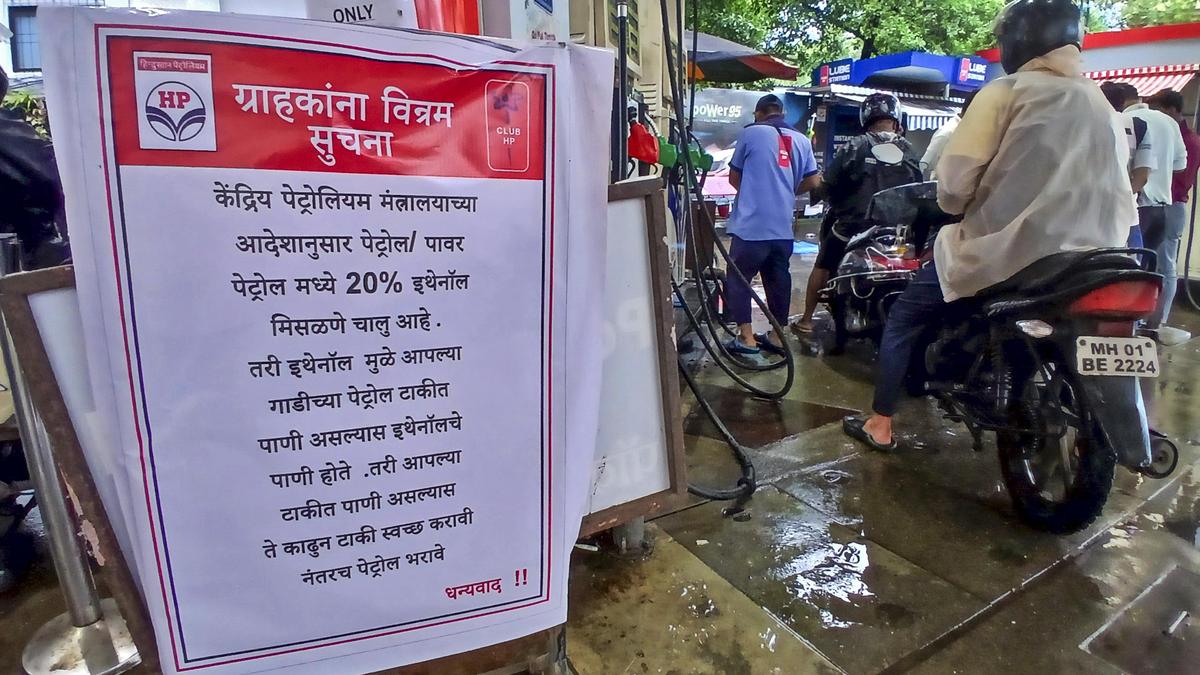

Addressing concerns over older vehicles, the Ministry said E20 underwent extensive testing covering engine durability, fuel systems, material compatibility, corrosion resistance, drivability and emissions before its nationwide rollout. File
| Photo Credit: PTI
While admitting that E20 blended fuel could result in a 3-5% reduction in the fuel economy of “some vehicles”, the government has also sought to explain why the blended fuel is not currently cheaper than pure petrol or fuel with lower ethanol levels.
The core reason, it said, was because the government is seeking to compensate farmers adequately, and so E20 fuel becomes relatively more expensive to produce than pure petrol whenever oil prices fall to around $70 a barrel.

This statement on Friday (July 10, 2026), in the form of a frequently asked questions (FAQ) document by the Ministry of Petroleum and Natural Gas, comes at a time when critics are questioning why fuel with 20% ethanol is not cheaper than pure petrol or fuel with 10% ethanol.
The document added that E20 fuel has a higher-octane rating and provides several other vehicular and emission-related advantages over unblended fuel.
Automobile firms ‘forced’ to mislead people on E20 fuel: Kejriwal
Mileage hit but higher quality
“It is true that in some vehicles there may be a 3-5% reduction in fuel economy,” the Ministry said. “But mileage is only one parameter. E20 offers a significantly higher-octane rating, superior anti-knock characteristics, faster combustion, better pickup, smoother acceleration and cleaner engine operation.”
“It produces negligible particulate emissions and substantially reduces lifecycle carbon emissions by around 40%,” it added. “In short, it is a cleaner, higher-quality and more efficient fuel than either E10 or pure petrol.”

Why E20 isn’t cheaper
The government also sought to explain why E20 fuel is not cheaper than pure petrol or fuel that has lower ethanol levels.
“Today, the Government purchases ethanol at remunerative prices so that Indian farmers are fairly compensated,” it said. “Take maize-based ethanol. We have progressively increased its procurement price and today it is around ₹71.86 per litre, even before GST, transportation, storage and depot handling costs.”
“Therefore, if international crude oil is trading at around $70 per barrel, E20 is actually costlier to produce than pure petrol,” the government explained.
However, it added that the price advantage of ethanol kicks in when $120–130 per barrel, the economics naturally reverse and ethanol becomes even cheaper.
The fact that 20% of the fuel sold in India is ethanol has also insulated the Indian market against global oil price volatility, and allowed the Indian government to pass on much lower fuel price hikes than in comparable nations.

Not a rushed rollout
Overall, the government also sought to assure the public that the decision to move to ethanol-blended fuel was not a “rushed” one.
“This has been a journey spanning over two decades from pilot projects in 2001, policy notification in 2013, institutional reforms after 2018, massive investments beginning in 2021, and then a carefully calibrated, phased increase in blending levels,” the document said.
It added that all stakeholders, including automobile manufacturing companies, testing agencies, oil marketing companies, and the Department of Food and Public Distribution were consulted before rollout.
Published – July 10, 2026 02:08 pm IST
#E20 #fuel #lead #mileage #hit #vehicles #Govt #admits #defends #blending
