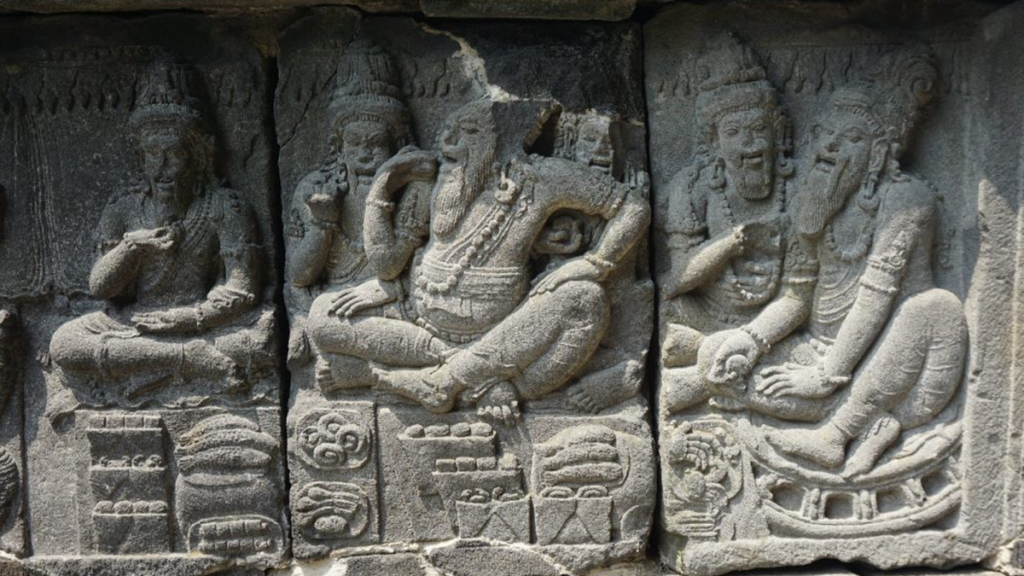
Over 1,100 years ago, a grand temple complex rose at Prambanan in Central Java, Indonesia, its three great shrines housing Shiva, Vishnu and Brahma. No such complex for the Hindu trinity was ever built in India. While visiting it a few weeks ago, one panel in the Shiva temple caught my eye: royal-looking men eating fish and meat. It made me smile as the contemporary Tamil word caivam (probably from shaivam) means ‘pure vegetarian’ food.

Devdutt Pattanaik at Prambanan
| Photo Credit:
Courtesy Devdutt Pattanaik
The Hinduism that reached Java was older than the vegetarian one. The horse sacrifice hymn (sukta 1.162) of the 3,500-year-old Rig Veda describes cutting and cooking the animal. ‘Purity’ was only a brief state around ritual, such as fasting during consecration, and ended when the ceremony concluded. There was no caste then. The word varna appears neither in the 3,000-year-old Purusha Sukta nor in the 2,300-year-old Ashokan edicts.
Around 2,500 years ago, monks brought a new idea: food shapes the mind. The Chandogya Upanishad (7.26.2) says pure food makes a pure mind, naming no dish. Jain and Buddhist monastic codes made non-harm a discipline, though the Buddha’s Jivaka Sutta let monks eat meat not killed for them. The Gita (17.8 to 10) sorts food by guna (attributes): juicy, oily and wholesome for sattva; salty, sour and pungent for rajas; stale and rotting for tamas. Meat goes unmentioned. Manu, author of Sanskrit law code, the Manusmriti (5.56) says eating meat is no fault, though giving it up earns great merit. A bonus, not a rule.

Status made it a rule. Chinese monk Faxian, crossing the Gangetic plain 1,600 years ago, found people avoiding onions and garlic, and killing, except the Chandalas, who hunted and sold meat. Vegetarianism already ranked people. Yet Chinese scholar Xuanzang, two centuries later in emperor Harshavardhana’s time, found fish, mutton and venison eaten across India. So the Hinduism that Shaiva priests and merchant courts carried to Java 1,400 years ago feasted without guilt. Bali still does. Its temple festivals serve roast pig, and its surviving caste system is not built on the kitchen.
A shortcut to climb the ladder
In India, the kitchen kept winning. The Jain poet and philosopher Hemachandra’s Yogashastra, in 12th century Gujarat, made diet part of the yogic path. Jains wrote that true Brahmins followed ahimsa, and that the sacred thread’s three strands embodied the tri-ratna, the three jewels of Jain dhamma.
Brahmins courting rich Jain patrons turned vegetarian. The Sanskrit texts Dattatreyayogashastra and Vasishtha Samhita (from 800 years ago) made mitahara, moderation not prohibition, a yogic discipline. The Hatha Yoga Pradipika, about 500 years ago, finally banned meat and fish for the yogi, along with curd and sesame.
Madhva in Udupi replaced the sacrificial animal with a dough figure. Gurus offered lower castes a bargain: give up meat and liquor, and climb the social ladder. The yogi Jambheshwar’s Bishnois community (from 1485) gave up meat, liquor and tree-felling. The mystic Chaitanya (1486 to 1534) made Krishna’s kitchen meatless for Bengalis of every caste. The ascetic Sahajanand Swami’s Shikshapatri (1826) turned Kanbi farmers into vegetarian Patidars. Guru Ghasidas did the same for the Satnamis, Govind Guru for the Bhils until Mangarh in Uttar Pradesh (1913), and Jatra Bhagat for the Oraons (1914).

The gurus lifted people up the ladder. None questioned the ladder. Indian sociologist M.N. Srinivas called this Sanskritisation in 1952, rejecting ‘Brahminisation’ since merchant communities largely led the way. Many Brahmins of Mithila, Bengal and Odisha eat fish and meat anyway.
Heed the Javanese merchant-king
A 1,000 years ago, Tamil Nadu’s Tevaram saints made the hunter Kannappar a saint for feeding Shiva boar meat, and the 12th-century poem Kalingattupparani by the court poet Jayamkondar gave Kali blood to drink and mocked Jain vegetarians.
Then, in the 16th and 17th centuries, the Siva Gnana Dipam and Cantalinka’s Kolaimaruttal, written at Perur near Coimbatore, made giving up meat a condition of being Shaiva. They targeted farming castes, probably the Vellalar, the non-Brahmin Shaiva monasteries wanted as followers. In the 19th century, scholar Arumuka Navalar and saint Ramalinga Adigal spread the idea. That is how caivam food became ‘vegetarian’ food.

In the 20th century, yoga gurus carried Indian spirituality abroad. Most came from Brahmin, Bania and Jain homes: Sivananda, Krishnamacharya, Iyengar, Pattabhi Jois, Osho, Prabhupada, even Gandhi. They sold the family kitchen as the universal spiritual diet, citing the Gita for a ban it never makes. A Californian giving up chicken for a yoga retreat has no idea she follows a Tamil Brahmin household’s rules — rules that once kept a Chandala outside the village.
Look again at the Javanese merchant-king with food at his lips. He worshipped Shiva and ate fish and meat, and the stone finds nothing strange. A Sanskrit scholar can, of course, argue that fish is water-vegetable, jala-taru in Sanskrit and frutti di mare in Italian. And the meat was niramish (purified) when cooked without onion and garlic.
Devdutt Pattanaik is the author of 50 books on mythology, art and culture.
Published – November 11, 2026 05:43 pm IST
#Column #Devdutt #Pattanaik #Hinduism #vegetarian