Just off the bustling CV Raman Road in Bengaluru, on a quiet lane skirting Sankey Tank, is Tharangini Studio, where a block printing workshop is underway. Apron-clad participants flit in and out of the studio, pausing occasionally to peek at the monkeys who have laid siege to a fruit-laden tamarind tree, one of the many shading the premises of this 50-year-old studio.
It is here, in this true-blue Bengaluru institution, the oldest surviving block printing studio in the city, that the design behind durable drinkware brand Stanley 1913’s first-ever Deepavali collection was born.

Marketed by the brand’s official retail partner in India, Bhaane Group, the Stanley 1913 x Nest Diwali Collection launched in India on November 3 with the 30 oz Quencher ProTour and the Stacking Cup Set, both available on the official Stanley 1913 India website or at a kiosk in Bengaluru’s Phoenix Mall of Asia. Globally, too, the design has made its way onto a range of leakproof products, including the 30 oz Quencher ProTour, 20 oz Flowstate Spring Bottle, 1 qt New Legend Vacuum Bottle, 16 oz Café-to-Go Mug and the Stacking Cup Set.
Genesis
“For our first Diwali collection, we wanted to start with the rituals that make the festival so personal: welcoming family and friends, lighting lamps at home, and sharing food and gifts,” says YuNien Chang, the APAC general manager of Stanley 1913. He adds that by working with Padmini Govind (partner at Tharangini Studio and the daughter of its founder, Lakshmi Srivathsa) and her team, these traditions came alive in objects people use every day.

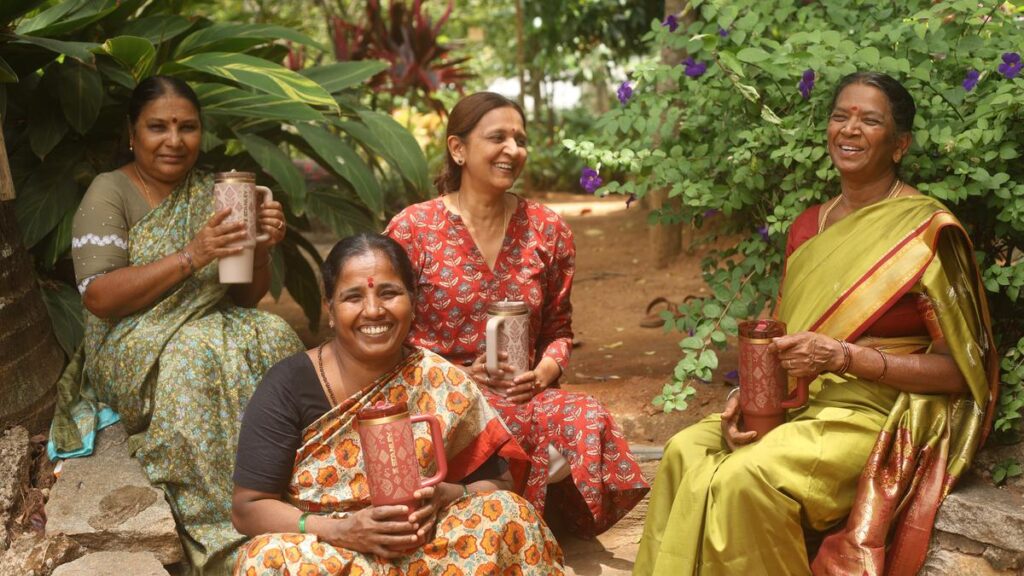
The collection, which starts at ₹5,000, has two colourways, Deepa Rose and Deepa Brown Sugar, featuring a paisley pattern resembling a mango fruit leaf as well as henna motifs. “Putting those patterns on a tumbler or a set of cups gives people another way to encounter that craft, whether they’re giving one as a Diwali gift or sharing chai long after the festival,” notes Chang.

Putting block print patterns on a tumbler or a set of cups gives people another way to encounter that craft
| Photo Credit:
Anahita Ananth
Over the years, Stanley has partnered with numerous brands and celebrities for its collections, including LoveShackFancy, Lionel Messi, FARM Rio, Starbucks and Barbie. And the origins of this collaboration came from Tharangini Studio’s association with Nest, a New York-based non-profit that supports and advocates for global artisans, makers, and the handcraft sector. “We have been part of a programme under Nest since 2022,” says Padmini, explaining that the non-profit certifies artisan studios around the world for their fair trade, ethical and sustainability practices. Over the following two and a half years or so, representatives of Nest frequented the studio, speaking to artisans and understanding, in minute detail, how the studio was being run. “They wanted to really ensure that we are truly doing justice to the artisans,” she says.

Through Nest, Tharangini Studio discovered that Stanley had put out a call for Deepavali design collaborations, inviting anyone who was interested in partnering with them to apply. “I had heard of Stanley, and it sounded like a very exciting opportunity, especially since this was the first time the brand was coming to India, and also the first time they were doing a Diwali collection,” says Padmini, pointing out that the studio ended up being shortlisted not only because of their designs, but also the story behind the brand. Chang agrees. “Tharangini is a women-led heritage studio that has kept hand-block printing alive across generations. The studio’s long relationship with Nest and its archive of more than 6,000 designs made it a natural partner,” he says.
The process and beyond
The design process began with the Tharangini team doing a deep dive into this very archive, recalls Padmini. “In the first three decades of Tharangini, from the time amma started it in the 1970s to 2007, when I got back from the US and jumped in, we were exclusively printing silk sarees. So, our library had a lot of vintage, festive blocks.” These blocks were then used to make fabric panels, she explains, unfurling an early trial panel on which some of the sample designs were presented. “For the past five decades, we have specialised in textile printing. That can, of course, translate into other media like drinkware, but you need to commit a design to cloth to know if it works,” she says.
Three panels of this block-printed fabric were then sent to Stanley, who went on to shortlist the designs they wanted to use on their products. “They took bits and pieces of the prints on these fabrics, because ultimately it needs to fit on the new medium. I think it is really clever, because it combines the best of different things,” says Padmini. After the design elements were chosen, they sent the studio a digital mock-up of what it was going to look like. “Once it is in the digital form, one can play around so much, unlike our work here, which is often very laborious,” she says.

The Stanley 1913 x Nest Diwali Collection has spotlighted the artisan makers behind the product in a very genuine way
| Photo Credit:
Courtesy Stanley 1913
When the final design was decided, the Stanley team sent the physical prototype to India, says Padmini. “The fact that they cared about the feedback from the team and their participation says a lot about how they value their supply chain and partnerships. It wasn’t about taking the design and just putting it out in the market, but something more meaningful, which resonated with the team,” says Padmini.

She adds, “While we’ve had design collaborations with people overseas before, this is the first time we have collaborated with something that has so much global reach.” She is especially delighted about being tagged on social media by users across the world, including, most recently, a person from Japan who did an unboxing video. For her, the fact that this collaboration allows the studio to celebrate its beautiful, unique archive in a space outside the medium of textiles is really special, “because it reaches different audiences in new ways.”
Published – November 12, 2026 05:35 pm IST
#Bengalurubased #Tharangini #Studio #designs #Stanley #1913s #firstever #Deepavali #collection