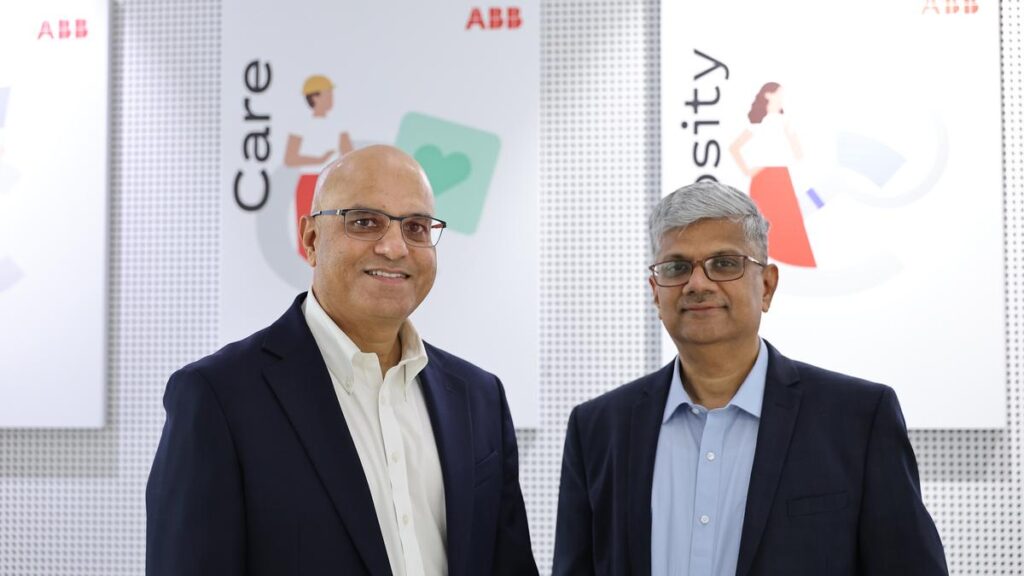
Contrary to fears that automation will lead to job losses, especially among lower-skilled workers, high-precision engineering firm ABB India has found that automation has not only allowed it to substantially increase its workforce in India, but also to employ lower-skilled workers and train them, the company’s CEO and managing director Sanjeev Sharma said in an interview.
Further, the company has committed to invest $75 million (around ₹708 crore) in India over 2026 and 2027 to fuel its organic expansion in the country, with a new focus on Tier-II and Tier-III cities, ABB India’s managing director-designate T. K. Sridhar said during the joint interview. Mr. Sridhar will take over as managing director in January 2027.
The need for lower skills
“It’s been a very interesting change with technology,” Mr. Sharma said at the company’s headquarters in Bengaluru. “If you look at our plant in Nelamangala (Bengaluru), where we manufacture switchgear, it’s a fully automated operation with a lot of robotics and very young people working on the desk to manufacture.”
“In the same factory, a few years ago when we hadn’t done that much automation, we required very skilled people,” he added. “But now, with automation and the guiding screens in front of each operator, we are able to bring very young people and train them very quickly to perform that complex job.”
Mr. Sharma explained that, with enhanced automation in ABB’s factories, the need for skilled labour has actually gone down. He added that while a worker’s departure used to delay hiring a replacement due to the need for skilled workers, that delay has now substantially reduced.
“Most of them are youngsters, young girls,” Mr. Sharma said. “Even if you are using a screwdriver, the screwdriver has sensors, it knows exactly how much torque to use. So, the device will move only if you put in the right torque.
“There are interlocks so that you are sure of the quality, but at the same time, the younger people with relatively less skills are able to be deployed,” he added.
He also explained that the speed and precision enabled by automation have helped the company to grow its operations in India and thereby also increase its employment. ABB India saw its employment grow 57% from around 7,000 workers in 2021 to more than 11,000 in 2026.

Investing in India’s hinterland
According to the company’s data, its revenue has nearly doubled to around $1.4 billion in 2025 from $730 million in 2021. Further, about 88% of its business comes from within India, and 12% from exports.
Of the $75 million the company has committed to invest over 2026 and 2027, $22 million will go to its Nashik electrification plant, $21 to its motion plant in Peenya in Bengaluru, $14 million to its electrification and automation plants in Nelamangala, $12 million in its electrification research and development lab and office in Hyderabad, and $6 million in its motion plant in Vadodara.
“On average, over the last 5-6 years, our capital expenditure has been ₹300 crore in India every year,” Mr. Sridhar said. “I think that investment journey will continue, because you need to build factories as the demand is robust. So, we keep modernising our factories.”
“Organic expansion is very interesting for us because it definitely gives us better return on investment,” he added. “We believe that is a journey that will continue.”
Mr. Sridhar added that the company has also changed its focus to also look at Tier-II and Tier-III cities in India.
“When we started this journey 8-10 years ago, we saw that we were all focused on customers in the bigger metros,” he explained. “Even our sales offices were structured around that. Then we realized that the future market is not going to stay there but is going to spread across the other parts of the country, so then we created cluster offices, which were more interesting to address the hinterlands of India.”
What is driving this, he said, was the rise of industries in smaller cities.
“I think there’s a new age of entrepreneurs who have started to build their own capacity over there and go into the industries and that’s helping us grow in these areas,” Mr. Sridhar said.
Published – November 05, 2026 05:40 pm IST
#Automation #boosted #employment #hiring #lowskilled #workers #India #ABB #chief