In July this year, India’s youth took to the streets over the NEET-UG paper leak, demanding accountability. The protests, which sprouted from Jantar Mantar in Delhi after a call from the Cockroach Janta Party, brought together thousands of young voices who refused to accept silence as an answer. Slogans were raised, many prominent figures came out in support, and instilled hope in the future of the nation.
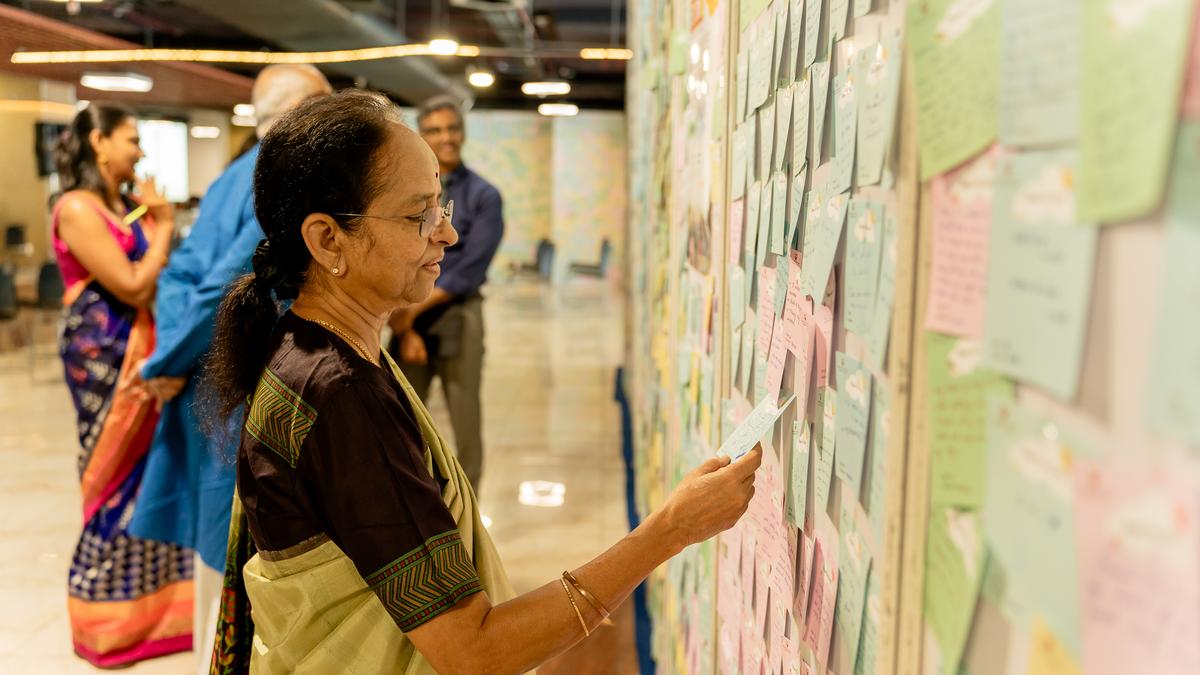
At a time of enormous social and economic change, when uncertainty about education and employment sits alongside the already difficult task of simply growing up, hope can be a precious thing. And sometimes, it needs a place to live. At the IIT Madras Research Park in Chennai, that place was a wall.

The Wall of Hope being put up by volunteers
| Photo Credit:
SCARF and Studio Vannam
Built from more than 20,000 colourful post-it notes, the Wall of Hope carries the thoughts, dreams, and purposes of young people. What began as an invitation to adolescents and young adults to write down their purpose in life became a nation-wide collection of messages of optimism.
The Wall of Hope is a youth-led initiative of the Schizophrenia Research Foundation (SCARF)’s Department of Youth Mental Health (YMH), born out of a simple question: what gives young people a reason to keep going?

Launched in October 2025 as a year-long campaign, the initiative invited adolescents and young adults to anonymously write down one reason for living — a dream, a person, a relationship, an ambition, or even something as ordinary as a favourite food or a pet. The campaign was designed to make conversations around distress and help-seeking easier.
“What struck me was, when I was looking through the posts, many of them spoke about family. I thought they would be more individual-focussed. But the fact that they recognised this and talked about the family and others as reasons for their good life, was pretty amazing,” says Dr Thara Rangaswamy, co-founder, SCARF.

GCC commissioner interacting with WOH
| Photo Credit:
SCARF and Studio Vannam
The idea was not to spell out to young people what hope should look like, but to give them the space to articulate it themselves. For SCARF’s Youth Mental Health team, which has been working with young people in schools, colleges and communities for several years, the campaign grew out of an understanding that conversations around mental health cannot always begin with a lecture or a list of advice.
“We’ve learnt over the years that when we want to engage with young people, we are only having a didactic conversation. When we are teaching them something, because it falls in as advice, they turn off. It needs to be a two-way street,” says Dr Pavithra Arunachaleeswaran, consultant psychiatrist and research lead, Department of Youth Mental Health, SCARF.
The Wall of Hope was not conceived simply as a mental-health awareness campaign, but as something young people could own. Over the course of a year, the initiative travelled through colleges, schools, urban settlements and communities, with young volunteers taking the idea into their own spaces.

Judge N Anand Venkatesh with the youth volunteers
| Photo Credit:
SCARF and Studio Vannam
“It was completely youth-driven, where each young person owned up to it. What SCARF did was just to stay there and provide support in the background. I think it gives them a lot of support when there’s someone they can go back to. And that empowers them, is what we learnt through this campaign,” Pavithra says.
The wall was never meant to be the destination. It was an entry point that could lead somewhere deeper. A young person writing about their parent, a dream, relationship or even their favourite food as a reason for living might help them begin thinking about what sustains them. On the other hand, someone else might recognise that they are struggling and need help.
“We normally don’t think on those lines. We just go from day to day, so that way this was a good exercise,” says Dr Thara.
Published – October 07, 2026 04:47 pm IST
#Wall #Hope #Chennais #IIT #Madras #Research #Park #space #young #voices
