Long before someone has entered the apartment, the development has already told them a great deal about what kind of place it is. That is why the first 60 seconds of arrival deserves far more attention in residential design than they traditionally receive.
This is becoming particularly relevant as the Indian homebuyer evolves. Knight Frank’s ‘Beyond Bricks: The Pulse of Home Buying’ report found that 37% of respondents identified upgrading to a better home as their primary reason for buying.
A transition
More importantly, it creates a psychological transition between the city outside and the environment within. Urban life is characterised by traffic, noise and constant stimulation. A residential community should begin to reduce that intensity from the moment one enters. Traffic slows. Landscape becomes denser. Buildings reveal themselves gradually. Pedestrian spaces begin to take precedence over vehicles.
In larger communities, it is important to plan entrances around peak-hour movement, road connectivity and internal circulation. Separate entry and exit flows can reduce bottlenecks and make one’s arrival feel calmer and easier to navigate.
Premium residential
There is sometimes a temptation in premium residential development to interpret a “grand entrance” literally and focus disproportionately on the gateway. But arrival is not one architectural moment. It is a sequence.
This becomes particularly important in large residential communities that function almost like small neighbourhoods. Residents, school buses, cabs, and visitors may all be moving through the development at the same time. Good master planning anticipates this complexity. Separate entry and exit points, designated visitor and service routes, intuitive drop-offs and underground parking can remove much of that everyday friction. Taking cars below ground can be especially transformative because it allows valuable surface area to be reclaimed for people, pathways, landscape, boulevards and community spaces.
Other factors
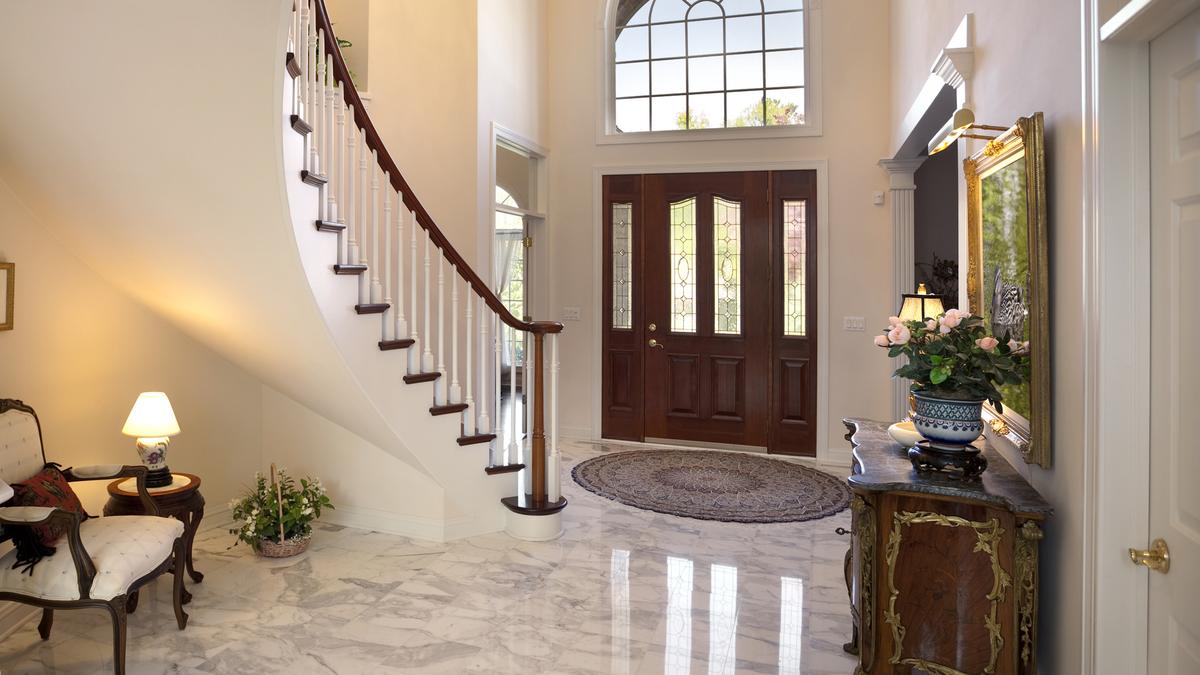
Historically, many residential lobbies were treated largely as circulation spaces: enter, wait for the lift and leave. But volume, natural light, materiality, acoustics, art and landscape all influence how a resident experiences this space.
A double-height lobby, for instance, is not valuable merely because it looks luxurious. Its proportions can create a sense of openness and decompression after moving through the city. Natural light and greenery can soften the environment, while thoughtfully chosen materials and artwork can give the building identity.
The lobby can also occupy an interesting space between public and private life. Comfortable seating allows residents to meet a neighbour, wait for a taxi or speak briefly with a visitor without taking every interaction into their home.
From product to experience
This shift in design thinking is happening alongside a broader change in India’s residential market. JLL Research found that homes priced above ₹1 crore accounted for 71% of residential sales across the top seven cities in H1 2026, compared with 62% a year earlier.
As buyers move up the value curve, expectations rise with them. Premium can no longer be defined only by square feet, fittings or an amenities checklist. It has to extend to the entire experience of living in the development. That includes details that may not always receive the largest space in a brochure, but they have an enormous influence on how a development feels over time.
The strongest arrival experiences do not rely on spectacle. That is the paradox of good design: enormous thought can go into creating something that ultimately feels effortless. For developers, therefore, the first 60 seconds should never be an afterthought. Before one experiences the home they bought, they experience the world designed around it.
The writer is CEO, Assetz Property Group.
Published – September 25, 2026 04:48 pm IST
#seconds #matter #residential #design
