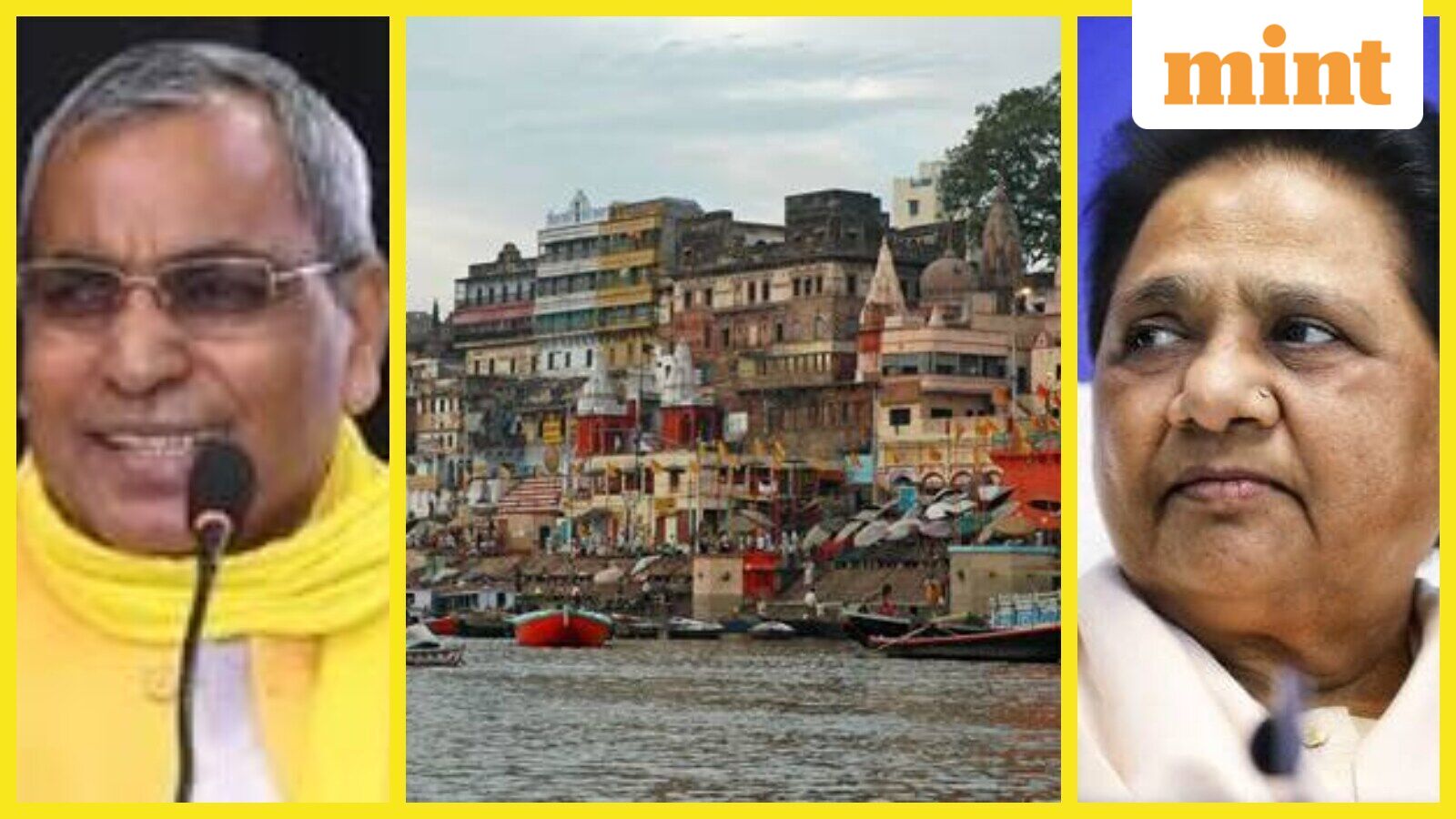
Suheldev Bharatiya Samaj Party (SBSP) chief and Uttar Pradesh Cabinet Minister Om Prakash Rajbhar on Monday revived the debate over dividing India’s most populous state, calling the split of Uttar Pradesh into four smaller states inevitable.
Speaking with ANI, Rajbhar, an ally of Bharatiya Janata Party-led National Democratic Alliance (NDA), added that making a leader from the Rajbhar community the Chief Minister of the proposed Purvanchal state would be a non-negotiable condition for any future electoral alliance.
What did Rajbhar say?
Rajbhar cited demographic strength and significant vote share across the eastern belt to back his political claim in support of his argument.
“The division of the state is inevitable. When the state is divided—encompassing regions like Purvanchal, Madhyanchal, Bundelkhand, and Harit Pradesh—if you look at the area where we are currently seated, starting from Ambedkar Nagar, the Rajbhar community holds the largest vote share across the entire Purvanchal region,” Rajbhar said.
The idea of dividing India’s most populous state fits into a blueprint that has been debated in UP politics for decades. “Therefore, for any party entering into an alliance, it will be a predetermined condition that the Chief Minister of the future Purvanchal state will be from the Rajbhar community,” he said.
While Rajbhar’s remarks have triggered fresh debate ahead of the 2027 UP Assembly elections, he is not the first to propose such a restructure.
Ambedkar’s push
Rajbhar is not the first political leader from UP to speak about the four divisions. It is, in fact, quite an old proposition over whether Uttar Pradesh, the country’s most populous state, could be reorganised into smaller states.
In 1955, BR Ambedkar had suggested splitting Uttar Pradesh into three smaller states in his book Thoughts on Linguistic States.
Usually, the proposal refers to having four broad regions in Uttar Pradesh. Western UP or Paschim Pradesh, Central UP or Awadh, Bundelkhand, and Purvanchal. Though not a formal demarcation, but UP is usually defined as a combination of these four geographical and socio-cultural regions.
Under the proposal, Purvanchal – covering Eastern Uttar Pradesh – is marked by high population density and faces challenges of unemployment and migration, but holds significant political sway.
Madhyanchal or Awadh Pradesh, covering the central region, would be anchored by major administrative and economic hubs like Lucknow and Kanpur.
Bundelkhand in the south is a resource-strained, drought-prone zone whose development depends heavily on major water infrastructure projects. Harit Pradesh or Paschim Pradesh, comprising Western Uttar Pradesh, has rapid economic growth potential due to its proximity to the National Capital Region and strong agricultural infrastructure.
Mayawati’s Assembly move
It was during the term of BSP chief Mayawati as UP chief minister in 2011 when a formal move towards dividing Uttar Pradesh was announced. Mayawati’s government passed a resolution in the Uttar Pradesh Assembly proposing to divide the state into Purvanchal, Bundelkhand, Awadh Pradesh and Paschim Pradesh.
The state government had then argued that Uttar Pradesh’s vast size often made administration difficult and that smaller states could lead to better governance.
The resolution was sent to the Centre. It was however not pursued further by the Mulayam Singh Yadav-led Samajwadi Party (SP) government, which came to power in 2012.
What are the four regions?
Paschim Pradesh: The region informally comprises 28 districts and parts of several others. It covers districts including Saharanpur, Muzaffarnagar, Shamli, Baghpat, Meerut, Hapur, Bijnor, Moradabad, Rampur, Amroha, Bulandshahr, Sambhal, Bareilly, Badaun, Pilibhit, Shahjahanpur, Aligarh, Etah, Farrukhabad, Mathura, Hathras, Agra, Firozabad, Gautam Buddha Nagar and Ghaziabad, as well as parts of Kasganj, Kannauj and Mainpuri.
Awadh Pradesh: This is the central part of UP, covering 17 districts, including Lucknow, Unnao, Rae Bareli, Sitapur, Lakhimpur Kheri, Hardoi, Barabanki, Ayodhya, Sultanpur, Amethi, Bahraich, Shravasti, Gonda, Balrampur, Mainpuri and Etawah, along with parts of Kasganj, which would make up the proposed state.
Lucknow, the state capital, lies at the heart of this region.
Bundelkhand: This would cover Jhansi, Jalaun, Lalitpur, Hamirpur, Mahoba, Banda and Chitrakoot districts. It also extends into neighbouring Madhya Pradesh, complicating proposals for a separate Bundelkhand state.
Purvanchal: The state, if formed, would broadly cover 23 districts — Prayagraj, Varanasi, Jaunpur, Ghazipur, Ballia, Azamgarh, Mau, Gorakhpur, Deoria, Kushinagar, Maharajganj, Sant Kabir Nagar, Siddharthnagar, Basti, Ambedkar Nagar, Mirzapur, Sonbhadra, Chandauli, Kaushambi, Fatehpur, Pratapgarh, Kanpur Dehat and Kanpur Nagar.
Why have four states?
Those who favour the division say that smaller states are easy to administer .
Uttar Pradesh is geographically vast, and its regions differ considerably in their economic structures, geography, agricultural patterns, migration trends and historical identities. At present UP has 403 Assembly seats, highest in any state of India.
Remember Uttaranchal, which later became Uttarakhand, was carved out of Uttar Pradesh in 2000.
Those who oppose argue that statehood alone would not resolve development disparities. They often cite financial and institutional complications involved in creating new states.
What is the process?
The division of states is carried out in accordance with Article 3 of the Constitution.
Article 3 provides that Parliament may, by law, form a new state by separating territory from an existing state, or by uniting two or more states or parts of states. It can also increase or diminish a state’s area, alter its boundaries, or change its name.
A Bill for this purpose cannot be introduced in either House of Parliament except on the recommendation of the President who refers the Bill to the legislature of that state for expressing its views within a specified period.
The division of the state is inevitable.
Article 3 requires the state legislature’s views to be sought, but not its consent. The final power to create a new state rest with Parliament.
#divide #Uttar #Pradesh #states #ideas #history #Mayawatis #plan #Rajbhars #push #poll #season #explained
