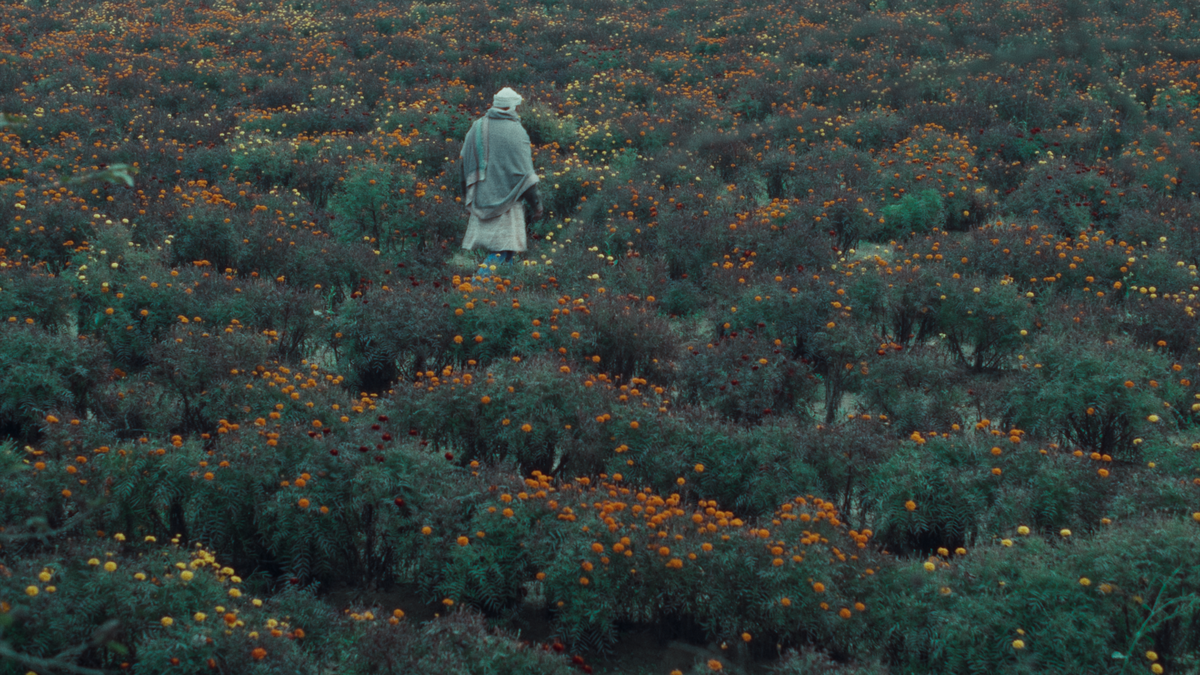
A haunting, fog-draped requiem for a vanishing way of life, young Ankur Hooda’s Khal Bachhda (The Calf Doll) allegorically critiques what is sacrificed on the altar of progress. After winning international acclaim at its world premiere at the Copenhagen International Documentary Film Festival, the independent film in Haryanvi is one of eight selected for the prestigious documentary competition at the upcoming 70th BFI London Film Festival.
Set in Dayalpur village near Faridabad, the hybrid, para-fiction drama breathes through Satbir Singh Hooda, an elderly retired teacher. When his only cow delivers a stillborn calf and stops lactating, his quiet world tears open. Desperate to stave off losses, the educated farmer is left with no choice but to descend into a forbidden rural ritual where a lifelike doll from the skin and body of the dead calf is crafted to trick the grieving mother into producing milk.
As he stitches the calf back together, deeper anxieties about identity and the exploitation of the aging peasantry surface. Their children have moved to the cities, leaving them at the mercy of profit-seeking middlemen, armed with oxytocin injections, urging farmers to liquidate their assets and tear off their emotional bond with the livestock. Skinning the calf becomes a visual metaphor for this mounting desperation to keep their lives and livelihoods lactating.

Stills from The Calf Doll
| Photo Credit:
Special Arrangement
“The practice of calf doll still exists. In northern India, it is mostly done with buffaloes, partly because of religious beliefs around cows and also a local belief that cows are smarter and a calf doll usually does not work on them. It is a banned practice, but a cost-effective way for the villagers to keep milking the cow after a calf’s death. Interestingly, while traveling with the film, I also discovered similar practices in some African and South American cultures. I found that quite fascinating,” relates the 25-year-old, who has cast his grandparents as themselves with a couple of actors. “Casting them felt completely instinctive as the film emerges directly from their lived experiences.”
Influenced by Turkish legend Nuri Bilge Ceylan, the self-taught filmmaker’s imagery of rural life and relationships is shaped by devouring Premchand and Chekhov. “The film began with a simple image that stayed with him. “One winter noon in my village, I saw my grandfather sitting alone, gazing at the neighbour’s cow with a childlike desolation after having sold his own herd reluctantly. An element which had been his lifelong companion, an important one after retiring as an English lecturer especially. It made me wonder what is left of you when you no longer possess what has defined your entire life? That question became the seed, and I wanted to enquire about this metaphysical dilemma…”

Ankur Hooda
| Photo Credit:
Special Arrangement
For his grandfather, Ankur says, the cattle were never simply livestock. “They were work, companionship, routine and perhaps most importantly, a part of who he was. The film grew out of my attempt to understand that relationship and connect it with the larger realities of the region.”
Reflecting on the role of private dairies and migration, Ankur says in Haryana, private dairies have massively shifted the older relationship between farmers and their cattle, turning livestock more into an economic calculation. “I have heard about several cases where the dairies intentionally kill calves to save costs of raising one and use illegal oxytocin injections instead, which are much cheaper. All of this is somehow linked with migration that created a gap between supply and demand of milk, which the dairies jumped to fill in.”
Younger people, he says, are leaving the villages for cities, while the older generation is left to manage the fields and cattle on their own. “As this way of life becomes harder to sustain, the animals slowly disappear from the household too.”
Ankur finds Amit Dutta’s writings on cinema and Gurvinder Singh’s Anhey Ghore Ka Daan very close to his heart. It gives us a sense of why the rural landscapes in the film border on the magical, and what he means when he says he had no real plans for what the film would become when he first noticed change in his grandfather. “That was the whole experiment I wanted to conduct: if one can truly discovera film in real spaces without deciding anything in advance rather than shootingone already written on paper.”

Stills from The Calf Doll
| Photo Credit:
Special Arrangement
Ankur says he consciously abandoned the idea of a script and intuitively improvised everything while interacting with the real spaces and characters of his village every day. “We weren’t thinking about whether we were making fiction, documentary or a hybrid, or even whether it would be a short or a feature. I was essentially running a personal experiment in spending time in these rural spaces along with my film comrades.”
He underlines that no producer, institution, or professional setup told them what the film should be, which helped them discover it freely. “More than a challenge, the lack of money gave us immense freedom. That cannot be bought.”
After a failed attempt at making a feature a year earlier, he wanted to find more intimate ways to approach cinema through unorthodox techniques. “It is shot in DIY fashion with the help of villagers, friends, and family. We shot it on (DOP) Anish (Sarai) and (creative producer) Achal’s (Mishra) small personal DSLRs, and borrowed basic lenses and sound recorders from friends.”

Stills from The Calf Doll
| Photo Credit:
Special Arrangement
Due to a lack of money, on the suggestion of Anish, Ankur shares that they decided to make film lights and rigs themselves at home, along with major help from his grandmother with basic tungsten bulbs, lamps, papers, and wood sourced from the local bazaars, and were able to shoot the entire film on an impossibly small budget. “But we were adamant about not letting that reflect on the screen… and North Indian winters proved to be a natural ally.”
For Ankur, the film is a prologue to a longer exploration of the region through a trilogy. “I’m interested in quietly documenting that dissonance between people and landscapes that are slowly fading as inevitable modernity moves in, and preserving some of those stories before they disappear with them.”
Published – September 15, 2026 04:35 pm IST
#Vanishing #bonds #Ankur #Hoodas #TheCalf #Doll #exposes #price #progress
