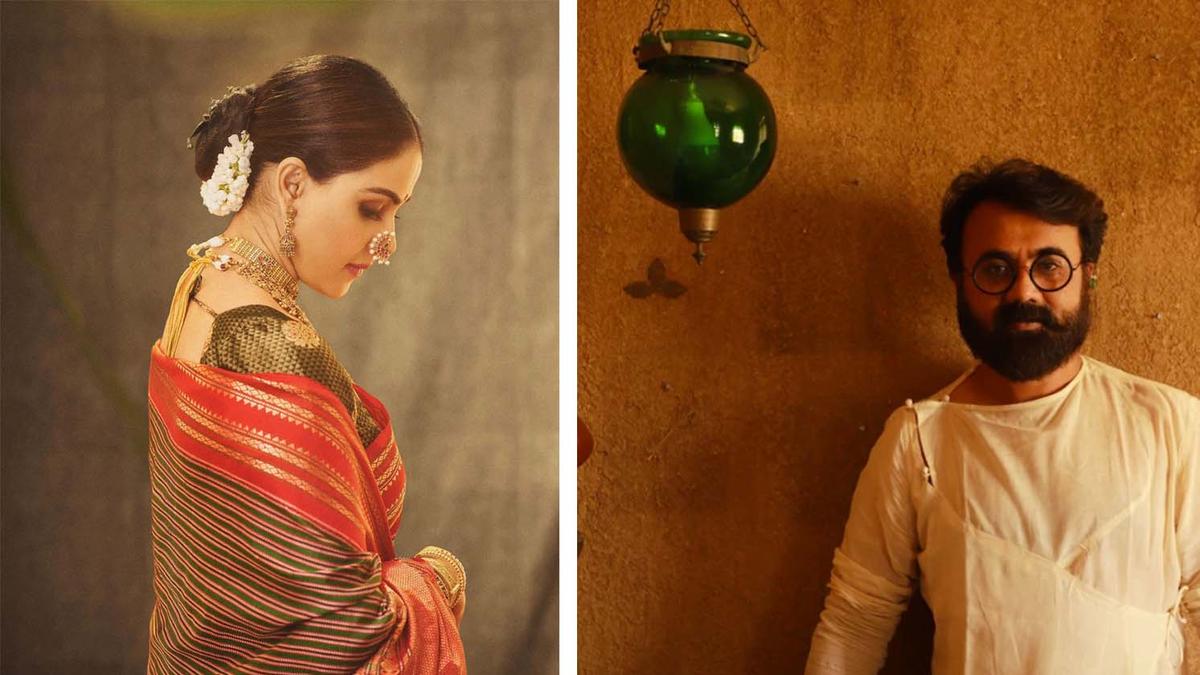
Dakkhan ko Chira (Weaves of Deccan), a two-day exhibition showcasing saris, paintings and jewellery of the western Deccan region, will be held at the Crafts Council of Telangana, Hyderabad.
Textile researcher and designer Vinay Narkar will present nearly 25 Maratha-style paintings, 100 saris and jewellery inspired by the architecture of the Maratha and north Karnataka regions. The collection is the result of a decade of research.
“The word revival is now overused,” says Vinay. His interest in the region’s textiles goes back to his childhood in Sholapur, where he remembers women wearing Ilkal saris. “Since Sholapur is on the Karnataka-Maharashtra border, it has a confluence of cultures, with influences from Karnataka, Maharashtra and Telangana. You see this in the cultural, linguistic and textile traditions.”

That early curiosity led him to explore the textiles of the western Deccan, alongside Maratha folk literature and paintings for cultural and textile references.

A Day at the Wada
| Photo Credit:
Special Arrangement
Maratha miniature paintings became a key part of his research. He studied how their aesthetics evolved through the 17th and 18th centuries, absorbing influences from both North and South India. His studio later commissioned Maratha-style paintings depicting the cultural life of the western Deccan.
“Textiles are the central theme in some paintings,” he says. A Day at the Wada, for instance, depicts life inside a Maratha mansion, with a 200-year-old Paithani at its centre. Vinay hopes the paintings will serve as visual documentation of the textiles, jewellery and architecture of the period for future researchers.
His parallel research into textiles and paintings led to an Ilkal-inspired collection a decade ago. At the time, he recalls, most Ilkal saris available in the market were rayon blends or made from low-quality silk. “It was tough to find pure cotton Ilkal saris.”

He began working with silk Ilkal saris for an elite clientele. “Traditionally, Ilkal saris were patronised by rural women, but I thought there was scope to make them aspirational.”
While traditional Ilkal saris were known for white stripes on a deep-red pallu, Vinay introduced contemporary checks, tweaking the design without losing its traditional character.
His work with weavers in Gadwal and Amarchinta in Telangana further revealed similarities in the design language across the western Deccan.
This research also led his studio to reintroduce traditional motifs including the crescent moon or Chandrakala, Motichoor and several varieties of checks from Maharashtra.

The two-day exhibition will feature saris, jewellery and paintings
| Photo Credit:
Special Arrangement/ Sushant Shinde
“The moon motif was widely used in older saris. I found several visual references, and Maratha folk literature mentions different Chandrakala patterns,” he says. Some were reintroduced into his collections, while contemporary celestial events provided new inspiration. The alignment of Venus and the crescent moon in March 2022, for instance, inspired the Chandrasakhi motif.
Other saris feature the rui phool border, a woven pattern resembling an eight-petalled flower that was once common in western Deccan handlooms. His experiments also brought back the Ram-Sita pallu and paisley motifs.
Another focus has been Motichoor, traditionally used as a filler between borders or within a pallu. Made up of woven dots, dashes and lines resembling crushed pearls, it was rarely the star of a design. Vinay wanted to change that.
His saris use motichoor as horizontal lines between the familiar Dafla checks of Maharashtra and north Karnataka. “It is traditionally a double-check pattern with two white lines and a central red line. When western Deccan weavers experiment with Motichoor vertically and horizontally, it transforms the textile from classic and humble to luxurious,” he says.

Vinay points out that long before motifs became central to textile design, checks and lines served as ornamentation. “Every variation in check pattern has a unique nomenclature in Maharashtra. We found several combinations and have consistently tried to recreate them.”
The exhibition will feature at least 10 types of checks, more than 25 designs and 15 types of borders. Vinay also highlights the stripes on the pallus of the pastoral Ganderi communities, which traditionally served as markers of identity.
While checks are integral to Deccan textiles, he distinguishes them from Chettinad checks. “The colour palette of Maharashtrian checks is more mellow, and the checks are smaller, with finer lines.”
Dakkhan ko Chira (Weaves of Deccan) will be showcased on August 14 and 15 at CCT Spaces, Crafts Council of Telangana, Banjara Hills, Hyderabad.
Published – August 12, 2026 02:59 pm IST
#Dakkhan #Chira #Hyderabad #exhibition #explores #textile #heritage #western #Deccan
