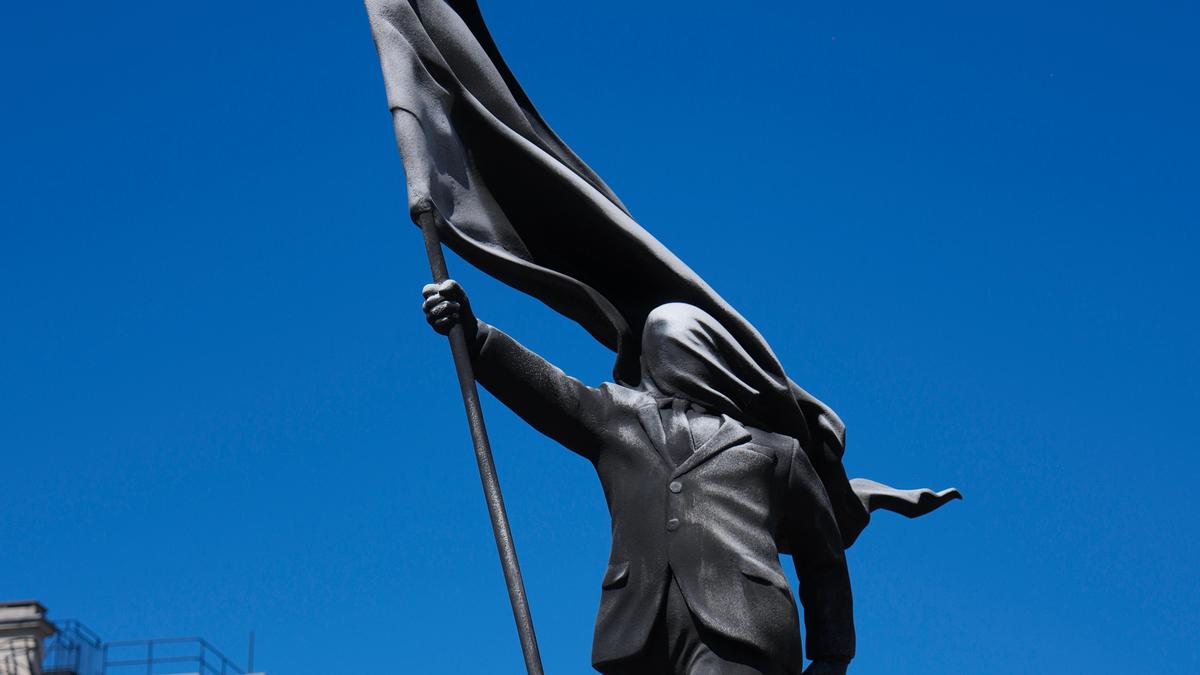
The sun was still soft and faint from rising when Londoners, in the midst of their morning walks and commutes, near Waterloo Place (a street known for its fantastic collection of statues), were offered an artistic surprise. Even when viewed from a distance, the silhouette, its outlines, and the visual message were stark.
A new statue, erected overnight without anyone’s notice. Atop a plinth it stood; a proud man marching forward, in a well-tailored uninteresting suit, holding a huge flag up in his right hand.
The problem, though, is that this proud man is blinded by his wind blown flag. It literally covers his face, and thus his next step, unknowingly, is off the plinth on which he is standing. The signature of the artist spelled ‘Banksy’ — anonymous and one of the most popular “artivists” of our time.

Banksy’s sign at the base of the plinth.
| Photo Credit:
AP
Artivism
The word artivism, as you may immediately note, is a portmanteau word combining “art” and “activism”. The meaning is, as suggests, art as activism or art as a form of protest.
The philosophy of the word is not something new and it is in the soul of anyone making art (say, simple things like when you write poem about how people should turn to each other instead of hating or larger things like making a succinct statue, like Banksy here, about the effect of blindly following a cause or dressing up as a coral reef to raise awareness about dying corals). Even before the existence of the word artivism, artists have combined art and social activism together.

“Support” sculpture by Lorenzo Quinn in Venice, highlighting the impact of climate change and rising sea levels.
| Photo Credit:
Wikimedia Commons
As a movement in the modern sense and genre by its own right, artivism bloomed during the era of the avant-garde when art was pulled out of the box as a liberation and challenge to conventional thinking. Art was used to challenge social norms, resist injustice, and promote awareness to issues that the spectator often forgets.

Rebel art
In society, there is quite often a misunderstanding floating around about the essence of art, which is oddly keen on isolating and opposing it against other logical enterprises. You must have felt a layer of it when, say, you heard someone say science has no connection to art. Art and science are often regarded as the north and south poles with no connection to one another. Likewise, art and politics are polarities with a line drawn between them. In our way of life, art can never be a pole. It is always functionally interdependent with the things we do, whether it be science, technology, politics, or anything else.

The Red Rebel Brigade.
| Photo Credit:
Wikimedia Commons
Fun Fact
Since the ages of the ancient empires, art has intertwined with politics. It functioned as a tool of soft power. Art was commissioned or gifted to show dominance, to persuade, to make things legit, etc.
Street art and subversion
Banksy’s statue of the man blinded by his flag is the continuation of a politics of intervention and raising awareness where art becomes witness to a society’s crises. Banksy began in the 1990s as a graffiti artist, popping up on the streets.

A graffiti by Banksy.
| Photo Credit:
Getty Images
Street art, by virtue of being profoundly subversive, is one of the most historically visible forms of artivism. It made people think, with the same vigour as how absurd theatre and avant-garde did during the post-world war years.
First, it was just graffiti. Then came murals, mixed media, guerilla art developing street art as a whole subculture of art. Street art was rebellion, a way to voice out frustrations against oppressive things in life. India’s mural culture from the 1990s simultaneously brought out defiant localised graffiti. Art connects us through a message, an expression, like how the Banksy statue instantly connected with myriad people across the globe. Art knows no borders and it speaks a universal language.

Graffiti art of Spiderman in Dharavi slum, Mumbai.
| Photo Credit:
Getty Images
World-renowned French artivist JR (Jean-René), recognised for his large black and white portraits has, among his various projects, done a monumental celebration of women with the project called “Women are Heroes” out of realisation that women are often primary victims of assault, war, and politcal or religious fanaticism. A brilliant example of street art and subversion.

“Women Are Heroes” by JR in Brazil.
| Photo Credit:
Thiago Trajano/Flickr

“I would like to bring art to improbable places, create projects so huge with the community that they are forced to ask themselves questions.”JRFrom an interview of JR published in Beaux Arts magazine
Fear of art
Thankfully, the Banksy statue is still up in London’s Waterloo Place. This isn’t always the case. There’s an odd fear perpetuating around artivist art such that when it pops up, it likely would be removed. Why so afraid? The endangered artivists and their art walk a dangerous tightrope.

An art installation by Chinese artist Ai Weiwei that consists of life vests worn by refugees bound to the columns of the concert house next to a statue at Gendarmenmarkt in Berlin, Germany. The life vests were among the thousands discarded by migrants and refugees after they crossed the sea from Turkey to Greece.
| Photo Credit:
Getty Images
None better than Ai Weiwei to know what it’s like to constantly befriend danger. Ai Weiwei is a Chinese artivist and dissident who has lived a deeply dangerous life, surviving childhood exile, police assaults, etc. His art, shaped by his own experiences with being constantly watched, authoritarianism, etc., takes a stance on human rights and being democratic. He is a very funny and playful guy who aces dark satire. In 2012, Weiwei wearing a bubblegum pink shirt, black coat, and hands cuffed, danced to PSY’s Gangnam Style except it was “Caonima Style” he was going for. The word, as a Chinese pun, was used to mock China’s internet censorship. Not surprisingly and true to the video’s message, it was taken down and blocked by Chinese authorities.

Ai Weiwei (front) dances with his friends as they make a cover version of music video of “Gangnam Style” by South Korean singer Psy.
| Photo Credit:
Reuters
Cinema Novo
Cinema Novo was a film movement in Brazil that not only revolutionised cinema and filmmaking in Brazil but also the Brazilian culture. Revolt, social problems, history, myth, poetry, came together with vigour in films. It subverted the power dynamics and class prejudices in the society and film aesthetics became an “aesthetics of hunger” as described by director Glauber Rocha. Cinema Novo tells that a starved man getting angry is not a primitive or backward mentality. It is the logical effect of being under oppression and being always neglected by society.

Brazilian film directors Eduardo Escorel (holding camera), Glauber Rocha (pointing), and Roque Araújo (in hat).
| Photo Credit:
Getty Images
Art evermore
Faith Ringgold was an American artivist known for her socio-political narrative challenges through quilts.
Shilo Shiv Suleman is an Indian artivist who utilises magical realism and technology to convey social messages.
Benjamin von Wong is a Canadian artivist known for his environmental art that speaks against ocean plastics.
The Red Rebel Brigade is a performance activist troupe advocating and raising awareness for climate crises.
Guerilla Girls is an anonymous group of female artists fighting to expose racial and gender imbalances in society.
#artful #resistance #Artivism
