After posting modest sequential revenue growth, the Bengaluru-based company raised its full-year guidance, echoing optimism on future demand expressed earlier by larger peer Tata Consultancy Services Ltd and rival HCL Technologies Ltd.
Speaking during the company’s post-earnings press conference on Wednesday, Infosys’s chief executive Salil Parekh pointed to a robust large-deal pipeline and improving demand from financial services and energy clients, supported by AI-led work, that are underpinning the company’s confidence in growth beyond the current financial year.
In the October-December quarter, India’s second-largest IT services company reported $5.1 billion in revenue, beating the $5 billion estimate of a Bloomberg poll of 36 analysts. The revenue figure was up 0.45% sequentially and 3.24% on a yearly basis. Most of the growth came from healthcare companies, which make up less than a tenth of its revenue.
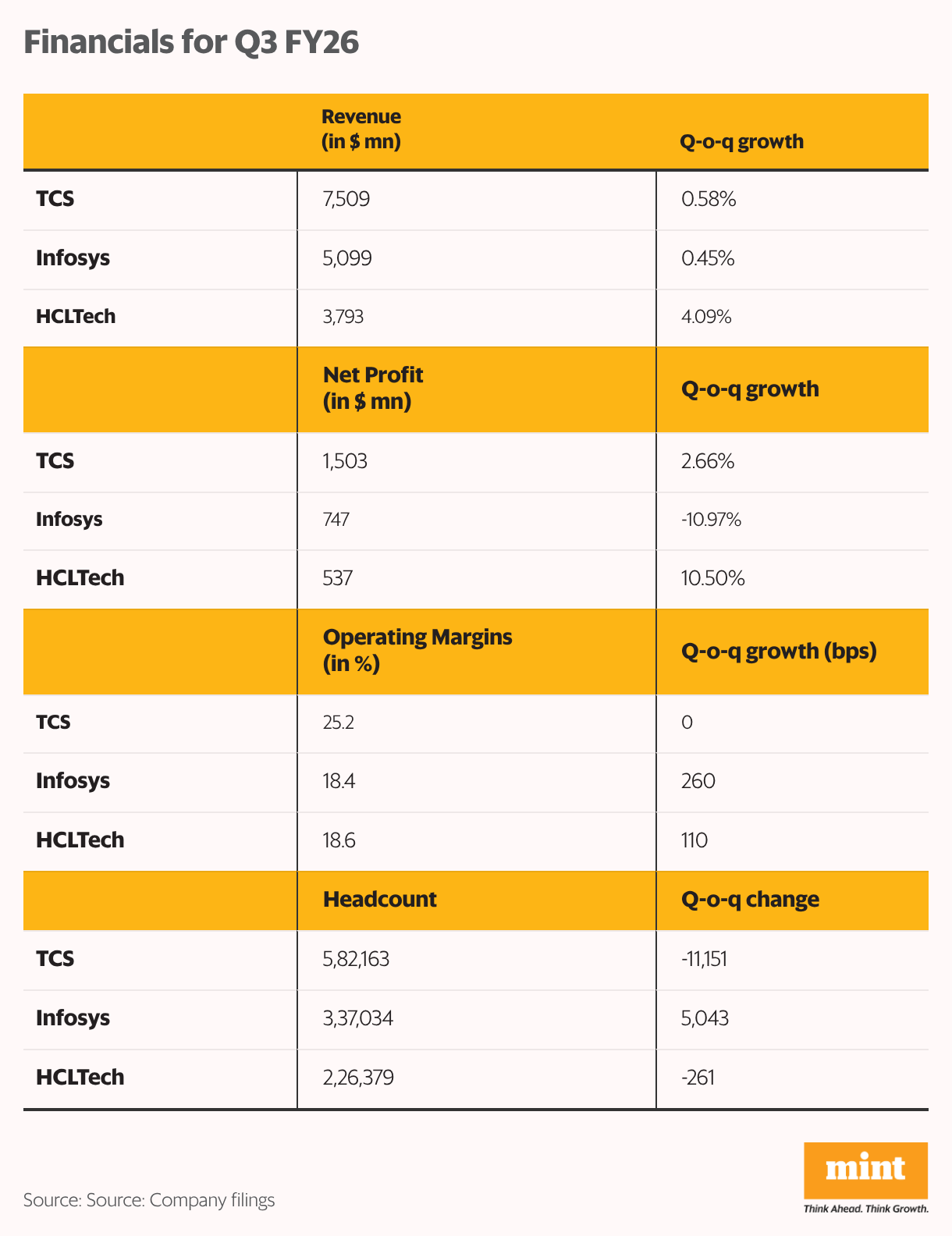
Its growth was the slowest among peers—TCS and HCLTech grew 0.58% and 4.09% on a sequential basis to end with $7.51 billion and $3.79 billion, respectively.
However, profitability took a hit, with operating margins falling 260 basis points sequentially to 18.4%, primarily because of the new labour codes introduced by the government, for which Infosys assumed an upfront cost of $143 million. To be sure, if the impact of the labour codes is discounted, the company’s operating margins expanded 20 basis points to 21.2%.
Peers TCS and HCLTech, too, incurred additional costs of $238 million and $109 million because of the labour codes, respectively. While HCLTech’s margins expanded 110 basis points to 18.6%, TCS’s margins were unchanged at 25.2%. The codes increase basic pay to employees and thereby raise statutory payouts such as provident fund and gratuity.
Infosys’s net profit, at $747 million, fell 10.97% sequentially and 7.1% y-o-y, and also fell short of a Bloomberg estimate by 31 analysts of $818.7 million.
The company now needs to report a revenue decline in the fourth quarter if it is to miss last year’s revenue of $19.28 billion.
At least one analyst gave Infosys results a thumbs up. “The top line is higher than we expected. The macroeconomic environment and rapid-build projects will accelerate for Infosys led by BFSI, retail and manufacturing clients,” said Amit Chandra, vice-president of HDFC Securities, adding that AI-led demand is expected to increase.
The company’s results were welcomed by the markets, with its shares rising 2.45% to $17.95 as of 6:05 PM during pre-market hours on the New York Stock Exchange.
Cautious optimism all around
Parekh remained cautiously optimistic about the future. “We are not seeing any deterioration, which is one sign, and we see overall, the macro environment seems to be where people are expecting maybe some interest rate cuts. We’ll see if that happens, especially in the US,” he said.
This caution was reflected in its revenue guidance for the full year, which it raised to 3-3.5% in constant currency terms, up from 2-3% in October. Constant currency does not take currency fluctuations into account.
This was in line with peer HCLTech, which narrowed its guidance to 4-4.5% for FY26, from 3-5% in the preceding quarter. TCS does not provide revenue guidance, but analysts expect it to report a full-year revenue decline.
Infosys’s demand commentary was similar to those echoed by peers.
“In Q2 (July-September 2025), we had called out that the overall demand environment is improving compared to Q1, so in Q3 that trend continues,” said K. Krithivasan, chief executive of TCS, in the company’s post-earnings conference call with analysts on 12 January.
He said the company is focusing on short cycle projects where decision making is faster. “We see a steady increase (in such projects), and you can see that reflected in our revenue that we are reporting, and this is across all industry segments,” Krithivasan said.
Meanwhile, HCLTech’s chief executive C. Vijayakumar pointed to continued uncertainty in the global market resulting in slow spending by clients. However, “the fundamental demand for technology as a driver for business transformation remains structurally intact”, Vijayakumar said during the company’s post-earnings press conference on 12 January.
He said discretionary spending is emerging in new pockets, and the company’s “focus is on proactively identifying where the new spending is occurring and targeting those opportunities”.
AI number not reported
Unlike its peers, Infosys has refrained from sharing AI-led revenue. TCS reported $1.8 billion in annualised revenue from AI as of December whereas HCLTech reported $146 million from advanced AI.
However, for now, Infosys expects more work from AI agents.
“There are places where the economics (of the deal) have changed completely from a client perspective. If you take legacy modernization here, if you use software agents, plus our expertise, plus our knowledge, the whole economics from a client perspective becomes much better, and that allows a lot of these projects which were not happening, to start happening,” said Parekh.
However, induction of these agents does not pose a challenge to hiring for now as the company re-iterated its stance of continuing campus hiring.
The company added headcount by 5,043 to end with 337,034 employees at the end of the third quarter.
In contrast, TCS and HCLTech cut headcount by 11,151 employees and 261 employees although much of the former’s decline was because of a layoff exercise in July last year where 2% of its workforce in middle and senior roles was given marching orders.
#Infosys #beats #revenue #estimates #sees #demand #recovery #gathering #pace