On July 24, 1897, in Kansas, a young girl was born to Edwin Stanton Earhart and Amy Otis Earhart. Little did they know she was destined to literally soar the skies with success. This is the story of Amelia Earhart — one of the most iconic aviators of the 20th Century.
Childhood in a nutshell
Born into a middle-class family in the United States of America, still recovering from financial depression, Amelia Mary Earhart grew up in a pretty unstable household. Her father’s job often demanded that they move from one place to another.
She and her sister, Grace Muriel Earhart, were brought up quite unconventionally by their mother compared to the then-societal stereotypes of American society. Quite often, Amelia was described as a ‘tom-boy’ as a child with an adventurous interest in exploring the neighbourhood, climbing trees, and even sledging downhill.

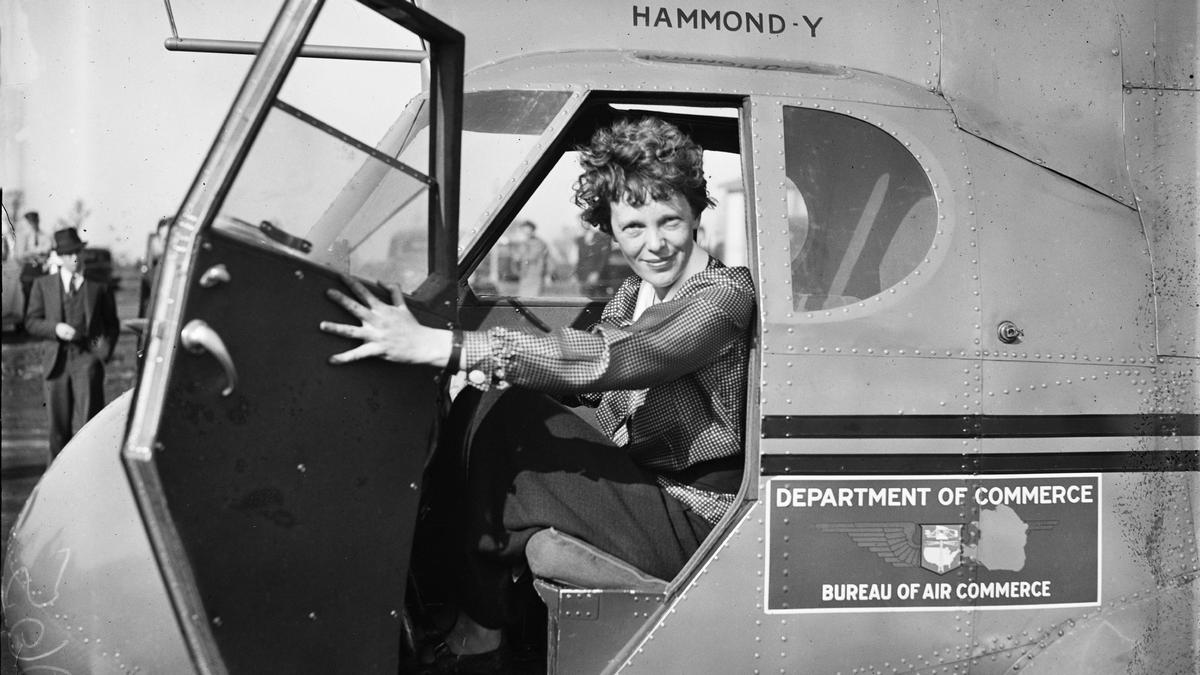
Amelia Earhart
| Photo Credit:
Wikimedia Commons
Amelia is said to have not given much attention to aeroplanes when she first saw them as a child and never showed much fascination with the metallic birds.
Soaring into adult life
Her first strong exposure to aviation came unexpectedly. During World War I, she volunteered as a nurse’s aide in Toronto, Canada, helping to care for wounded soldiers returning from the European battlefields. Near the hospital where she worked were makeshift airfields where pilots practised, and watching these flights stirred a fascination in her about aeroplanes. By 1920, when she finally took her first aeroplane ride, she knew she wanted to become a pilot herself.
Paying for flying lessons was not a cakewalk, and after a series of odd jobs, she obtained her pilot’s license from the Fédération Aéronautique Internationale after studying under pilot Anita “Neta” Snook. In 1923, she became one of around 16 women in the world to hold an international pilot’s license, making her a pioneer in the heavily male‑dominated field.
Since the start, Amelia started breaking records in the field of aviation. By 1922, she had reached an altitude of 4,300 feet, setting a women’s altitude record for aviation. These early achievements helped establish her reputation as a daring and skilled pilot, even though most people still regarded flying in itself as dangerous and impractical.
The breakthrough
In 1928, Amelia was invited to join a transatlantic flight (crossing between places on both sides of the Atlantic Ocean) as a passenger, not as the main pilot. The flight was intended to be the first woman‑crewed transatlantic crossing and made her famous overnight, even though she had not actually piloted the plane for most of the trip.
Newspapers in the United States celebrated her as “the first woman to cross the Atlantic by air,” and she became a media sensation. Amelia later emphasised how the media overstated her role, while recognising the importance that fame played in helping her advance women’s participation in aviation.
Proving your skills in a male-dominant field is a difficult task even now, let alone in the 1920s and 30s. Determined to prove her own flying skills, Earhart worked hard to fund and plan her solo transatlantic flight.

Amelia Earhart.
| Photo Credit:
Wikimedia Commons
In 1932, she took off from Harbour Grace, Newfoundland, in a single‑engine Lockheed Vega 5B. After flying for about 15 hours, she landed in a pasture near Londonderry (now Derry) in Northern Ireland, becoming the first woman to fly solo across the Atlantic Ocean. For this achievement, she received the U.S. Distinguished Flying Cross, one of the highest honours in American aviation, and also the Gold Medal of the National Geographic Society. She also became the first woman and second person overall to make a solo, nonstop transatlantic flight.
Breaking and setting records
Between 1930 and 1935, Amelia set at least five women’s speed and distance records. These flights helped show that women could handle the same gruelling challenges as male pilots. She also pushed the limits of what was considered possible in long‑distance aviation.
Beyond flying, Amelia is remembered for her role in advocating for women in the aviation and professional world. In 1930, she became the first woman vice president of the National Aeronautic Association, an important organisation that awarded and certified aviation records. She also helped found “The Ninety‑Nines,” an international organisation of female pilots, and served as its first president.
Giving people, especially girls and women, an inside look at the dangers and thrills of aviation, Amelia also wrote books and articles about her flying experiences. She edited the ‘Airwomen’s Association’ column for Cosmopolitan magazine and later joined the faculty of Purdue University as a career advisor and lecturer, where she encouraged women to pursue science, engineering, and technical careers.
Iconic and tragic
By 1937, Amelia Earhart had become one of the most famous women in the world. This also pushed her to take on an even more ambitious challenge — a flight around the globe along an equatorial route. Her plan involved covering more than 46,000 kilometres with the experienced navigator Fred Noonan accompanying her.
On June 1, 1937, they took off from Miami, Florida, in a twin‑engine Lockheed Model 10‑E Electra and stopped in South America, Africa, India, and Southeast Asia. By June 29, they had reached the Lae area, now Papua New Guinea, with only about 7,000 miles remaining.
On July 2, 1937, the pair left Lae, aiming to reach Howland Island — their refuelling point. They made several radio calls, indicating that they were having trouble with navigation and that they were running low on fuel. Their last confirmed radio contact came around 8:00 a.m. local time, when they spoke with the U.S. Coast Guard stationed near Howland to help guide them in. After which the pair vanished.
The search
President Franklin D. Roosevelt authorised a massive search which ended on July 18, 1937, without finding any conclusive trace of Earhart, Noonan, or the Electra. In January 1939, she was declared legally dead based on no evidence of survival. Multiple theories have come up post-legal declaration to date on what exactly might have happened to this aviation icon.
While conclusive evidence is still missing on the case, the legacy Amelia left behind opened a much bigger door to women aviators and, more importantly, popularised the fact that women can, in fact, shine in any field of their choice on land, the sea or up in the sky!
#Amelia #Earhart #soared #high #sky
