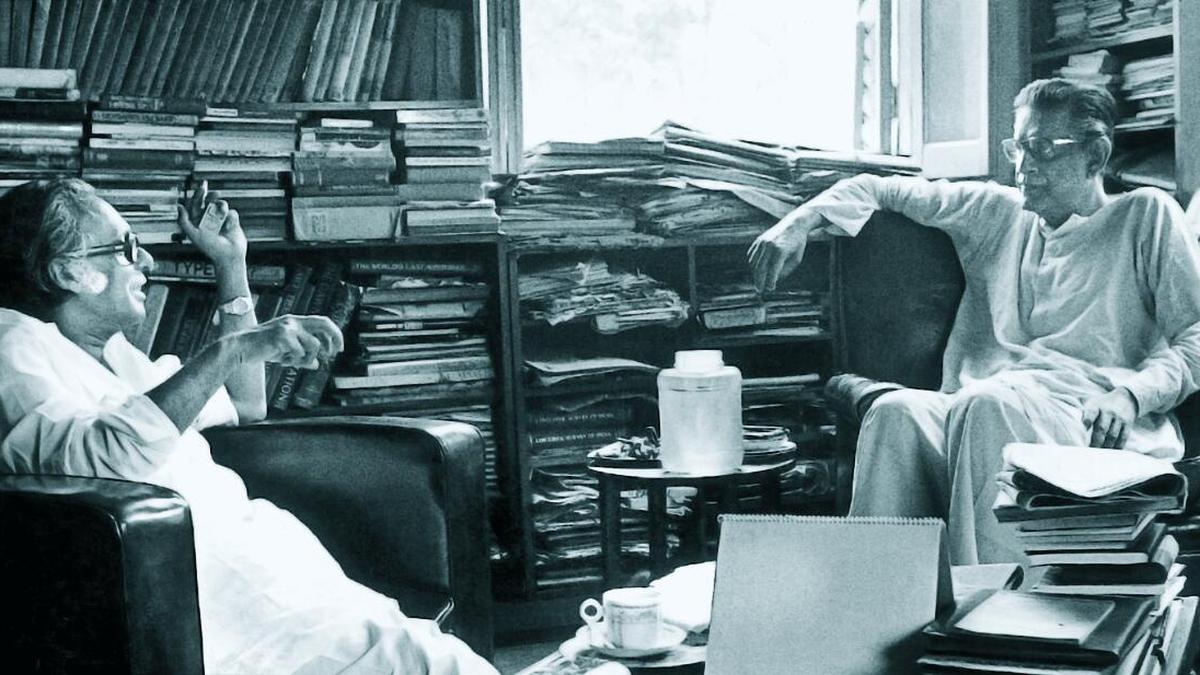
Ever wondered what the master storyteller, Satyajit Ray’s moments of trepidation looked like? Before calling “Action” or “Cut” on the sets of Pather Panchali, the maestro was often overcome by nervousness. Standing beside him was the one person who instinctively understood those silences. It was his closest friend, collaborator and art director, Bansi Chandragupta.
When the words caught in Satyajit’s throat, Bansi would fill in for him and call “Action” and “Cut”, easing him through the uncertainty. Their camaraderie extended beyond the art and craft of filmmaking. On the sets of Apur Sansar (1959), Bansi was the only person close enough to casually light the director’s cigarette, no one else would have presumed to. Years later, that small gesture lingers as more than an anecdote. It became a metaphor for a friendship that kindled one of the greatest bodies of work in Indian cinema – one friend quite literally keeping the flame alive for the other.

Bansi Chandragupta with Satyajit Ray
| Photo Credit:
Saibal Maitra / Facebook
Professor Sanjoy Mukhopadhyay, former Head, Department of Film Studies at Jadavpur University, inherited many of these stories through friendships of his own. He heard them over years of adda with legendary film editor Dulal Dutta, who edited every Satyajit Ray film from Pather Panchali (1955) to Agantuk (1991), and cinematographer Soumendu Roy, who assisted Subrata Mitra during the making of Pather Panchali. When Sanjoy served as Director and CEO of the Roopkala Kendro (2005–08), Soumendu joined the institute as a guest faculty in the Department of Cinematography, where the two spent countless evenings in conversation.
Lessons in ‘khistology’
Professor Sanjoy smiles before calling it perhaps the most fascinating friendship of them all.
Former Chief Minister of West Bengal Jyoti Basu and barrister and former Advocate General of West Bengal Snehangshu Acharya were almost the same age. After studying at Presidency College, Calcutta, they both went on to read law in England, where they qualified as barristers. Both would go on to become towering figures of the Left movement. Beyond politics lay a friendship sustained by irreverent humour, spirited adda and long evenings over Scotch.

Jyoti Basu
| Photo Credit:
Snehangshu Patronobish
Their friendship, however, began much earlier. When Jyoti was a student at Presidency College in the early 1930s, he and writer Samar Sen, then a fellow student, would finish classes at 4.30 in the afternoon before making their way to the lawns of Hedua, opposite Scottish Church College.
There, Snehangshu conducted what they jokingly called lessons in “Khistology.”

The subject had no place in any university syllabus. It was his own invention, and were playful lessons in Bengali slang, or khisti, delivered with remarkable creativity and wit. “Snehangshu was legendary for his command over colourful expletives, and both Samar Sen and Jyoti Basu counted themselves among his most devoted pupils. You couldn’t possibly conduct such classes in civil society today,” the professor laughs.
“Years later, when the two friends were in England, both developed a fondness for Scotch whisky. Snehangshu taught Jyoti that good Scotch should never be hurried and that it should linger on the lips before it is swallowed,” traces Sanjoy.
Both remain important figures in the 35 years of Left rule in Kolkata but their ardent friendship survives in memories of afternoon lessons on Hedua’s lawns and the slow appreciation of a glass of Scotch.
The café that built Indian cinema
“On Kolkata’s Hazra Road once stood a small café called Paradise Cafe where names that would go on to become the brightest luminaries in Indian cinema gathered when most were struggling and didnt have more than a buck or two in their pockets,” says Sanjoy.

Hrishikesh Mukherjee
| Photo Credit:
Special Arrangement
Paradise Café was modest in size but immense in the company it kept. During the 1940s, it became an informal refuge for members of the Indian People’s Theatre Association (IPTA), welcoming everyone from actor Prithviraj Kapoor, poet Kaifi Azmi, actor Balraj Sahni, to film director and editor Hrishikesh Mukherjee, filmmaker Mrinal Sen, film director and screenwriter Ritwik Ghatak and music director and song writer Salil Chowdhury.

Salil Chowdhury
| Photo Credit:
Special Arrangement
Someone always found the money for tea. “More often than not, it was Hrishikesh Mukherjee. He was earning,” Sanjoy says simply, “so naturally he paid the bill.”
Ritwik Ghatak, on the other hand, was famous among friends for borrowing money. Around those café tables they spoke endlessly about cinema, politics, literature and the lives they still hoped to live.

“They would often say, ‘We haven’t really done anything yet. There is still so much left to do’”, recalls the professor.
In August 1955, after Pather Panchali was released, Mrinal Sen and Ritwik Ghatak walked the half kilometre from Paradise Café to Basusree Cinema to watch it together. “Mrinal Sen watched it twice that day,” remembers Sanjoy.
Long before they became legends, they were simply friends sharing tea, unpaid debts and impossible dreams around the same table.
Beethoven, bottles and Bengal modernism
Professor Sanjoy explains that sculptor and painter Ramkinkar Baij and artist Benode Behari Mukherjee arrived at Shantiniketan’s Viswa Bharati at Nobel Laureate Rabindranath Tagore’s invitation.

Ramkinkar Baij
| Photo Credit:
Special Arrangement
Both were fiercely original artists and found themselves drawn towards European artistic traditions at a time when Shantiniketan’s Kala Bhavan remained firmly rooted in the Oriental school.

A sculpture by Ramkinkar Baij in Shantiniketan
| Photo Credit:
Sushanta Patronobish
Their curiosity did not sit comfortably with Nandalal Bose, then Principal of Kala Bhavan who frequently complained to Tagore that the two artists borrowed too freely from Western styles.

“Tagore, however, saw things differently. His own paintings had already departed from Visva Bharati’s prevailing aesthetic, absorbing influences from Europe in ways that distinguished them from the institution’s artistic traditions. It was perhaps for this reason that Tagore himself never held an exhibition of his paintings at Visva Bharati,” says Sanjoy.

Benode Behari Mukherjee
| Photo Credit:
Special Arrangement
Tagore urged Nandalal not to interfere and said, “They are young. Let them paint the way they wish.”
Freed by that faith, Ramkinkar and Benode Behari brought to Santiniketan ways of seeing that were almost unheard of there.
“Ramkinkar would often arrive at Benode Behari’s home carrying a bottle of alcohol. Benode Behari, not much of a drinker himself, never objected. Their evenings drifted from Beethoven to Mozart, from Japanese aesthetics to European Surrealism. They looked at the world through artistic traditions that remained largely outside Santiniketan’s mainstream,” adds Sanjoy.
Although their temperaments were very different, those conversations deepened into an enduring friendship. One often found the two in long adda sessions on Western music or modern art, conversations that did little to please Nandalal.
But those very conversations opened an entirely new artistic avenue at Shantiniketan. Today, both are refered to as the pioneering figures of Indian modernism.
“My dear Vid….”
At first glance, maverick poet and playwright Michael Madhusudan Dutta and Ishwarchandra Vidyasagar, one of the foremost architects of the Bengal Renaissance and an uncompromising advocate for women’s education and social reform, seemed the unlikeliest of friends. They appeared to belong to entirely different worlds.

Ishwarchandra Vidyasagar
| Photo Credit:
Special Arrangement
“Vidyasagar was disciplined, deeply principled and unmistakably Brahminical in both appearance and temperament. Michael was flamboyant, an alcoholic, born into a zamindar family, dismissive of convention and happiest in English. For most of his literary life he wrote and conversed almost exclusively in English. His remarkable Bengali works emerged over barely six years,” notes Sanjoy.
“Every letter Michael wrote to Vidyasagar began with, “My dear Vid.” Many urged Vidyasagar to distance himself from Michael, branding him reckless, immoral and disreputable. Vidyasagar refused. When Michael sought admission to the Calcutta Bar, the ‘babus’ of the society petitioned the Chief Justice, arguing that someone of such questionable character should never be admitted,” says Sanjoy animatedly.
“The Chief Justice turned to a handful of Bengal’s most respected public figures. The very first mark of approval he received was Vidyasagar’s. He declared Michael fully competent to join the Bar. Vidyasagar recognised the genius that others overlooked. Michael, in turn, recognised that beneath Vidyasagar’s Sanskrit inflected speech, dhoti and austere exterior stood a revolutionary who was reshaping education and social reform in Bengal,’’ says Sanjoy, explaining the zany dynamic that ran deep and strong.
Their friendship challenges every comfortable definition of friendship itself. One drank heavily (Madhusudhan) , the other abstained (Ishwarchandra), one wore a three piece suit and rarely lived in Bengali neighbourhoods (Madhusudhan), the other remained deeply rooted in traditional Bengali life (Ishwarchandra).
Madhusudhan championed English education and literature and Ishwarchandra transformed indigenous education but the affection between them never faltered.

Michael Madhusudan Dutta
| Photo Credit:
Special Arrangement
“Vidyasagar admired Michael’s writing deeply. Michael stood firmly beside Vidyasagar during his campaign for women’s rights. When financial ruin overtook the poet, Vidyasagar generously lent him money at a time when almost no one else trusted Michael enough to do so. Both understood that they were attempting something unprecedented, Together, in different ways, they were breaking Bengal away from feudal traditions,” outlines Sanjoy.
“Michael’s Meghnad Badh Kavya and Virangana overturned accepted moral hierarchies, recasting Ravana and Indrajit as heroic patriots while questioning the moral certainty of Ram himself. It was radical then and remains radical now,” points out Sanjoy.
When one voice became another
The rich, grainy baritone of singer and music director Hemanta Mukhopadhyay flowed into ‘mahanayak’ or great hero and actor Uttam Kumar’s screen presence like a tributary joining a great river. Together they created a current that still runs through the golden age of Bengali cinema and music.
Their friendship and extraordinary creative partnership continues to live in the vast reservoir of songs and films they left behind.
In a rare digitised cassette interview restored by AudioRestorations by Moloy Ghosh on YouTube, Hemanta says, “Uttam Kumar amar kachher manush, ekanto aponar jon, amar chhoto bhai. Tokhon Uttam Kumar manei ami aar ami manei Uttam. Jeno eki ma-er dui shontan.” (Uttam Kumar was my own, my younger brother. In those days, Uttam Kumar meant me, and I meant Uttam as if we were two sons of the same mother.)

Hemanta Mukhopadhyay and Uttam Kumar
| Photo Credit:
The Unforgettable Music of Hemant Kumar / Facebook
As the interview proceeds, Hemanta goes on to sing the brooding song, “Mono Mane Na.”
As the song ends, Hemanta says, “Odbhut byapar… chobi dekhar por dhora gelo na gaan gulo amar, na Uttam Kumar-er nijer konthe.” (The extraordinary thing was that after watching the film, people could no longer tell whether the songs were mine or Uttam Kumar’s own voice.)
Perhaps there can be no greater testament to friendship than this that two lives, and two artistic identities, become so deeply intertwined that audiences can no longer tell where one ends and the other begins.
The friendship behind the revolution
Legendary music composer Salil Chowdhury and filmmaker Ritwik Ghatak were contemporaries and inseparable friends. Their friendship flourished as much through collaboration as through conversation. They worked together on films such as Komal Gandhar (1961) , Bari Theke Paliye (1958) but beyond the work lay long hours of laughter, politics and adda.

Ritwik Ghatak
| Photo Credit:
Special Arrangement
Both believed that art must speak to ordinary people and carry the weight of political conviction. Salil composed the music for Ghatak’s Bari Theke Paliye, while the two also crossed paths on projects such as Musafir and Madhumati.
Though a song Salil composed for Komal Gandhar was ultimately left out of the final film, their artistic conversations continued beyond the screen.
Beyond politics
The friendship between former Chief Minister of West Bengal Buddhadeb Bhattacharjee and Biman Bose, former State Secretatry of the Communist party of India existed outside the ideological boundaries that often defined public life. Away from political identities and Marxist discourse, they met over adda, private jokes and conversations that belonged entirely to friendship rather than public life.

Biman Bose and Buddhadeb Bhattacharjee
| Photo Credit:
Special Arrangement
The works of these greats changed Bengal’s art, cinema and literature. Their friendships changed them. History remembers the films, the books and the sculptures. Time remembers the friend who steadied a hand, paid a bill or stood just outside the frame, making sure someone else could shine.
#Friendship #Day #Friendships #shaped #Bengals #cinema #literature #art #politics
