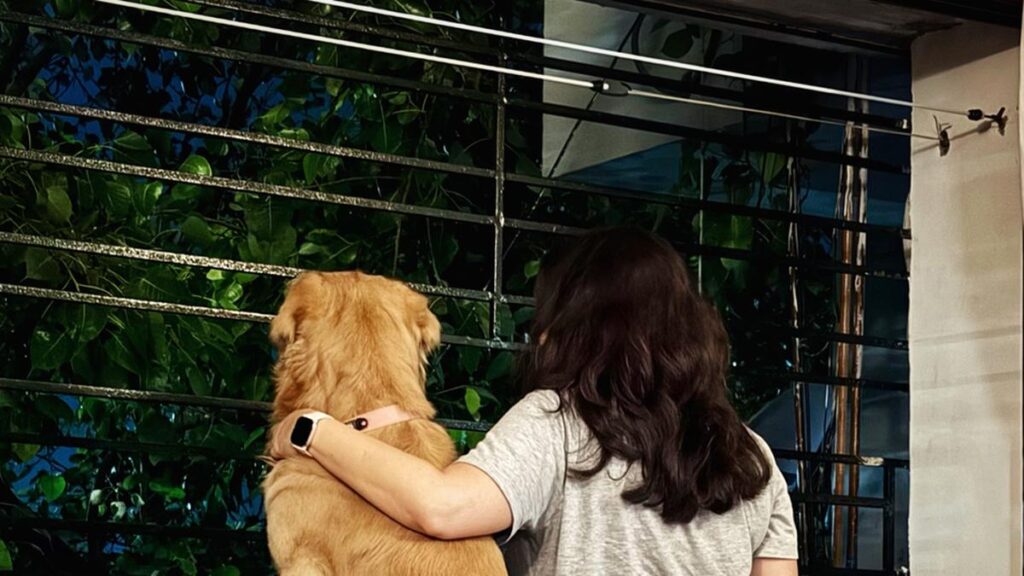
At Anjana’s (name changed on request) home, sitting in front of cups of freshly brewed tea, on a fine evening, her boy, Milo, is restless as it is also time for his pedigree snack. The bell rings, and the door opens to the one with a cap that bears Milo’s favourite name, the pet shop that delivers their food on a call. The delivery boy waved his hand, and Milo wagged his tail in unison. “Ten years ago, in Chennai, a door delivery of dog food was not even a possibility. But now they deliver any pet product within minutes on a call, says a Chennai-based pet parent.”
The accessibility of pet-related products and their grooming has become extensive on dedicated websites for popular pet shops and on grocery applications. Tanvi (name changed), a working professional from Bengaluru, has a folder of applications on phone, dedicated to her cat. “A plethora of applications started appearing on app stores and became a part of my life within a few years.”
Read | Pets emerge as emotional lifelines amid rising stress
A search for a pet product on any application gives unending scrolls for you and drools for your pet. A pet parent like Ms. Anjana, who has been raising a pet for over a decade and conveniently orders food and services for their pet, would definitely trace back the beginning of abundance roughly five years ago. What would have resulted in this affluence? Is it an organic growth or a sudden boom?
The COVID ‘booster’
It was during the COVID time that the pet industry got its boost. According to data from Tracxn, the pet industry hit a high in 2021, exactly the year people were facing hurdles financially, physically and mentally due to the pandemic.
In that year, 76 pet startups were reportedly launched in India, which was higher than both the preceding year (66) and the following years (50).
Pramilesh, one of the founders of Pandora Pet Mall in the Kozhikode district of Kerala, says that his team foresaw the boom, and chose the beginning of 2021 as the right time to enter the pet market. Being located near his ancestral village, knowing most of his clients personally, he could easily analyse the surge. “Most of the new pet parents were those who had to move to work-from-home mode.” For many who were confined to four walls, pets became therapeutic mentally.”
According to Dr. Soorej K., the founder of Cochin Pet Hospital, Kerala’s first private multi-speciality veterinary hospital, after the COVID outbreak, with the newfound affection for pets, the trend of ‘teacup breeds’ has upturned. He says that people preferred breeds like Shih Tzu and poodle dogs, and Persian cats that could be raised inside their flats.
How India’s petcare boom is creating new avenues for small business owners
Though this surge was witnessed in 2020, the pet industry has always been one with a steady and stable growth. “I don’t think such a sudden spike like this again will be a good thing, as many pet parents abandoned their pets after the COVID lockdown period; thus most of the infrastructure and mechanisms that were brought in by the industry lay unused after the expeditious hike. The situation of every other industry that hit a high is almost the same.” “This industry will continue with this same stable growth as people look up to pet care irrespective of times,” he said. The IBEF data on India’s pet-care industry proves Dr. Soorej has a right prospect as it projects a seven-fold growth from a ₹30,434 crore valued industry in CY 2024 to a ₹2.1 lakh crore one in CY 2032.
A ‘wuff’ revolution
Dr. Soorej said there was a change in people’s attitude towards dogs when they were restricted within homes. Sarah Cherian, a business developer with Zoho, said she wanted a companion to push through the one year that she worked from home during COVID.
“A conventional image of dogs was of a ferocious one that takes care of your home. But the work-from-home culture brought about a change in people’s attitude.” A “wuff” is what people liked more than a shuddering growl that dogs stood for.
With great cuteness comes great spending. Exotic breeds of dogs and cats are ardent fans of exotic food. “My cat would give you a deadly stare if you go with a bowl of ‘Drools’. On a sniff of it, her look tells you ‘no, this is not my food.” Ms. Tanvi talks about her Persian cat, Bella. From the data by IBEF, pet food contributes to the largest share of the industry, which was valued at ₹4,000 crore in CY 2024. According to Euromonitor, the food market of the country is expected to hit ₹10,000 crore by CY 2028.
Abundance to homeless
An amateur dog breeder, Ranjith K.J. has seen people buying and increasingly raising “stud dogs” during the COVID lockdown, to benefit the increasing demand for puppies.
“After the demand hit a low, people started to somehow avoid the ‘stock’ that they had.” Dr. Sooraj has seen people selling Shih Tzu puppies for ₹5,000, which were, at times during lockdown, being sold for as much as ₹60,000.
A tremendous trend of pet boarding and pet adoption surfaced during this period. Dogs of Madras, a pet adoption service based out of Chennai, talks about witnessing a striking hike in dog adoption rates five years ago.
Most of them were due to the same reason Mr. Pramilesh mentioned. “Around 2024-2025, we have seen a lot of re-homing requests,” team Dogs of Madras says. It was the time when they hosted pet adoption drives regularly. Relocation to work, according to the team, was one of the biggest reasons people give up their pets. They lose the once-achieved interest in taking responsibility for a pet.
Published – July 26, 2026 12:50 am IST
#Pet #wellness #underlying #theme #industry #grows #steady