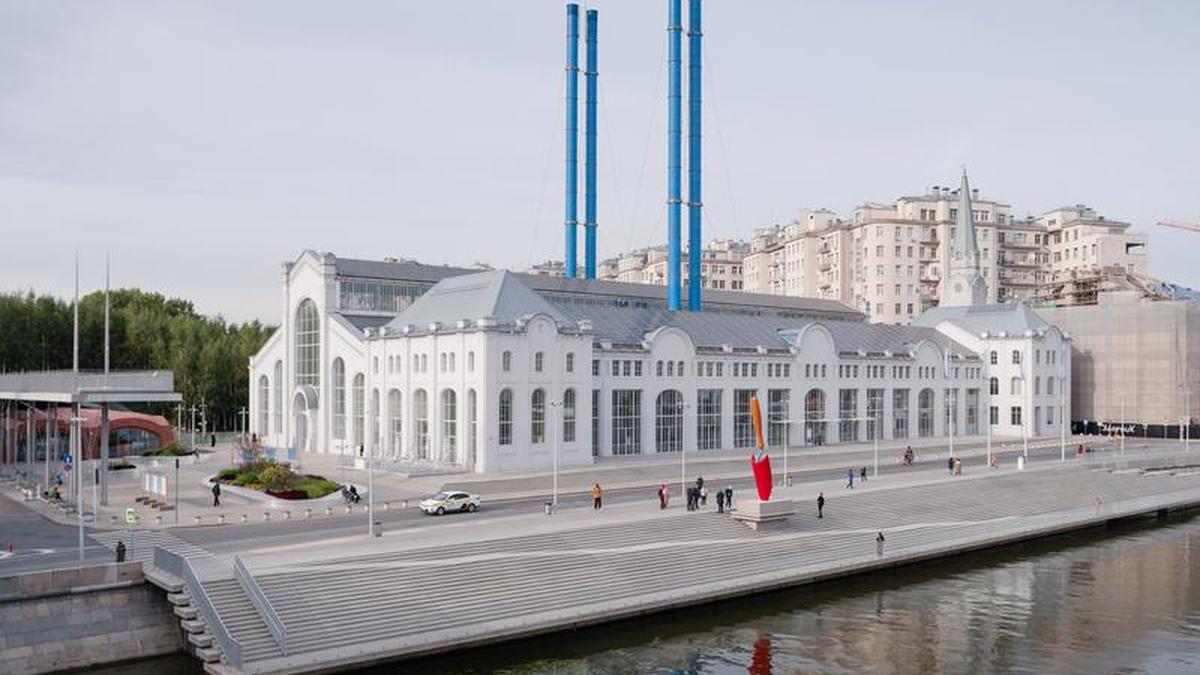

A view of Moscow’s GES-2 House of Culture, which hosts the exhibition
| Photo Credit: Courtesy: GES-2 House of Culture
Almost a century after Rabindranath Tagore stepped on the Russian soil, in 1930, Moscow has mounted the most significant international exhibition of the polymath. The World in a Single Nest: Following the Way of Tagore, on view at GES-2 Hou till August 23, showcases Tagore’s ideas about education, ecology and artistic freedom — not as historical artefacts — but as living frameworks for understanding the fractured present.
Organised by GES-2 House of Culture, in collaboration with leading institutions from India and Russia, the exhibition assembles more than 50 works by Tagore alongside rare archival material, contemporary artistic interventions and an ambitious cross-cultural dialogue. In a geopolitical climate defined by hardened borders, the exhibition quietly but insistently returns to one of the 20th century’s most persuasive advocates of intellectual openness.
The title of the show bears the conceptual weight of the project. It draws from the phrase ‘The world in a single nest’ — the unofficial motto of Visva-Bharati University, founded by Tagore at Santiniketan, as an experiment in education beyond conventional classrooms in 1921.

One of the works titled ‘Man and Bird’ (1931–1932)
| Photo Credit:
Courtesy: Rabindra Bhavana Museum, Visva-Bharati University
“The phrase encapsulates the idea of unity, civilization, international exchange and openness as the basis for individual cultures and countries to prosper,” says the exhibition’s curator Elena Yaichnikova. According to her, Tagore’s internationalism rested not on abstraction but on “the ideal of a world where deep knowledge of one’s own culture is combined with a desire for dialogue with other cultures.”
For Russia, the exhibition reconnects with Tagore’s cultural encounter that happened almost a century ago. For India, it reasserts his place as one of the most radical educational thinkers and artistic visionaries. However, rather than compartmentalising Tagore as poet, painter or Nobel Laureate, the exhibition presents him as a thinker whose artistic practice emerged from an integrated philosophy of life. His paintings are portrayed, not merely as aesthetic objects, but as extensions of a worldview where learning happened beneath trees.

Ruma Choudhury’s ‘Ajoy River’ (set of three works) in kan grass, banana fibre, cotton, remi fibre and paper pulp
| Photo Credit:
Courtesy: GES-2 House of Culture
This emphasis is reinforced by Artem Bondarevskiy, director of GES-2 House of Culture, who says, “it is impossible to speak of Tagore solely through his artistic or literary legacy. Paintings, poetry and prose were, for him, merely ways to convey the need for us to interact with Nature and with each other.”
By centering Visva-Bharati itself — where outdoor classes continue and art remains inseparable from everyday life — the exhibition reveals Tagore’s creation: an educational model that continues to embody interdisciplinarity and global citizenship.
The retrospective’s contemporary resonance is sharpened with the inclusion of works by artists who practiced at Santiniketan such as Ruma Choudhury and Prasanta Sahu.

Prasanta Sahu and Emami Art’s ‘Drumstick tree and other stories + Mapping Craters II’
| Photo Credit:
Courtesy: GES-2 House of Culture
Ruma gathers bark, fibre and soil from Birbhum district and Santiniketan to craft handmade paper, transforming local material into the foundation of her work. Prasanta’s engagement with farmers and craftspeople reconstructs inherited knowledge embedded in labour, landscape and memory. “Neither of them is illustrating Tagore,” says Ushmita Sahu, director, Emami Art, Kolkata. “But both are working from a position he articulated and then built a university to put into practice.”
Fittingly, the exhibition — with visitors moving between Tagore’s paintings, archival documents and contemporary installations — suggested an atmosphere of rediscovery rather than commemoration. The message remains remarkably contemporary: that the world, despite its divisions, can still be imagined as a single unit.
Published – July 13, 2026 03:25 pm IST
#landmark #Rabindranath #Tagore #exhibition #Moscow #century #visit
