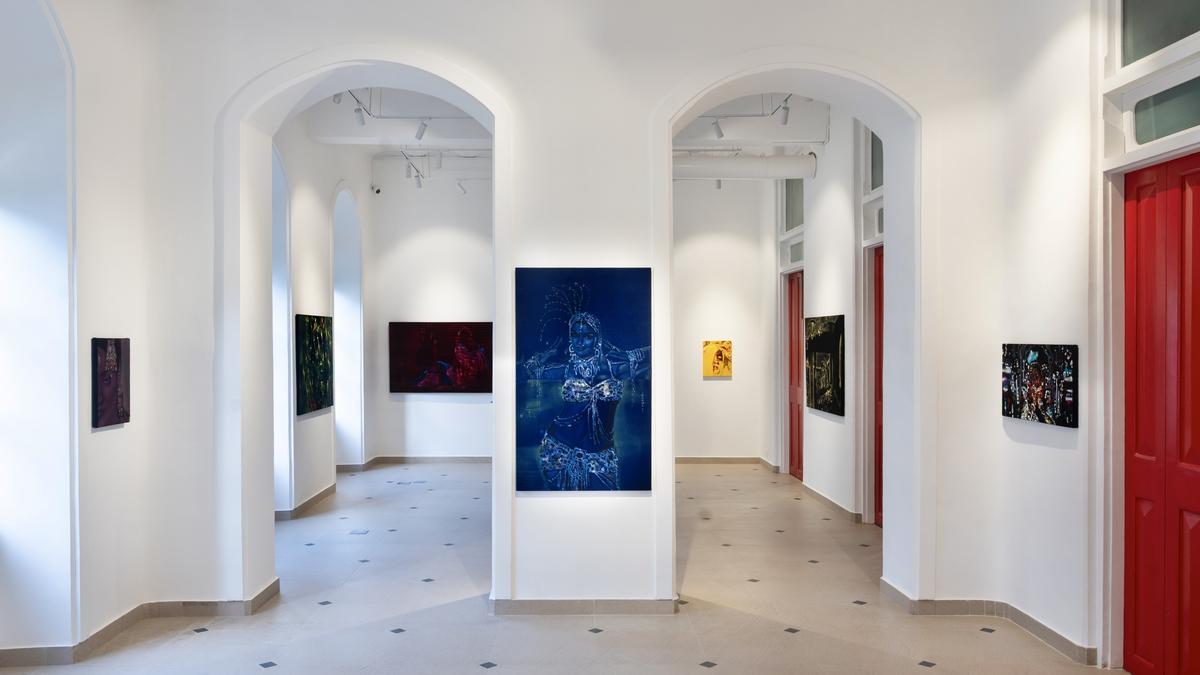
“I think I’ve wanted to open my own gallery since I was an embryo,” laughs Sunaina Rajan, founder of the 1,600 square-feet Gallery Maxima, Mumbai’s newest contemporary art gallery. “I always knew I had to do it. It was just about waiting for the right time, and feeling prepared enough to make the leap.”
At 28, Sunaina has long been the person collectors, curators and journalists turn to when looking for the next generation of artists. “People would always ask me, ‘Who’s hot right now?’” she says. “I became the encyclopedia of what was happening in the contemporary art scene.”

Gallery Maxima in Mumbai
| Photo Credit:
Special arrangement
That reputation was built during her years at Chemould Prescott Road, where she co-founded Chemould CoLab, the gallery’s platform for emerging artists. Stints at the School of the Art Institute of Chicago, Lévy Gorvy Dayan and the Museum of Art & Photography, Bengaluru, followed, before she took a deliberate detour into the business of art at Nature Morte.
“I knew how to work with artists and mount exhibitions, but I didn’t understand the business side,” she says. “For two years, I focussed on sales, acquisitions, building collections, and relationships with collectors. Now I understand both worlds.”

Her commitment to emerging artists is rooted in experience rather than generational kinship. As co-founder of Chemould CoLab, Sunaina introduced artists such as Gurjeet Singh, Kuldeep Singh, Anirudh Shaktawat, Rithika Pandey, Shailee Mehta and Pallavi Sen through their first solo exhibitions in Mumbai. Today, she continues to keep a close eye on younger practices. “There are a few artists whose work I return to again and again, including Kuldeep Singh, Purvai Rai and Arpita Akhanda,” she says.
“They’re going to be the next tastemakers,” she says. “They’re showing us what contemporary art can be and how traditional mediums like oil painting or ceramics can be reimagined.”
When evaluating an artist, Sunaina looks beyond the image itself.
“Running a studio practice and making art are two very different things,” she says. “Is the work archival? Will it last? Is the artist thinking about preservation, storage and transport? Are they stretching custom canvases or buying ready-made ones? Are they mixing their own pigments or squeezing paint straight from the tube? Those decisions tell you how seriously they’re thinking about the life of the work.”

Sunaina Rajan
| Photo Credit:
Special arrangement
Before opening Gallery Maxima, Sunaina sought advice from several established Mumbai gallerists.
“They all told me the same thing — find the space first. That’s the hardest part.”
After rejecting countless properties with low ceilings, awkward layouts, weak staircases or no access for transporting artworks, she found what she was looking for at Kitab Mahal in Fort. The 14.5-foot ceilings, soaring arches and single rectangular hall immediately appealed to her. But it was the foldable red doors that sealed the deal. “Where have you seen a gallery with red doors?” she says. “The moment I saw them, I knew they’d become the gallery’s identity.”

Works from artist Maithili Chaturvedi
| Photo Credit:
Special arrangement
The original beige stone flooring remains, now punctuated by a grid of black granite. A mustard-yellow coffee table sits beside a green Chandigarh chair. Sunaina describes Gallery Maxima as a maximalist space — not because it is crowded, but because every object has been carefully considered.
“I didn’t want another white-cube gallery,” she says. “Everything here has been chosen deliberately so it complements everything else.”
The inaugural exhibition, Dream Girl, features Mumbai-born artist Maithili Chaturvedi, whom Sunaina first met when the artist interned at Chemould Prescott Road before leaving for the Rhode Island School of Design. She has followed Maithili’s practice ever since.

Works from artist Maithili Chaturvedi
| Photo Credit:
Special arrangement
The exhibition comprises oil paintings on velvet that revisit iconic Hindi film heroines — from Hema Malini, Rekha and Madhubala to Helen, Zeenat Aman, Parveen Babi and Dimple Kapadia. “Almost anyone can connect with these works because they recognise the actress, the song or the film,” says Sunaina, “But Maithili is also examining how these women were constructed through the male gaze — as objects of beauty, desire and ideal femininity. She’s reclaiming those familiar images through her own female gaze. All her subjects are caught in motion — dancing, performing, inhabiting a stage — while the audience, too, performs the role of spectator.”

Works from artist Maithili Chaturvedi on display
| Photo Credit:
Special arrangement
Even the choice of material reinforces the idea.
“Velvet has always been associated with theatre because that’s what stage curtains were made of. And instead of painting on white canvas, she’s choosing hot pink, bright purple and yellow.”
Over the years, Sunaina has also noticed a shift in collecting habits.
Collectors whose homes are filled with modern masters are increasingly making room for younger artists. A [SH] Raza or a [FN] Souza may still dominate the living room, but guest rooms, studies and bars are becoming spaces for emerging practitioners. Increasingly, collectors are hanging works by different generations side by side.

“I also know parents who buy one artwork every year after their child is born,” she says. “By the time the child turns 18, they’ve built a collection that’s deeply personal and full of stories.”
For Sunaina, that is ultimately what good collecting is about — not buying names, but building a relationship with art over time.
Dream Girl by Maithili Chaturvedi is on view at Gallery Maxima, 2nd Floor, Kitab Mahal, Fort, until August 1, Tuesday to Saturday, 10.30am to 6.30pm
Published – July 07, 2026 03:11 pm IST
#Mumbai #contemporary #art #gallery #Gallery #Maxima
