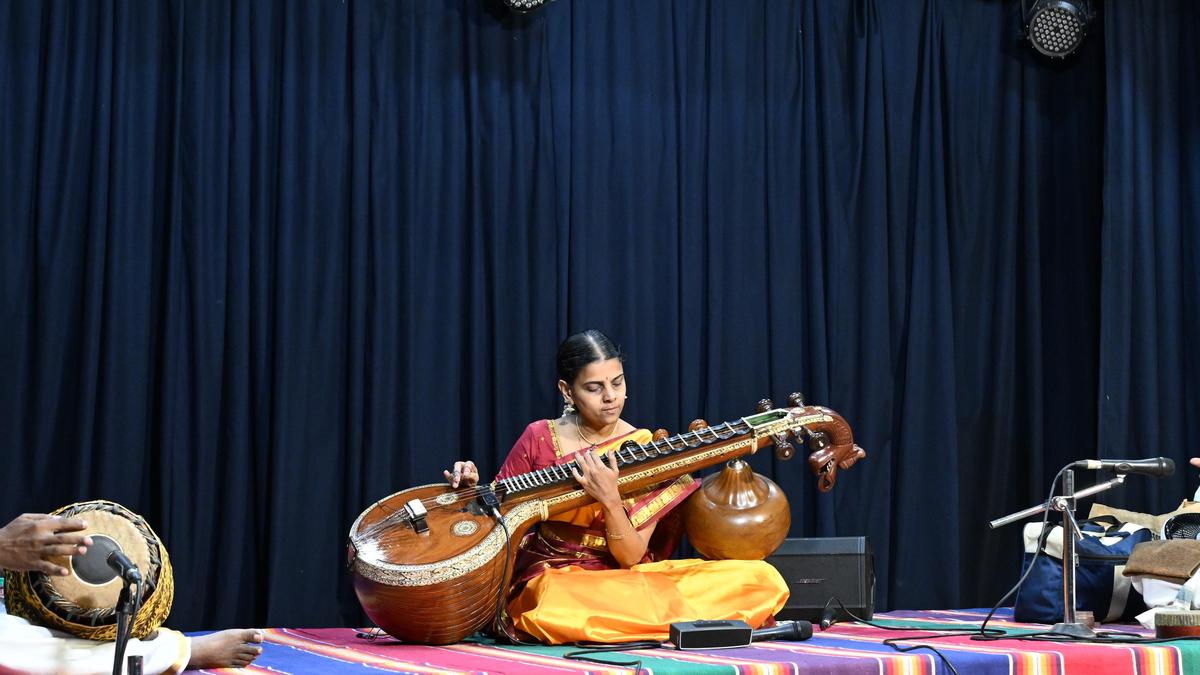

S. Nithyasree performed along with B. Ganapathiraman (mridangam) and B.S. Purushotham (kanjira).
| Photo Credit: M. Srinath
S. Nithyasree presented a veena recital at Narada Gana Sabha under the Mangalam Muthuswamy Veena Endowment series. She was accompanied by B. Ganapathiraman on the mridangam and B.S. Purushotham on the kanjira.
The recital commenced with the Nattakurinji pada varnam ‘Chalamela’, followed by Harikesanallur Muthiah Bhagavatar’s ‘Gam ganapate’ in Hamsadhwani. Kalpanaswaras, rendered in two speeds, added vitality to the composition. Nithyasree then explored Jaganmohini through a brief raga alapana before presenting Tyagaraja’s ‘Sobillu saptaswara’. The accompanying swara passages were rendered in two speeds, though the second-speed patterns occasionally tended towards repetition.
A change in pace came with a leisurely chowka kala rendition of Muthuswami Dikshitar’s ‘Kamalamba samrakshitoham’ in Anandabhairavi. The sub-main of the evening was Lathangi. Nithyasree offered an expansive alapana that highlighted the raga’s many characteristic panchama-varjya and shadja-varjya phrases, while traversing all three octaves with ease. The gradual movement, between the lower, middle and upper registers, contributed to the raga’s sense of expansiveness and helped sustain the listener’s interest.This was followed by Patnam Subramania Iyer’s kriti ‘Marivere’ (Khanda Chapu tala), embellished with kalpanaswaras. The Lathangi segment stood out for its poise and control.

Nithyasree displayed diversity in talas.
| Photo Credit:
M. Srinath
Madhyamavati was the main raga of the evening. While the alapana displayed a free-flowing approach, a more structured exploration centred on some of the raga’s defining phrases might have enhanced its impact. The tanam that followed was more concise, though the increased tempo occasionally affected its clarity and control. Tyagaraja’s ‘Rama katha sudha’ was the kriti, with the niraval at ‘Dharmadhyakhila’ followed by kalpanaswaras, in two speeds. The swara exchanges were neatly executed, and the concluding swara passages incorporated imaginative kanakku patterns and jantai prayogas, adding complexity. The progression, from the sub-main Lathangi to the more elaborate Madhyamavati , provided a clear sense of build-up in the latter half of the recital.
Throughout her concert, Nithyasree demonstrated a willingness to engage extensively with manodharma and displayed diversity in talas. At times, however, a slightly more measured pace in the compositions may have enabled greater precision in rhythmic alignment.
The concert concluded with Dharmapuri Subbaraya Iyer’s Khamas javali ‘Marubari talalenura’. Ganapathiraman and Purushotham supported the recital with restraint and sensitivity, adapting well to the varying demands of the programme.
Published – July 06, 2026 03:24 pm IST
#Swara #speed #raga #explorations #shaped #Nithyasrees #veena #recital
