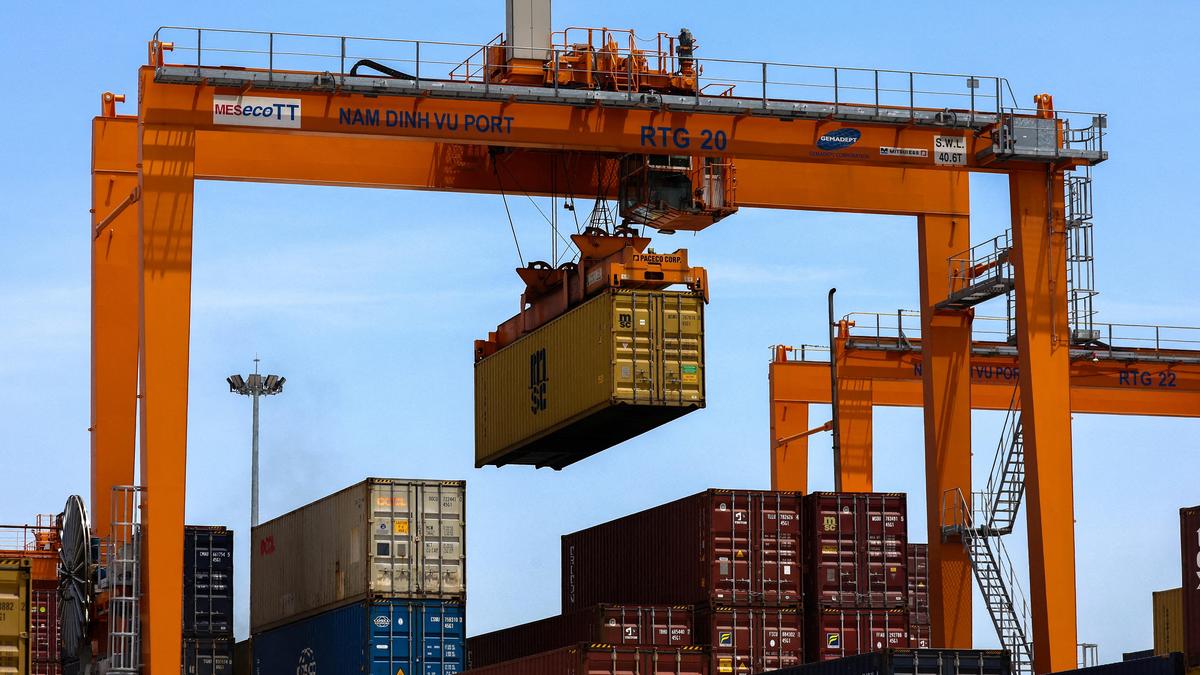

India’s trade with China has expanded despite the political freeze in relations since 2020. File
| Photo Credit: Reuters
Greater investment from China into India will be good both for the economics of the relationship and for broader bilateral ties, Ambassador to China Vikram Doraiswami said on Saturday (July 4, 2026).
The Indian envoy also made a pitch for greater Indian exports to China, especially in areas such as pharmaceuticals where India is globally competitive.

“Obviously, we would like to be able to export more to China. This is nothing unreasonable about suggesting that,” he said, speaking at the World Peace Forum, an annual foreign policy forum in Beijing, at a panel on protectionism and global economic governance.
“Particularly in areas where we believe we have a competitive advantage like pharmaceuticals. For instance, we’re one of the world’s big exporters of pharmaceuticals to advanced markets. We hope Chinese partners will work with us to ensure that Indian production firms, producing high quality generic medicines, being the same products that have been exported to the U.S. and elsewhere, can be exported to the Chinese market. We think there is a balance of advantage for both countries, including value for China and of course, value for the relationship.”
India’s trade with China has expanded despite the political freeze in relations since 2020. Both sides have begun a process of normalising relations following Prime Minister Narendra Modi’s meeting with Chinese President Xi Jinping in October 2024, in the wake of disengagement along the Line of Actual Control (LAC).

However, trade remains lopsided with a ballooning deficit. According to Commerce Ministry data, China was India’s largest trading partner in 2025-26, with bilateral trade growing to $151.1 billion, and the deficit as high as $112.16 billion. Mr. Doraiswami noted that trade had gone up “regardless of the ups and downs of the larger political relationship”. India’s exports had recently also increased to China. “That means that the market opportunities there. We need to find ways of making it easier,” he said.
India continues to import large amounts of electrical machinery and finished goods from China, as well as a range of intermediate goods. “How do we find ways in which India and China can be connected with a widening basket of goods that both sides can provide each other, but also a sense that reasonable mechanisms to protect consumers can be applied in a way that enables India also to export more of the goods that it can export elsewhere in the world also to China,” he said.

“In other words, it would be easier to consider that the trade wouldn’t be exactly 50-50 balanced, but one side would have more exports, provided that exports consist of goods that we can also add value. If it is pure consumption goods, that becomes a little harder to sell as a reasonable mechanism for the deficit.”
On investments from China, he said “the policy environment has been specifically changed in the last few months to facilitate greater Chinese investment.” In March, India relaxed restrictions on investments from China that were imposed in early 2020 under Press Note 3.
Mr. Doraiswami said India was “willing, not just to help make the investment happen, but also to listen to their concerns and find ways in which we can offer more handholding assistance to enable [Chinese] businesses to come into India.” “That, I think, is good for the economics of the relationship. It is also good for the larger country-to-country relationship,” he said.

“As the relationship is moving towards normalisation, the government of India has taken steps to reestablish opportunities for Chinese businesses to invest in the Indian market,” he said. “We would like that connection to be better because obviously today it isn’t just India, but across the world, where Chinese inputs into the manufacturing process across the board, whether it’s chemicals, new renewable energy products, etc, is critical for international manufacturing.
That connects with the trade point. As long as the trade basket includes goods in which we can step up, value add, and [enable] production for our own market but also for export markets with the countries with whom we have now established trade arrangements and across the board, that would be an easier sell in India.”
Published – July 04, 2026 02:40 pm IST
#Chinese #investment #good #larger #relationship #Indias #envoy #China
