“Didi, what should I make tomorrow?” Tulsi calls out, untying the dupatta knotted around her waist while cooking. This is a customary question before she leaves for the day. “I’ll message you later,” replies her employer Komal Shah, 37, a marketing professional.
Tulsi, 26, relocated from Nepal to Bengaluru seven years ago. Now, she cooks at three houses daily, spending at least a couple of hours in each. That evening, Shah sends her a WhatsApp voice note and a link, asking, “Can we make this tomorrow?” The link is for a YouTube recipe video on bisi bele bath, a spicy rice dish from Karnataka that Tulsi has never heard of. “The name itself is challenging,” she says. She watches the video between dinner and chores, and again while walking to Shah’s house the next morning.

“My WhatsApp has more cooking links than anything else,” Tulsi jokes, naming at least 10 dishes, from a Greek tomato and feta salad to an Italian marinara pasta, that she’s attempted in the last three months.
| Photo Credit:
Pratima Chabbi
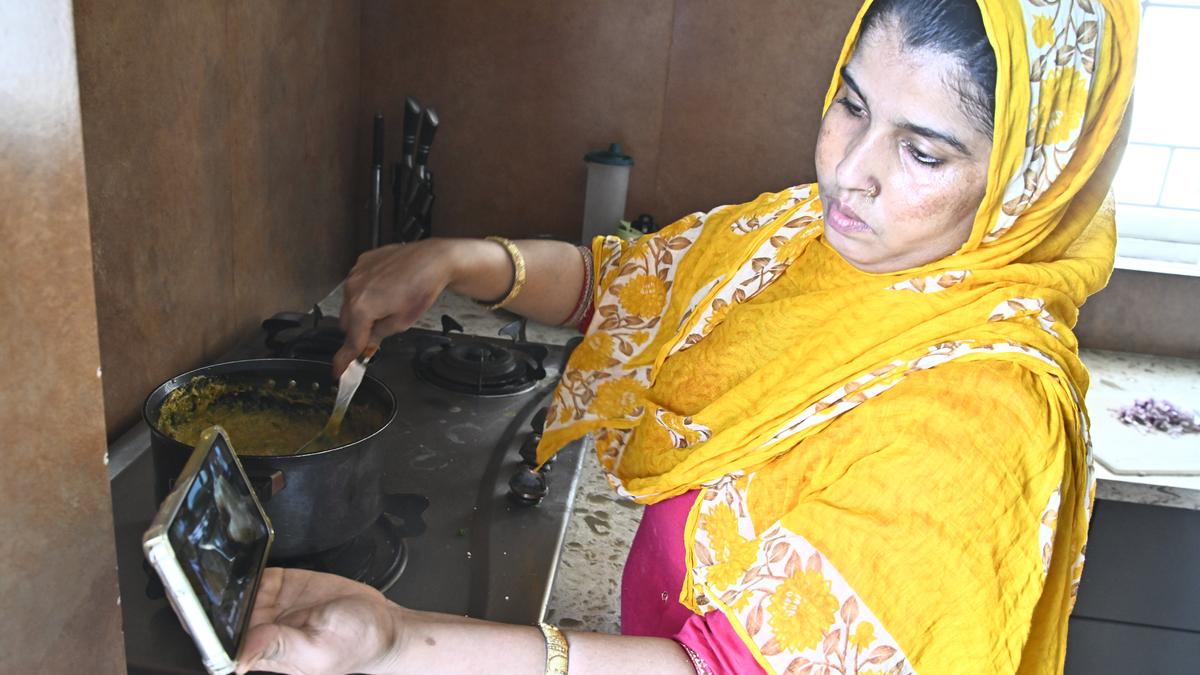
In the kitchen, Tulsi props her phone against a steel dabba and hits play. As a voice lists the ingredients, she pauses the video, gathers the vegetables and spices, and then presses play again. This is her new normal. “My WhatsApp has more cooking links than anything else,” she jokes, naming at least 10 dishes — from a Greek tomato and feta salad, to a Keralan avial and an Italian marinara pasta — that she’s attempted in the last three months. She follows a cooking video at least three times a week. “When someone stands beside you, there’s pressure. With a video, if something isn’t perfect, you can fix it the next time,” she adds.
Tulsi watching a recipe video
| Video Credit:
The Hindu
Tulsi’s bisi bele bath reveals a bigger change happening across India’s kitchens. Recipes that once used to be shared with domestic cooks through in-person lessons, handwritten notes, TV shows and hours spent cooking together, now come as WhatsApp links, Instagram Reels, and YouTube videos.

The cooks watch, pause, replay and adapt these recipes, bringing new dishes into different homes and sometimes to their own families. Most dishes they’ve never seen, let alone tasted, before. But they are enterprising — a cook from Odisha says she’s recently learnt khao suey from YouTube, another from Siliguri has mastered Turkish eggs. Elsewhere, cooks are trying shakshuka, Caesar salad, thecha prawns, cold soups, roast chicken, and pesto pasta.

Moni Bibi Khan in Bengaluru cookig from a recipe video.
| Photo Credit:
Sudhakara Jain
Inside the YouTube kitchen
Moni Bibi Khan, 31, from West Bengal, has lived in Bengaluru since 2019 and worked for Gauri Chabbi, a 39-year-old banking professional for six years. She remembers when meals were more predictable. “In the first year, didi stood with me in the kitchen, opening spice boxes and explaining what’s used in everyday Keralan and North Karnataka dishes,” says Khan. “She showed me how cooking curry leaves with a pinch of asafoetida creates a rich, savoury tempering.”

Gauri Chabbi encourages her cook to try out different cuisines.
| Photo Credit:
Special arrangement
As the family’s tastes changed, Khan learnt to cook more dishes. “Now, at least five nights a week, they want something new. Last night, I made chicken chukauni, a Nepali dish didi had seen on Instagram. This weekend, I will make egg fried rice and garlic vegetable stir-fry, which I’m an expert at now. I even learned stroganoff [the Russian dish usually made with beef and sour cream],” she says proudly. Even if the video is in English, Khan finds the visuals helpful. “Once I see it, I understand. If I get stuck, I ask didi,” she says.

Moni Bibi Khan has learnt to cook dishes such as stroganoff and chicken chukauni from recipe videos.
| Photo Credit:
Sudhakara Jain
In Pune, Sejal Malavde, an HR professional, recalls how her cook, Dasni Devi, 35, introduced herself four years ago, saying, “I can learn to cook by watching YouTube videos.” One of Devi’s recent experiments was rice paper dumplings. After making them at work, she took the recipe home and made them for her 12-year-old son’s school tiffin. “He loved it,” she says.
For many employers, the willingness to learn from videos is now something they look for in a cook. Monica Shroff, 57, who works for an online gifting retail company in Mumbai, says her cook, Sunaina, 35, suggested that she share YouTube recipes with her because her repertoire was limited. Shroff sends her links for fish curries, grills, smoothies, cold soups, and jowar roti.
But learning isn’t always as easy as watching a video once and cooking the dish perfectly. Language can be a barrier. In Kochi, Sumayya Sharaf, 37, sends recipes to her cook Tezal Thomas, 45, who has been with her family for nearly 18 years. Some videos are in English, while others are in languages neither of them understands. “Shorter videos are great for quick explanations, but if the language is unfamiliar or too fast, I send a detailed voice note along with it,” she says.

For Tezal Thomas, cooking new recipes is a welcome break from his everyday routine of cooking sambar, thoran, pathiri or parotta.
| Photo Credit:
Special arrangement
Sharaf also takes screenshots of various steps, especially when Thomas gets stuck. “I noticed that he used to play them again and again. That’s why I began sharing screenshots,” she says. Clear captions help, she adds, but if the instructions are vague, like stating “some this” or “some that,” she uses ChatGPT to convert the measurements into grams.

Mastering the air fryer
New recipes often mean new equipment in the kitchen, too. Sharaf, who grew up in Muscat, has been using air fryers for years, and she now encourages Tezal to use it by sending him no-oil air-fryer recipes — though he doesn’t always like them. “Less oil means more time,” he teasingly complains. Cooking new recipes is also a welcome break from his everyday routine of cooking sambar, thoran, pathiri or parotta for her joint family of around 20 members.

Sumayya Sharaf sends recipes to her cook Tezal Thomas. “If the language is unfamiliar or too fast, I send a detailed voice note along with it,” she says.
| Photo Credit:
Special arrangement

In Chennai, Neelakantan and Ameera D’Costa say their cook Sandip, 35, from Siliguri, easily moves between their oven, air fryer, and induction stove to make dishes such as roast chicken, khao suey, and pizza. After years of cooking in different homes, Sandip now experiments with both recipes and the presentation of the food. He has learnt how to make charcuterie boards from YouTube, and use ingredients such as kaffir lime leaves in marinades. “Sometimes it comes out nicely, sometimes I modify it and try again,” he says.
Of course, things don’t always go as planned. Aishwarya Sudarshan, a Mumbai-based publicist, recalls how her cook Farin wanted to scramble the eggs for shakshuka because “she was worried they would otherwise remain raw”. Thomas tried making Mangalorean ghee roast prawns, but the ingredients were new to him and the proportions incorrect. “It was a disaster,” Sharaf laughs. “The dish was cumin-forward. We tried many ways to fix it, but finally gave up”.

Aishwarya Sudarshan, a Mumbai-based publicist
| Photo Credit:
Special arrangement
A democratic culture
The smartphone is at the heart of this change, carrying recipes, notes, screenshots, shopping lists and schedules. India is the world’s second-largest smartphone market. Late last year, the country had 1.06 billion active cellular mobile connections, according to a DataReportal study. While some critics may claim that sharing video links strips home kitchens of its age-old traditions of apprenticeship and oral recipe sharing, according to Delhi-based food writer and anthropologist Shirin Mehrotra, it is, in fact, creating a more democratic culture. Technology, she says, is helping “create a wider archive of recipes, making it easier for people to revisit, and less likely for it to disappear within families”.

Technology is helping “create a wider archive of recipe”, says Delhi-based food writer and anthropologist Shirin Mehrotra.
| Photo Credit:
Special arrangement
It is also giving workers and other individuals from low resource environments access to better skills and jobs — though primarily only in the big metros. Moreover, as Antara Rai Chowdhury, an academics and research consultant, puts it, not only are they learning to cook from these videos, they are “also uploading their own content, getting recognition for what they make. That’s a different kind of knowledge circulation”.

Now, domestic cooks are “also uploading their own content, getting recognition for what they make”, says Antara Rai Chowdhury, an academics and research consultant.
| Photo Credit:
Special arrangement
Today, cooks who can learn from video recipes are a valuable resource in many cities. After Devi told her Pune-based employer Malavde about her prowess with YouTube, the latter has recommended her to several employers. A cook who can plan, make a varied meal, and set the table is a “huge plus”, adds Shroff, especially for people with long workdays. This can translate to better pay, too. (Salaries in metros start from ₹5,000 and can go up to ₹15,000.) Mumbai publicist Sudarshan says, “If a cook offers more variety and independence in the kitchen, an extra ₹1,000-₹2,000 is something we happily offer.”
Pros and cons
Placing this shift within India’s informal domestic-work economy, however, reveals several roadblocks. According to Aditi Surie, a sociologist who studies technology, gender, and informal work at the Indian Institute for Human Settlements, “For part-time cooks, digital upskilling can improve employability and gain them a less supervised, more flexible kitchen, but for live-in workers, it could become another unpaid task.”

“For part-time cooks, digital upskilling can improve employability but for live-in workers, it could become another unpaid task,” says Aditi Surie, sociologist.
| Photo Credit:
Special arrangement
Also, what of workers with keypad phones? Or older workers, cooks with low literacy, and those whose phones are controlled by their husbands or sons? “They are structurally excluded — not because they cannot learn, but because the conditions have not been set up for them to participate on equal terms,” says Chowdhury. “So, there are both labour-market advantages and disadvantages at this point, and it is important to track both.”

Meanwhile, in many homes, videos haven’t completely replaced the old relationship, just merely changed the exchange. In Hyderabad, Vinitha Venkat sees a version of this between her father, R.V. Venkateswarulu, 83, and their cook Wahida, an Assamese woman in her mid-30s who moved to the city a decade ago. “I’ve always liked making things. Earlier, it was carpentry, now it’s mostly food. I spend a lot of time watching videos and bookmarking things I think the family might enjoy,” says Venkateswarulu, who finds recipes online and sends them to Wahida.

R.V. Venkateswarulu finds recipes online and sends them to his family’s cook, Wahida.
| Photo Credit:
Siddhant Thakur
“These days, I’m always looking for something new to try, especially if it might get my grandson to eat a little more.” Wahida, who watches the videos at home, sits with Venkateswarulu the next morning and discusses the recipe — often giving her own suggestions and tweaks — before she starts cooking.
Training ‘smart’
As services such as BookMyBai, ChefKart, Cookzy and Urban Company’s InstaHelp make it easier to book cooks — transforming a deeply personal task into a purely transactional service — outfits are working on bringing trust back into the picture. Jinn, a new cook-booking platform, trains its employees in both cooking and customer preferences before placing them. “Cooking is about making soulful, thoughtful food,” says co-founder Mrinal Sharma. “Customers specifically request cooks who make satvik food or healthy meals.” After registering, prospective cooks are trained in the Jinn kitchen, where recipe videos by chefs such as Nisha Madhulika and Ranveer Brar are part of the training material.

Cooks from Jinn
| Photo Credit:
Special arrangement
The everyday creator
Today, domestic cooks are also becoming sources of cooking knowledge themselves. Rajeshwari Mangar Thapa, 35, known online as Raji Didi (@homefoodswithraji; 336k followers on Instagram), started appearing last year in cooking videos made by her employer, Aishwarya S. Krishnan. The videos showcase simple, healthy home-style meals, where Thapa talks in Hindi about gluten, protein sources such as tempeh, and healthy snack options (air-fried banana chips). Her recipes include everything from the Tibetan noodle soup thukpa to a Catalonian Romesco sauce. “If a nutritionist does the same thing, it will not land with people as well as a home cook does,” says Krishnan, 29, founder of Bengaluru-based creative agency True Umami. “People relate to her.”
Thapa’s first surprise was an Instagram message from another domestic cook who had attempted making one of her dishes at his employer’s home. “Earlier, I used to ask others how to make a dish. Now people ask me,” she exclaims, adding that her videos gets likes, recipe questions, and plentiful messages from other cooks. Krishnan responds to all the messages, and till date, they haven’t tried to monetise the account.
Who they follow
Many employers compare recipes from different creators before choosing which to send to their cooks. Shroff, for instance, likes Swasthi’s Recipes and Archana’s Kitchen. But the cooks have their preferences, too. Shubhra Chatterji, a filmmaker in Mumbai, says her cook, Nazia, prefers YouTube over Instagram and looks up videos by Sanjyot Keer, Sanjeev Kapoor, and Ranveer Brar — because the recipes are simple and she wants to see what “master chefs” do differently.

Shubhra Chatterji, a filmmaker in Mumbai.
| Photo Credit:
Special arrangement

Chatterji’s cook, Nazia, prefers YouTube over Instagram.
| Photo Credit:
Special arrangement
She is part of a broader online trend in which domestic cooks and household workers are becoming visible beyond the homes where they work. In Mumbai, Heena Ali (@heenaali9248; 125k followers) could be called a trendsetter. In 2023, she started building an online following after her employer suggested she record her daily life and cooking videos. Last year, she participated in the MasterChef India auditions (where the winner gets ₹25 lakh as prize money).
Domestic cook Sapna Jamadar often appears alongside her Mumbai-based employer Prasoon Dargarh on @boywhodecorates (267k subscribers), and now wants to establish her own identity on social media.
Celebrities have played a role in giving this trend visibility. Ever since filmmaker Farah Khan’s cook Dilip Mukhiya started appearing on her YouTube channel in 2024, the duo’s banter has won him fans and followers. Actor and TV personality Archana Puran Singh’s house help Bhagyashri began appearing on her Reels during the pandemic lockdowns. Today, she is surprised to be recognised at events and get asked for selfies.
Taking aglio olio home
So, is this shift in how culinary knowledge travels through households making Indian kitchens more multicultural today? Or, is it helping ease some of the class differences that exist between employer and employee? Social observers say things are still too nascent to draw concrete conclusions. “While it allows cooks and employers to access different cuisines and techniques, it isn’t necessarily making Indian kitchens multicultural,” says Mehrotra, cautioning against treating this as a simple liberation through YouTube. After all, in India, domestic workers’ bargaining power varies sharply by city and region, and caste, community and household control still shape the work. But, she adds, the trend could be “creating the opportunity for that [multiculturalism]”.

Meanwhile, back in Bengaluru, Tulsi shares that many of the dishes she has learnt at Shah’s house are now a part of her own cooking. Pasta is one of them. Recently, after making aglio olio for Shah, she swapped the spaghetti and olive oil for a cheaper pack of Sunfeast pasta and regular cooking oil, and prepared the dish at home.
That night, her children sat on the terrace outside their one-room kholi, eating pasta with their hands, while her husband ate dal and rice. “Mummy, make this every day,” they told her. Tulsi laughed as she slowly repeated the unfamiliar name “aglio olio”, and then convinced her husband to try a bite.
The Bengaluru-based writer is the author of ‘The MTR Story: A Labour of Love’.
#Indias #domestic #cooks #digital #age
