Last year, British television aired a documentary called Sex, Me and Disability, which followed a man living with Duchenne muscular dystrophy — a severe, progressive genetic disorder that weakens the skeletal, cardiac and respiratory muscles — as he navigated dating, intimacy and the awkward logistics of wanting what most people want but are rarely forced to articulate: to be desired by someone else.
The documentary drew attention because it spoke openly about sex and disability, a combination that still makes many people squirm. Watching it from India, I found myself less surprised by the subject matter than by the fact that such a documentary existed at all.

Here, disability is something we are happy to discuss so long as it remains safely inspirational. We like our disabled people triumphant at the Paralympics, acing competitive exams or delivering motivational speeches. We are considerably less comfortable imagining them on a bad Hinge date.
A few months ago, I spoke to a Delhi-based chartered accountant who was born with cerebral palsy, a neurological condition that affects movement and muscle coordination. In his case, it manifests as a slight limp and stiffness in one arm. He earns well, travels often, has a close-knit group of friends and can discuss tax regulations with ease.
What he can’t seem to crack is dating.
When he was 25, he’s now 27, he matched with a woman online. They chatted for weeks before finally meeting. They talked about work, films and travel. Afterwards, sensing her hesitation, he asked if she would like to meet again.
She told him she had agreed to the date because she felt sorry for him. Not because she was interested. The memory still makes him laugh with a few kilograms of old hurt.
“At least she was honest,” he said, adding, “I just want someone to share things with,” he told me.

A young woman with prosthetic hands using her Tablet
| Photo Credit:
Uma Shankar sharma
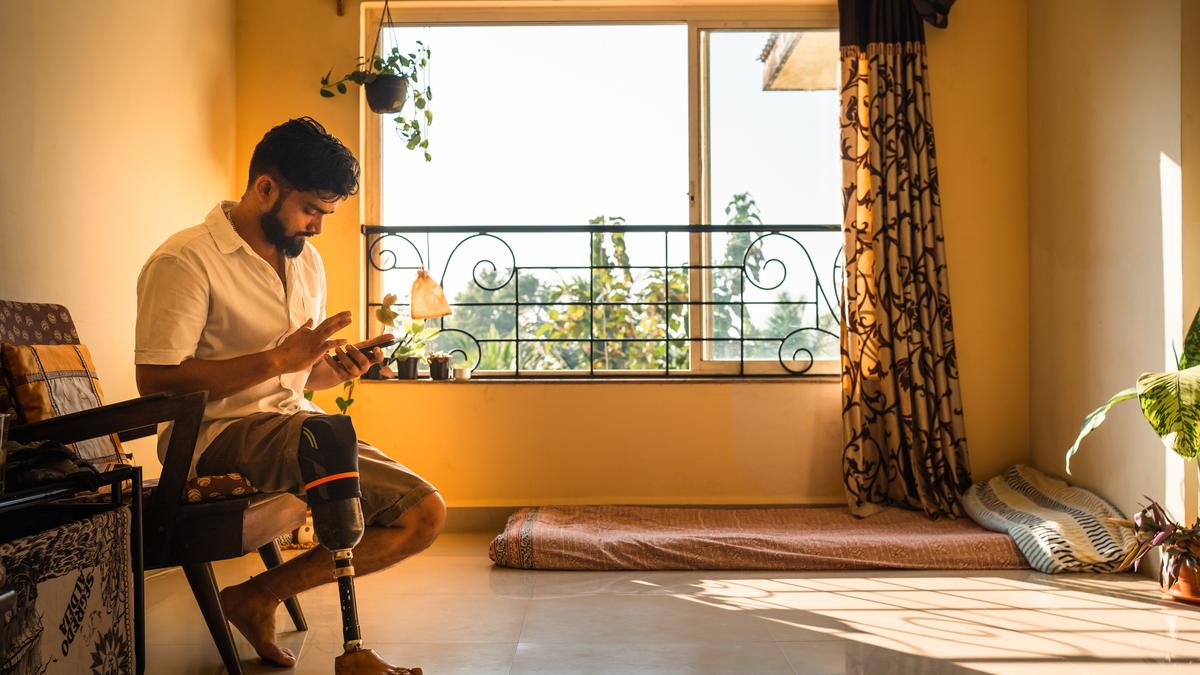
It struck me then that perhaps the greatest cruelty of how we think about disability in India is not exclusion from public spaces, though that remains a serious problem. It is the assumption that disabled people somehow exist beyond desire itself.
Which is what makes modern dating so paradoxical. Dating apps were supposed to democratise romance. For many disabled users, they have done anything but. A widely cited survey commissioned by the Australian disability support platform Mable found that three in five people with disabilities found it difficult to find a romantic partner, while 81% preferred not to disclose their disability immediately for fear of rejection. A 2022 study published in Cyberpsychology, a journal focussed on social science research about cyberspace, found that while digital platforms offered disabled people valuable opportunities to pursue relationships despite social isolation, they also exposed them to new forms of ableism and self-monitoring.
It’s never that simple
I first came across the work of disability activist Nu Misra in 2023 through Revival Disability India, the platform they founded. A queer, non-binary disability justice activist, Nu has consistently pushed conversations around disability into territory that remains deeply uncomfortable in India: love, desire, intimacy and belonging. Much of our disability discourse is understandably focussed on access — education, employment, healthcare, transport and public infrastructure. Revival asks a different set of questions: Who gets to flirt? Who gets to have a crush, get ghosted, fall in love or have their heart broken? Through essays, community discussions and advocacy, Nu has challenged the tendency to infantilise or desexualise disabled people and to view them through the lens of pity rather than possibility.
Mumbai-based Anushka Pathak, 29, knows this all too well. She lost her right arm in a bus accident at 15 during a school trip to Daman and Diu. If disability taught her adaptation, dating taught her something else entirely: how quickly people reduce disabled people to narratives rather than individuals.
On Tinder, Bumble and Hinge, she became so accustomed to explaining the accident that she kept a pre-written response in her Notes app and pasted it into conversations. Men asked intrusive questions about her body, marvelled that she lived independently and went to the gym, and occasionally offered compliments laced with condescension, telling her they would marry her “despite” her disability. One man admitted he had taken her on a date because he was writing a sociology paper on disability and relationships.
“I genuinely didn’t know whether to laugh or be offended,” she said. Others told her they liked her but couldn’t “justify” a relationship to their families.
Intimacy coach Aili Seghetti recalls working with a visually-impaired man in his late 20s who entered the dating world after a long-term relationship ended. Women would cancel plans after learning he was blind, usually offering vague excuses. Eventually, he began disclosing his disability on his profile because he did not want to conceal something that would inevitably come up.

Differently-abled persons pose for a selfie
| Photo Credit:
Hindustan Times
Dating apps didn’t work, so he tried events like speed dating, singles mixers and social gatherings. However, before the socialising had even begun, he was already managing enormous sensory and logistical stress. His fear wasn’t merely rejection. It was that nobody would approach him and that he would not be able to approach anyone else amid the chaos.
Many rejected him outright, pushing him further down the isolation hole. Nobody wants to take responsibility for delivering rejection, Aili says, and the dating world can be brutally judgemental when it comes to “high-quality” matches, a phrase that often translates to appearance, education and income.
In a culture that continues to treat disability as a complication, the search for love can begin to feel like asking to be seen at all.
A fortnightly guide to love in the age of bare minimum

Published – June 19, 2026 02:53 pm IST
#Disabled #single #love #India
