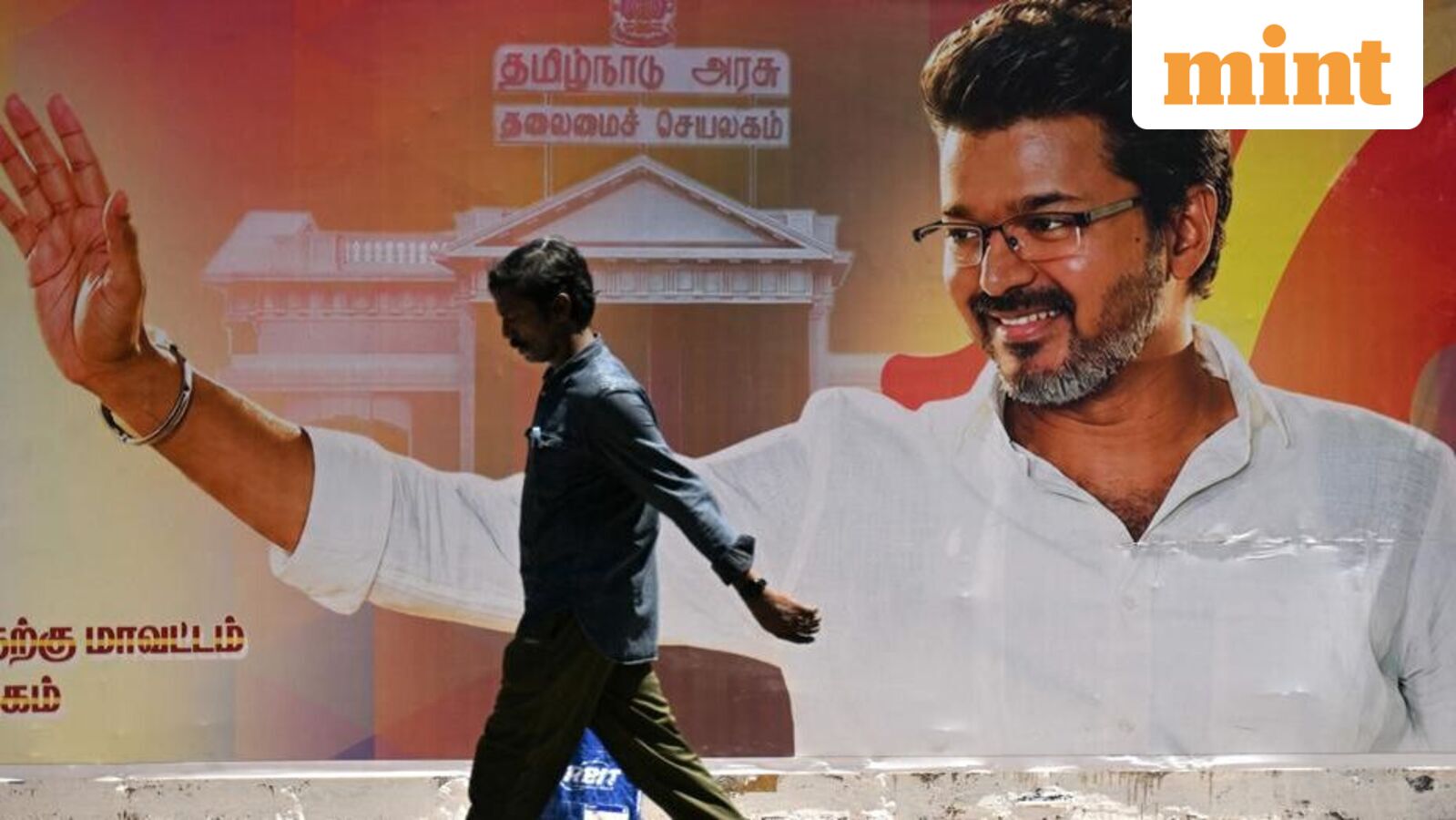
TVK Government Formation: The Tamilaga Vettri Kazhagam (TVK) emerged as the single-largest party in the recently concluded Tamil Nadu Assembly elections, leaving the state’s traditional Dravidian giants — the DMK and the AIADMK — trailing behind. Yet, TVK chief Vijay is scrambling to secure the numbers to cross the majority mark and form the next government in the state.
Vijay met the Tamil Nadu Governor Rajendra Arlekar twice, staked a claim to form the government with the Congress party’s support. Yet the governor is not convinced and has asked Vijay to bring documents proving a majority in the 234-member Tamil Nadu assembly. The majority mark is 118.
At present, Vijay’s TVK holds 108 seats, while Congress, with 5 MLAs, has pledged support. Together, TVK+ Congress have 113 MLAs, still five short of the majority mark of 118 in the 234-member Tamil Nadu assembly. Vijay won the election in two seats, and this seat has to be vacated. In that case, the TVK has 107 seats, but the majority mark is also 117 seats, as one seat will go to a bypolls.
People also ask
AI powered insights from this story
•5 QUESTIONS
Vijay’s TVK party emerged as the single-largest party with 108 seats but falls short of the 118-seat majority mark needed to form the government. Even with the support of the 5 Congress MLAs, their total stands at 113, leaving them five seats short.
The Tamil Nadu assembly has 234 members, and the majority mark required to form a government is 118 seats. If Vijay vacates one of his two seats, the majority mark will be 117.
Currently, the Congress party with 5 MLAs has pledged support to Vijay’s TVK. Discussions are ongoing with the Communist Party of India (Marxist), Communist Party of India, and VCK, who have two seats each, to secure their support.
Yes, the Governor has asked Vijay to bring documents proving a majority in the 234-member Tamil Nadu assembly before he can be sworn in as Chief Minister. Vijay has met the Governor twice to stake his claim.
Yes, there are historical examples where Governors have invited parties to form governments despite lacking a clear majority. Notable instances include Maharashtra in 2019 and Karnataka in 2018, as well as at the centre with Atal Bihari Vajpayee in 1996.
As suspense continues over next government in Tamil Nadu, the executive committee meeting of the Communist Party of India (Marxist), being held in Chennai, is currently underway amid ongoing discussions over government formation in Tamil Nadu.
Also, the Communist Party of India (CPI) leaders are also meeting at the party office in Chennai. Both, the Left Parties have two seats each in the State Assembly. Later in the day, both the left parties will meet with leaders of the VCK where a final call will be taken on offering support to the TVK. The VCK also has two seats in the assembly. If the three parties offer support to Vijay his front will easily cross the halfway mark of 117 seats.
The series of meetings come amid intense political deliberations following the hung verdict in the Tamil Nadu Assembly elections.
The outcome of the meetings would be known later. For now, the TVK-led potential coalition still falls five short of the majority mark in the 234-member Assembly. And this despite TVK emerging as the single-largest party in the elections after stunning the ‘Dravidian’ parties in the State.
While the Governor has sought proof for a majority government from Vijay, there have, however, been occasions when the Governor asked parties or coalitions to form governments without a majority.
Maharashtra and Karnataka
There have been examples of Governors inviting parties to form governments despite lacking a clear majority include Maharashtra in 2019, when the Governor Bhagat Singh Koshyari swore in Devendra Fadnavis and Ajit Pawar in an early morning ceremony without firm numbers.
In 2018, in Karnataka, Governor Vajubhai Vala invited BS Yediyurappa to take oath without the veteran BJP leader having a clear majority in the House.
There have been examples at the centre as well when the President, Governor’s equavalent nationally, allowed single-largest party to form the government. In a classic example, BJP veteran Late Atal Bihari Vajpayee was invited by President Shankar Dayal Sharma to form the government in May 1996 after the saffron emerged as the single largest party, despite lacking an outright majority. Vajpayee was sworn in as Prime Minister but resigned after 13 days, realising he could not secure the required support
Vajpayee later formed a government for 13 months in 1998, and subsequently led a stable coalition for a full term after the 1999 elections.
There are more examples at the state level.
Goa Assembly Election2017
In 2017 Goa Assembly election, no party could secure a majority in the 40-member House. The Congress emerged as the single largest party with 17 seats, while the BJP won 13. The Maharashtrawadi Gomantak Party and the Goa Forward Party won three seats each, Independents secured three seats and the NCP won one.
Soon after the results were declared, the BJP began putting together support from smaller parties and Independents.
Manohar Parrikar, then Union Defence Minister, returned to the State to lead the effort. With the backing of the MGP, the GFP, two Independents and the lone NCP MLA, the formation reached a strength of 21.
On 12 March, Parrikar met Governor Mridula Sinha and staked claim to form the government. The Congress, despite being the single largest party, was unable to secure enough support to form a majority coalition in time.
Governor Sinha invited Parrikar to form the government. He was sworn in as Chief Minister on 14 March. The BJP-led coalition later proved its majority in the Assembly.
Manipur Assembly Election 2017
In 2017, the Congress emerged as the single largest party in Manipur, winning 28 seats in the 60-member House.
The BJP secured 21 seats, short of the majority mark of 31. The National People’s Party and the Naga People’s Front won four seats each, while the Lok Janshakti Party, Trinamool Congress and an Independent candidate won one seat each.
The BJP managed to secure the backing of the NPP, the NPF, the LJP, the AITC legislator and the Independent MLA, taking its strength to 32.
The Congress, despite being the single largest party, was unable to gather enough support to form the government. BJP leader N Biren Singh then staked claim to form the government.
After three days of consultations with various parties, Governor Najma Heptulla invited Biren Singh to form the government, citing the “stability factor”. He was sworn in as Chief Minister on 15 March.
The BJP-led coalition later proved its majority on the floor of the House.
Governor’s Role
Experts said there is no question of the Governor first ascertaining whether a person has a majority inside the Raj Bhawan, and then asking for that majority to be proved again on the floor of the House.
“The Governor cannot avoid convening the House. He can ask anyone whom he believes commands the confidence of the house to form the government. A motion of confidence can be sought, and even a person without a prior electoral majority can win the motion if the opposition present and voting does not decide to vote against the motion,” senior advocate Sanjay Hegde wrote on X.
Can the governor call single-largest party?
There have been many commissions that have answered this question. As per the Sarkaria Commission Report (1983), which discusses the Role of the governor, if a single party has an absolute majority in the Assembly, the leader of that party should automatically be asked to become the Chief Minister.
The Governor cannot avoid convening the House. He can ask anyone whom he believes commands the confidence of the house to form the government.
However, if there is no such party, the governor should select a Chief Minister from among the following parties or groups of parties by sounding them, in turn, in the order of preference indicated below:
- An alliance of parties that was formed prior to the elections.
- The largest single party staking a claim to form the government with the support of others, including “independents.”
- A post-electoral coalition of parties, with all the partners in the coalition joining the government.
- A post-electoral alliance of parties, with some of the parties in the alliance forming a Government and the remaining parties, including “independents”, supporting the Government from outside.
The Sarkaria Commission report has been cited extensively in many Supreme Court judgments, according to legal news website Bar and Bench.
Many of the Sarkaria Commission’s recommendations regarding Article 356 have been endorsed. In SR Bommai v. Union of India (1994), the SC held that the Governor must invite the leader of the party commanding a majority in the House, or the single-largest party/group, to form the Government.
Key Takeaways
- The Governor has the authority to invite parties to form a government even without a majority.
- Historical examples illustrate how political coalitions can form despite lacking an outright electoral majority.
- The importance of coalition-building in contemporary politics is highlighted by TVK’s current situation.
#times #parties #formed #governments #sans #majority #Vijays #TVK #scambles #numbers #Tamil #Nadu
